

Budget deficits bad for development
23 Sep 2018
Continuously operating under budget deficits has the potential to jeopardise future development efforts.
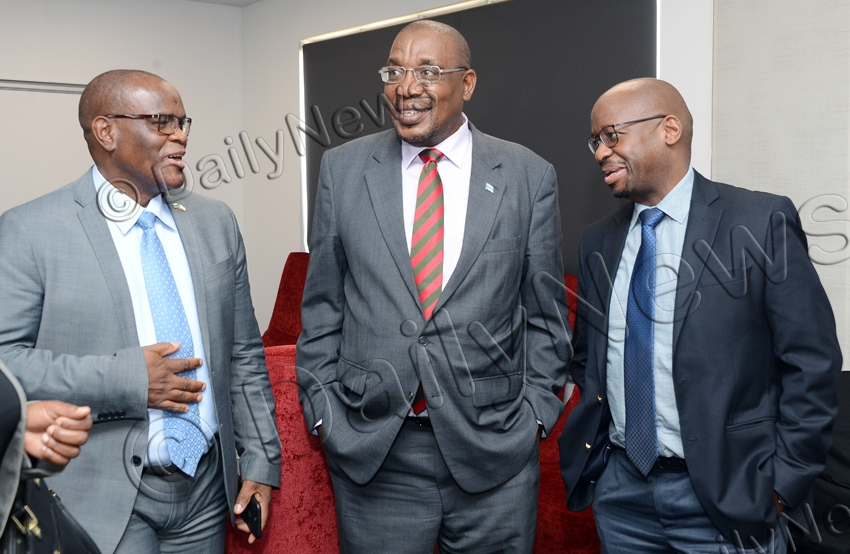
Making opening remarks at this year’s Budget Pitso for local authorities recently, the Minister of Infrastructure and Housing Development, Mr Vincent Seretse said for the past two years, government had been working around a constrained budget resulting in consecutive budget deficits.
He said the deficits were mainly incurred in financing pressing national development challenges and the Economic Stimulus Programme (ESP).
Minister Seretse pointed out that another deficit was expected for the 2019/20 financial year; adding that in light of this, government would continue with efforts to contain expenditure and explore alternative sources of revenue.
He thus implored local authorities to assist government by ensuring that programmes under their supervision were implemented timeously, effectively and efficiently so as to reduce cost overruns as well as derive value for money.
“Strengthening revenue collection at the local level can also go a long way in assisting government to broaden the revenue base,” he said.
Raising a different point, the minister encouraged all stakeholders in the development process to take part in the NDP11 mid-term review, which was expected to be undertaken in the 2019/20 financial year.
He said the review process was critical as it was an opportunity to assess progress as well as consider remedial measures that could be put in place to address any challenges encountered in the implementation of the plan.
On the highlights of the 2019 budget strategy paper, the deputy secretary for Macroeconomic Policy at the Ministry of Finance and Economic Development, Mr Kelapile Ndobano stated that ‘ domestic economic performance had been mixed over the recent years contracting by 1.7 per cent on 2015, recovering to reach 4.3 per cent in 2016 before declining to 2.4 per cent in 2017’.
Mr Ndobano indicated further that the med-term domestic outlook remained optimistic, with growth forecasts expected to rise moderately to 4.5 per cent in 2018 and 4.2 per cent in 2019.
He however pointed out that the anticipated recovery would depend on such factors as; a continuous rebound in the global diamond market, government’s continued supportive fiscal policy as well as reforms to further improve the business environment among others.
For his part, Dr Kelesego Mmolainyane from BIDPA underscored the importance of monitoring and evaluation, which she said could enhance the effectiveness and efficiency of the implementation of the budget process.
Dr Mmolainyane also indicated how local authorities played a critical role in the implementation process, saying their role could not be over-emphasised.
During the open discussions, Ghanzi District commissioner, Mr Loeto Porati decried lack of decentralisation in the implementation process.
Mr Moselwa Gaealashwe from Ngwato Land Board observed that despite the talk on economic diversification that had been ongoing for years now, it was disappointing that it could not be stated in clear terms what progress had been made so far.
He said presently, the country was at a point where it could state, sector by sector, what progress had been made towards diversifying the economy.
The Pitso, which brought together representatives from local authorities all over the country, is an annual consultative forum that accords participants the opportunity to reflect and have an input in the development strategies and programmes and projects to be considered for the forthcoming financial year. Ends
Source : BOPA
Author : Keonee Kealeboga
Location : GABORONE
Event : Budget Pitso
Date : 23 Sep 2018
Related News

30 Jul 2026
BMC eyes new export deals
29 Jul 2026
Modisaotsile on rise to the top
29 Jul 2026
Poultry industry attains self-sufficiency
28 Jul 2026
Ross Breeders pioneers Botswana poultry exports
28 Jul 2026