


Free Zimbabwe starts life without Mugabe
27 Nov 2017
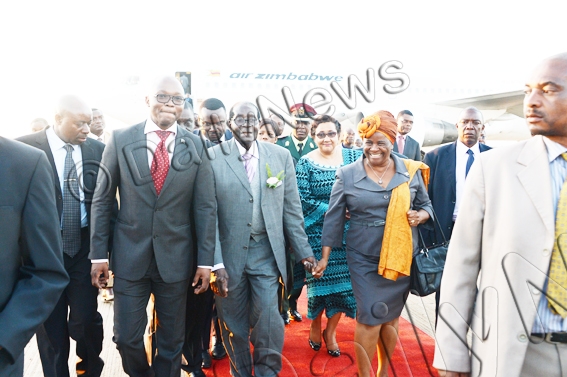
Extraordinary scenes of jubilation on the streets of Harare and Bulawayo greeted Robert Mugabe’s decision to tender his resignation as the president of Zimbabwe, as the evening of November 21, 2017 marked the dawn of a remarkable career for the last of Southern African Frontline leaders.
Events in the week leading up to the resignation bore the hallmarks of a Shakespearean tragedy, as President Mugabe’s most trusted lieutenants turned their backs on him, and well calculated Machiavellian scheming took place in a palace coup of sorts.
Having taken part in the Zimbabwean liberation struggle, and ruling the country for 37 years, President Mugabe had got to dominate Zimbabwean psyche, and polarised regional opinion, celebrated in equal measure as a hero as was reviled as a villain.
One of the leaders of the Frontline States alongside Botswana’s Sir Seretse Khama and Sir Ketumile Masire, Dr Kenneth Kaunda of Zambia, Julius Nyerere of Tanzania, Samora Machel of Mozambique as well as Eduardo Dos Santos of Angola, President Mugabe was one of the founders of what is now the Southern African Development Community (SADC, previously SADCC).
The last of this crop of regional leaders to descend from national leadership, President Mugabe’s legacy will be debated by historians for decades to come.
A Zimbabwean of Shona-Zezeru origin, Robert Gabriel Mugabe was born on February 21, 1924, at Kutama in the Mashonaland West province of colonial Zimbabwe (Southern Rhodesia).
President Mugabe was educated at a local Catholic mission school, Kutama Seminary, before his acquisition of a string of university degrees, the first at Fort Hare in South Africa, others later through correspondence.
At Fort Hare in South Africa’s Eastern Cape, President Mugabe come into contact with future fellow regional leaders Kaunda and Nyerere.
President Mugabe worked as a teacher in Southern Rhodesia, Northern Rhodesia (Zambia) and Ghana, where he met his first wife Sally Hayfron to who he was married until her death in 1992, before marrying his former secretary Grace Marufu in 1996.
Back in Zimbabwe, President Mugabe partook in the liberation struggle, joining Joshua Nkomo’s Zimbabwe African People’s Union (ZAPU), shortly before he and others broke away to form the Zimbabwean African National Union (ZANU).
ZAPU would mostly draw support from Nkomo’s Ndebele kinsmen, while the majority Shona embraced ZANU.
As most African states got independence in the 1960s, Rhodesian leader Ian Smith declared the Unilateral Declaration of Independence (UDI) in 1965, entrenching Rhodesia as a white-ruled settler colony.
This fueled the struggle by the indigenous majority for independence.
President Mugabe, detained by Rhodesian authorities between 1964 and 1974 reemerged in the trenches, taking over as the leader and First Secretary of ZANU on 18 March 1975 leading the movement for 42 years until 19 November 2017.
Portugal’s Carnation Revolution of April 25 1974 overthrew the dictatorship of Estado Novo and within a year, the Southern African Portuguese settler colonies of Angola and Mozambique got their independence, just as Mugabe was emerging from ten years in prison.
Under Machel, Mozambique in 1975 was able to offer Mugabe and ZANU the base to wage an armed struggle in what became known as the Rhodesian Bush War.
With Joshua Nkomo’s ZIPRA forces advancing from Zambia and President Mugabe’s ZANLA forces attacking from Mozambique, Rhodesia became a war zone. Negotiations with British authorities for independence begun in the late 1970s, with Frontline leaders Kaunda, Nyerere, Seretse and Machel involved in the process.
President Mugabe is said to have been a reluctant partaker in the Lancaster House agreement that paved the way for Zimbabwe’s independence in London in 1979.
He is said to have preferred revolution over evolution; but Zimbabwe’s April 18, 1980 independence would evolve out of a negotiated settlement rather than liberation troops storming into the capital Salisbury (later renamed Harare).
After initially forming a Patriotic Front with Nkomo’s ZAPU, President Mugabe went on his own and won Zimbabwe’s first general elections.
As the prime minister of independent Zimbabwe, he united the old warring factions, with many of the old Rhodedian senior civil servants retained in government and Nkomo appointed the Home Affairs minister.
President Mugabe’s government invested in education and health for ordinary Zimbabweans, and the economy was among the better performing in the region during the early years of independence.
But cracks began to appear. An arms cache found in a farm in Matabeleland in 1982 was used by President Mugabe to accuse Nkomo of plotting to overthrow the government.
A brutal supression of this alleged mutiny led to the North Korea trained Fifth Brigade attacking former ZIPRA combatants and ordinary villagers accused of harbouring them.
From January 1983 until December 1987, anywhere between 10 000 and 20 000 people, mostly the Ndebele minority were killed during the repression, known as the Gukurahundi or Matabeleland Massacre.
President Mugabe and Mr Nkomo signed a Unity Accord in December 1987, and Mr Nkomo returned from exile as prime minister of Zimbabwe, with Mugabe now called the president, but still the head of state and government.
ZANU and ZAPU officially merged to become Zimbabwe African National Union- Patriotic Front (ZANU-PF).
The Willowgate Scandal of 1988, which exposed state ministers’ corruption in the government purchase of motor vehicles provided proof that all was not well.
In the 1990s as the heavy investment on education, health and state-led development took its toll on the economy, Zimbabwe adopted World Bank and International Monetary Fund (IMF) sponsored Economic Structural Adjustment Programme.
With the Washington Concensus policies- liberalisation, deregulation, privatisation- only led to retrenchments without the private sector creating new jobs.
As workers became dissatisfied, trade unions rose in popularity, with the Zimbabwean Congress of Trade Unions led by Mr Morgan Tsvangirai eventually evolving into a popular political party- the Movement for Democratic Change (MDC).
The Lancaster House agreement had provided for land reform to be financed by Britain. In the late 1990s, President Mugabe reminded British authorities of this historical obligation, but was spurned by the then prime minister at Downing Street Tony Blair.
War veterans became agitated, seeking compensation for their effort in liberating Zimbabwe.
President Mugabe’s government sent troops to the Democratic Republic of Congo (DRC) to assist the government of Mr Laurent Kabila in its war against rebels, and this proved financially costly for a Zimbabwean economy that was already under strain.
Payout to the war veterans further triggered inflation. President Mugabe’s loss to the MDC in a constitutional referendum in the year 2000, triggered a new wave of authoritarian rule.
This begun a ‘Jambanja’ or ‘organised chaos’ fast track land reform led by the war veterans- now on President Mugabe’s side after the payouts- with white owned farms violently targeted for handover to landless blacks sympathetic to ZANU-PF, and party elites.
Zimbabwe’s economy, which had relied on agricultural output and associated industry as it’s mainstay, was now collapsing.
Youth militia and the Central Intelligence Organisation (CIO) were unleashed on political opponents.In domestic and foreign podiums President Mugabe used anti-imperialist rhetoric, endearing himself to Pan-African audiences and Blacks in the diaspora who saw him as the only African leader with the spine to confront the West over its colonial legacy.
President Mugabe survived the post-2000 economic and political meltdown for 17 years. But in 2017, ZANU-PF was polarised by internal strife between the generation 40 (G40) faction led by first lady Grace Mugabe and the Lacoste faction led by vice president Emmerson Mnangagwa, all vying to take over post-Mugabe.
Mr Mnangagwa’s ousting as vice president in early November 2017 proved the end game.
Army commander General Constantino Chiwenga orchestrated a house arrest for Mugabe, and ZANU-PF decided to recall Mugabe as its leader and institute an impeachment process.
Mugabe eventually gave in and decided to resign from office.
The popular will of the people finally took place, albeit after power jostling among elites who had always been a part of Mugabe’s excess.
Nevertheless, Mugabe will also be remembered for his indelible contribution to his country’s liberation, that of South Africa and Namibia as well as in building SADC.
Throughout his tenure in office always a aknowledged Botswana’s small role in his country’s independence struggle.
His narration of a personal friendship with former president Masire at the latter’s funeral in Kanye in mid 2017 provided evidence of the human in Robert Gabriel Mugabe.
As the region bids him farewell, and Zimbabwe enters a new era, his legacy will be remembered for both the positive and negative; a larger than life master orator who was the last of the Frontline States leaders. ENDS
Source : BOPA
Author : Pako Lebanna
Location : GABORONE
Event : Feature
Date : 27 Nov 2017
Related News

21 Aug 2026

20 Aug 2026
Botswana Donates FMD Vaccines To Lesotho
20 Aug 2026