

Oil committee meets
21 Nov 2017
The Department of Energy hosted the Southern African Customs Union (SACU) Interstate Oil Committee Meeting (IOC) recently to discuss oil industry issues in Botswana, South Africa, Lesotho, Swaziland and Namibia.
The bi-annual meetings which are held on a rotational basis have become the platform for maintaining regular contact amongst members regarding all aspects of the acquisition, storage, supply, distribution and related issues of petroleum products the customs union area.
The establishment of the committee was also borne out of the recognition that there was need for continued supply of petroleum products to all members of SACU on a sustained basis as well as the need to harmonise specifications and price formulae of petroleum products to enhance regional trade.
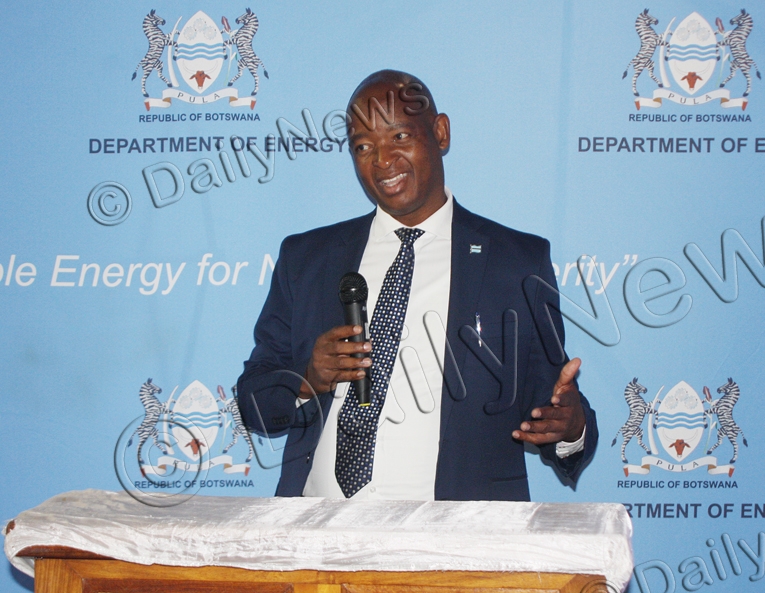
Addressing the meeting, the deputy permanent secretary in the Ministry of Mineral Resources, Green Technology and Energy Security, Mr Moremi Phiri noted that member states agreed to collaborate on matters covering amongst others, security of supply and distribution of petroleum products, pricing of fuels, product quality and safety matters and any issues affecting the oil industry in the region.
Mr Phiri explained that the meeting in Namibia in 2017 recognised the need for the development of models for the oil industry margins.
“On realising that different countries use different methodologies to award margins to the industry, the meeting agreed to come up with a more standardised approach for the determination of the margins,” he added.
The deputy permanent secretary also observed that implementation of a standardised margin determination model for SACU member states is key in realising their common objective.
To that end, he said that Botswana had commissioned a study to develop a margin determination model.
Whilst recognising that South Africa continued to use the Regulatory Account System (RAS) and other countries use the CPI inflation based approach, he urged Botswana to complete the study and share the results with other states.
Mr Phiri also mentioned that the region continued to face fuel supply challenges hence the need to explore innovative ways of ensuring security of supply.
Botswana, he added, is exploring the coal to liquids technology and the development of the biofuels, as well as the possible collaboration with other member states for joint procurement from the international markets.
“The meeting also stressed the need for strengthening monitoring tools to ensure industry compliance to the 14 days of commercial buffer storage. The buffer storage complements the strategic stock holding programme,” he noted.
The ministry is still progressing works for the construction of 171 million litres strategic fuel storage facility at Tshele Hills, and the expansion of the existing Francistown storage facility, he added.
In addition, he maintained that government was also looking into developing a multi-product cross-border fuel supply pipeline from South Africa into Botswana, as well as the construction of the Ghanzi fuel depot closer to Namibia.
Consequently, he highlighted that the drafting of the Petroleum Products Bill and the Gas Supply Bill is ongoing.
The Energy Policy, he mentioned, has been tabled in parliament and will be debated in the July 2018 parliament session.
On other issues, he said that the Botswana Energy Regulatory Authority (BERA) commenced full operations on the 1st of September 2017.
For his part, the executive manager, Petroleum at BERA, Mr Kenneth Kerekang informed the meeting that prior to his organsation, regulation of the petroleum industry was all over in different departments.
However, he explained that going forward BERA would regulate the whole supply chain.
The director of Channoil Consulting Limited who have been engaged to review petroleum products pricing structure in Botswana, Mr Dermot Campbell explained that the objective of the study is to review the current petroleum products pricing structure and its impact on the local oil industry taking into account the alternative sources and routes for fuel supplies, especially Namibia and Mozambique and recommend an updated petroleum products structure for Botswana.
Phase 2 of the study, he highlighted, would involve implementing the recommended system, providing technical support and skills transfer.
Puma Energy executive, Mr Bakalanga Masala briefed the meeting on industry practices on safe handling of fuels.
He informed the meeting that if petroleum products are not handled in the right way, this impacts on the bottom line and the sustainability of a business.
Consequently, he said that at all times product quality and standards have to be preserved and that businesses in the fuel sector need to have competent personnel and the right facilities.
Therefore, he urged that trucks, service stations, tanks and storage facilities should be monitored to comply with regulations.
“If anything happens along the supply chain, this impacts on the oil company involved,” he noted. ENDS
Source : BOPA
Author : Puso Kedidimetse
Location : KASANE
Event : Bi-Annual Meeting
Date : 21 Nov 2017
Related News

30 Jul 2026
BMC eyes new export deals
29 Jul 2026
Modisaotsile on rise to the top
29 Jul 2026
Poultry industry attains self-sufficiency
28 Jul 2026
Ross Breeders pioneers Botswana poultry exports
28 Jul 2026