


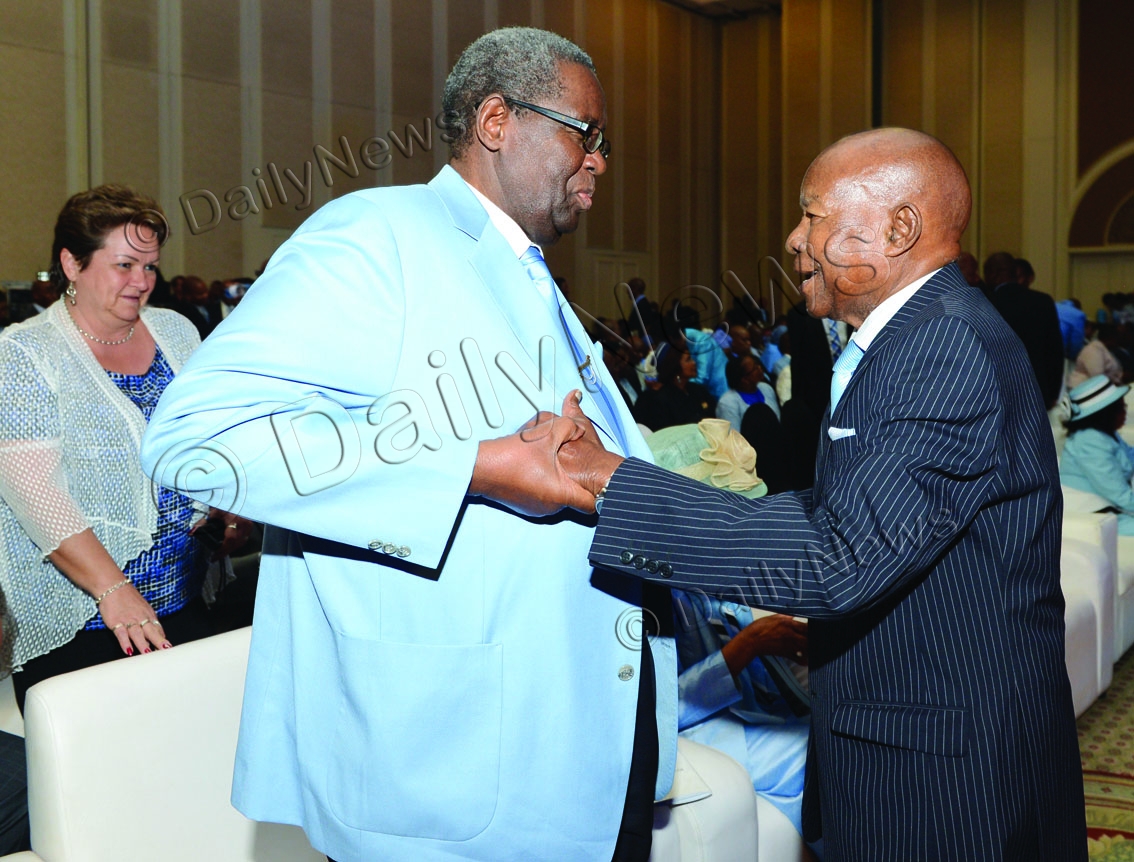
Kedikilwe remembers Sir Ketumile
29 Jun 2017
If one reflects at the state Botswana was in at the time the country gained independence in 1966 and look at developments that have taken place over the years, one would understand the effort, hard work and time the second President of Botswana Sir
Ketumile Masire had put in to see the country where it is today, says Former Vice President Dr Ponatshego Kedikilwe.
He said Sir Ketumile fondly called Rra Gaone is regarded as one of the founding fathers of this nation, a legend and a person of high caliber who has helped lay-down the foundation of this country.
Dr Kedikilwe said at the time Botswana gained independence, Botswana was one of the poorest countries in the world with little infrastructure.
Dr Kedikilwe said the country only had six kilometers of tarred road adding that Botswana only had P734 000 raised through taxes from Batswana while Great Britain contributed P8.8 million to the country.
He said mineral resources such as diamonds and copper among others were not discovered yet and Batswana’s livelihood was centered on agriculture.
He explained that diamonds came into the picture later around 1967 though mining operations commenced around 1972 in the Orapa area, noting that the discovery of diamonds which are the backbone of the country led to a number developments such as schools.
Dr Kedikilwe said one of the first assignments he worked with Rre Masire was when Sir Ketumile was still Vice President and Minister of Finance and Development Planning and he Dr Kedikilwe was a public servant where they travelled together to America to seek financial assistance from the First National Bank of Boston.
He said the trip was a success in that the bank which they went to agreed to loan Botswana some funds.
He said subsequently the bank authorities also came to Botswana and visited the mining explorations taking place in the Jwaneng area.
“I was assigned by Rre Masire to lead the Boston Bank Authorities to visit the area where the mining explorations were taking place in now what is called Jwaneng,” he said.
However he explained that Jwaneng did not exist by then and the area was all bush with some excavations done here and there during the mining explorations.
“When we visited the area, it was then that I saw a diamond for the first time in my life. The rough diamonds looked like salt granules and I expected to see something sparkling,” he said.
Mining started around 1982 in the area and the Jwaneng mining town was founded.
He went on to state that Rre Masire is also remembered as one of the pioneers in setting up the University of Botswana.
He said Rre Masire assigned by the First President Sir Seretse Khama led a delegation around the country informing the nation about the importance of education and higher learning, self-reliance and intentions to setup a university.
He said at that time Batswana were requested to raise fund for the establishment of the University of Botswana.
He said Batswana contributed immensely towards the initiative and many donated cattle, goats, sheep and even eggs to be sold to raise fund for the university project.
He said the move strengthened the bond of unity among Batswana as a people working towards a common cause of building a nation.
“Ra-Gaone could be remembered for all these deeds until the university was opened around 1982 with him as the first Chancellor,” he said.
Ra-Gaone and Sir Seretse Khama, he said also played a significant role in the fight against apartheid.
He said before Botswana gained independence the oppression of black people by the apartheid regime had over spilled into Bechuanaland.
“I experienced apartheid when I was a young man who had just completed Form Five at Kgale Senior Secondary School and working at a whole sale in Lobatse where I first met QKJ. Black people were sold food through a back window at Lobatse Hotel and ate their food outside while white people were the only ones allowed to enter the place,” he said.
“Rre Masire and Sir Seretse Khama played a significant role in the battle against this human segregation instigated by the apartheid regime in South Africa also in Rhodesia now Zimbabwe and South West Africa now Namibia.
He also played other roles in Africa on peace and conflict resolution mission assignments,” he said.
Dr Kedikilwe said Sir Ketumile was a God fearing person and visionary leader who he and his predecessor, first President of Botswana Sir Seretse Khama fought against apartheid on the basis that people or humans were created by God and in this regard they were all equal before God.
He said even after independence the fight against apartheid continued resulting in Botswana in the leadership of President Sir Seretse Khama and Sir Ketumile as Vice President initiating what was called ‘Front Line States’ against apartheid.
He said later on the country led the establishment of Southern African Development Co-ordination Conference (SADCC) in 1980 which was later called Southern African Development Community in 1992.
“Botswana was then made the headquarters of SADCC and SADC and all this took place with President Sir Ketumile Masire and Botswana playing a significant,” he said.
“It was on this believe that the fight against the oppression of black people in Africa continued where Sir Ketumile also nearly lost his life for the cause while on transit to Angola in 1988 to attend Frontline States meeting. I was travelling with President Masire at the time as I was Minister of Presidential Affairs and Acting Minister of Foreign Affairs standing in for Dr Gaositwe Chiepe who was on other obligations in the country."
He said while on their flight route to attend the meeting at about 35000 feet in the air, the engine of the plane on the right side was hit by what was revealed as a heat seeking missile.
He said the pilot decided to descend plane from the high altitude and managed to control it until it finally crash landed on an airstrip in a small village in Angola.
“After we crash landed some farmers around the area came to our rescue. At first we had a communication breakdown in that when we tried to speak English, French and even Swahili to inform them who we are and what transpired they could not understand us. I tried to explain to them that Rre Masire was President and that he sustained injuries from the incident and needed to be taken to hospital but everything remained blank. We then started naming presidents around the SADC area and the Angolan President Jose Eudardo dos Santos and luckily they got the picture that we were with a person of high stature-Sir Ketumile. They then took us to a nearby old house that belonged to a white Portuguese,” he explained.
Dr Kedikilwe said they managed to get assistance from there and Rre Masire was taken to hospital.
“I then managed to get hold of Angolan Authorities and informed them what had happened and also contacted the Acting President of Botswana by then Mr Peter Mmusi. The Angolan Presidential plane was sent to come and pick us up though the area we were in was a risky area prone to apartheid regime attacks."
He said all this demonstrated that Botswana and in particular Sir Ketumile was a key role player in the fight against apartheid and oppression of black people. ENDS
Source : BOPA
Author : Tshepo Mongwa
Location : SELEBI PHIKWE
Event : Interview - Sir Ketumile Masire Tribute
Date : 29 Jun 2017
Related News

21 Aug 2026

20 Aug 2026
Botswana Donates FMD Vaccines To Lesotho
20 Aug 2026