


Last member of inaugural cabinet bows out
27 Jun 2017
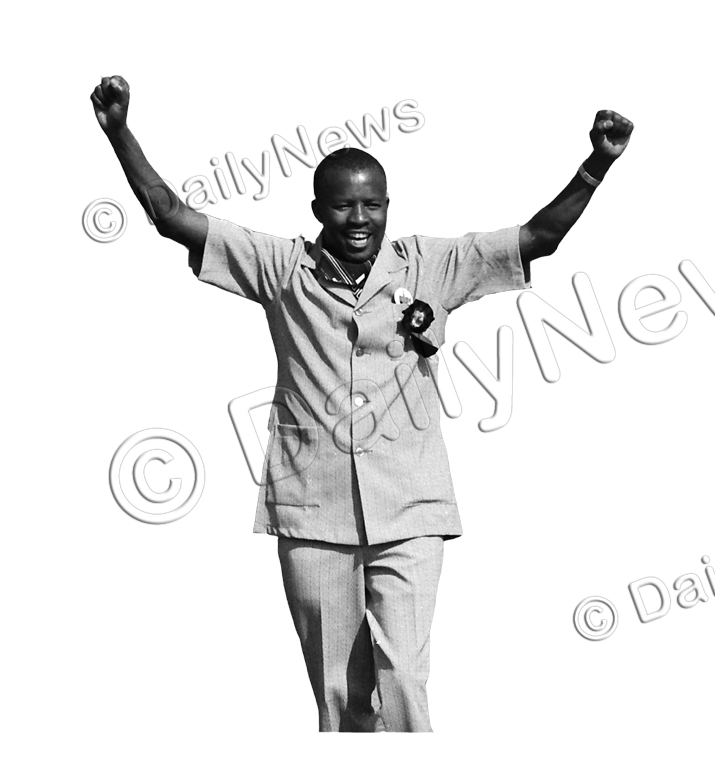
Until his death this week at the age of 91, Sir Ketumile was the only surviving member of the country’s first Cabinet.
Not only that. He was also the surviving member of the founders of the Botswana Democratic Party (BDP).
His political life spanned 32 years of active participation. It could even be more if one has to take into account his years in the Legislative Council.
But his partisan politics was in the Botswana Democratic Party (BDP) which he co-founded with the likes of first President, Sir Seretse Khama, Moutlakgola Nwako, Goareng Mosinyi, Tsheko Tsheko, Moleleki Tsoebebe and Dabadaba Sedie. It was him with Sir Seretse who wrote the constitution of the party.
The idea of forming the BDP as an alternative party to the Botswana People’s Party was sold to Sir Ketumile and others by Sir Seretse in November 1961 after a sitting of the Legislative Council in Lobatse.
The BPP had indeed taken Botswana by storm with its politics which roused the emotions of every corner they reached.
Sir Ketumile became the first BDP secretary-general, the position he voluntarily vacated in 1980. Following the 1966 general elections which the party won with a landslide victory, Sir Ketumile became the country’s vice president and minister of finance.
In 1969, Kgosi Bathoen11 resigned from chieftainship and contested the elections that followed against Sir Ketumile. Sir Ketumile was defeated. That was a sad moment in Sir Ketumile’s political history. But Sir Seretse felt he could not dump his long-time friend with whom he partnered to guide the territory’s future. He brought him back as a nominated MP.
Sir Seretse was impressed by the performance of Sir Ketumile and returned him to the position of vice president and minister as well. Masire contested the next elections in the Ngwaketse/Kgalagadi Constituency and won. Sir Seretse said that was tactical move because his friend was “unwanted in Kanye”.
Towards the 1974 general elections, Sir Seretse paid glorying tribute to Masire for having travelled through the length and breadth of the country “explaining the BDP government programmes in the language the people understood very well.”
By the language, the people understood very well, Sir Seretse did not mean that Masire spoke to the people of Bokspits in Afrikaans because that is the best language they understand better or spoke Ikalanga when toured the North East.
Sir Seretse knew and endeared Masire’s sense of humour which he used to his advantage even in difficult situations. For instance in the early seventies, Masire addressed a kgotla meeting in Mochudi on the benefits of selling cattle to the Botswana Meat Commission (BMC). He had talked about bonus paid by the meat commission saying it benefited the seller.
During question time, a man stood up questioning why the government had been concealing those benefits to the Bakgatla and other tribes except Bangwato and Bangwaketse.
He also accused Masire of coming to Mochudi to urge the Bakgatla to sell to the BMC so that they “eat Bangwaketse and Bangwato left-overs.”
The man argued for a long time saying had they been told long time ago about the existence of bonus they would be rich by then because the bonus would have supplemented “agterskot” which the BMC offered. Agterskot is an Afrikaans word for bonus but the man thought those were two different things.
From the mood of the meeting, it was clear that the majority of people thought Masire had been cornered. But when he responded, people began to see Masire at his best.
One was heard saying “ehe ba mo romile ba moitse motho wa teng ebile.
He had responded by telling the people that in Serowe they spoke of “esele” while those in Molepolole spoke of “tonki” while referring to a donkey and therefore one “cannot say I have a tonki but I need to have esele” adding that,“you in Mochudi if the BMC is offering you agterskot, then you are receiving bonus. Bonus and agterskot is one and same thing.”
That was Sir Ketumile Masire. A man gifted in the techniques of communication.
He was talented in that area. He showered considerable talent for getting what he wanted.
He spent 32 years in active politics, 14 of them as vice president, secretary-general and 18 years as president.
He succeeded Sir Seretse who died in 1980.Two years after the death of Sir Seretse, the BDP celebrated 20 years of existence. Sir Ketumile wrote a forward message which seemed like prediction of the future.
It was a message that touched the hearts of many at the BDP.
This is what he had to say, “we cannot, and must not rest on our laurels and bask in the gory of past performance and achievements of the founding fathers.
As we move from the known to the unknown, from the simple to the complex we need a clear vision and a steady gait, determined in all our endeavours that only the best is good for the BDP and for Botswana.
At this juncture, one cannot help feeling so little done, so much to do. The task ahead is horrendous, a real challenge to be met by our concerted effort.”
Sir Ketumile’s presidency had to content with the deteriorating political situation in Southern Africa.
He was kept so busy that there was a time when he would eat breakfast in Gaborone, lunch in Tanzania and supper in the air. He would return to Botswana and fly back to either Tanzania or Zambia the following day because some new developments happened after their previous day’s deliberations necessitating a new approach.
One day on his way back from Addis Ababa, Sir Ketumile’s aircraft had a stop-over in Lusaka for refueling and around ten o’clock in the evening. Zambian President Kenneth Kaunda arrived at the airport to greet Sir Ketumile. They held an unscheduled meeting which lasted until a few hours before sunrise.
By that time, Mozambique and Zimbabwe had been liberated as well as Angola. Southern Africa however, still remained a volatile area because events in Namibia and South Africa posed potential threat to freedom in the region. Although the MPLA in Angola was in power, South Africa and the United States destabilised the country by supporting UNITA while the Soviet Union and Cuba supported the MPLA government. Fidel Castro was more forceful, sending thousands of soldiers to Angola to enable MPLA government gain military superiority over South Africa.
The US came out with what they called “constructive engagement” but it turned out to be “destructive engagement” as the situation in Angola worsened and Botswana was at the receiving ends. South African President began accusing Botswana of allowing freedom fighters to cross the border to bomb targets inside that country. South Africa used proximity to the border to point an accusing finger at a particular country whenever bombs exploded in that country.
If it exploded in Zeerust or Rustenburg, it was Botswana, if bombs exploded in the Orange Free State, it was Lesotho and if it exploded in Middleburg, it was Swaziland.
There came a time when Sir Ketumile felt enough was enough and decided that PW Botha must be told to stop his bullying tactics on Botswana. That he did by telling Botha through the press that Botswana did not have the capacity of policing the more than 1 000 kilometre- long border with South Africa.
He did not end there. He reminded Botha that a border is a line separating two countries and that being so, South Africa should prevent freedom fighters from entering the country by policing their own side of the border because they had the resources to do so. Masire’s message was loud and clear.
Faced with that dilemma, Botha responded with bombs on Gaborone with a view to punishing Sir Ketumile.
He resisted South Africa’s other attempt at forcing Botswana to establish diplomatic relations and convert the labour office in Roodepoort near Johannesburg into a diplomatic mission saying he did not want to see himself at the “same table with apartheid.”
In 1980, Sir Ketumile was in the US selling Botswana to the Americans. After a meeting at the State Department, Secretary of State, James Baker was heard murmuring to a staff member of the State department that he wished “that Africa could at least have a few leaders who managed the economies of their countries like Masire does”.
The beginning of the nineties was a challenging period in the BDP since Sir Ketumile became its leader 10 years previously. In 1991 he appointed a commission of enquiry into problems of land in Mogoditshane and other peri-urban villages such as Tlokweng and Gabane.
The findings of the commission which was chaired by Englishman Kgabo had damning criticism of Peter Mmusi who was the party’s chairperson and Daniel Kwelagobe who was the party’s secretary-general.
The BDP responded to the outcome of the commission by suspending the two party veterans.
The two men resigned their Cabinet positions to clear their names through the courts. Indeed the High Court cleared them of any wrong-doing. There was tension within the BDP as factions intensified with the Kwelagobe/Mmusi team demanding the reinstatement of their men. Masire remained steadfast to principle as he refused to bow down to pressure offering to resign the presidency instead of doing what he considered unrealistic.
Sir Ketumile was by nature a patient person. He never rushed into taking decisions on delicate issues. For instance, during the Mochudi riots of 1995, he sent the police and the army to restore law and order.
But when it became clear that the rioters were not prepared to abide by the law, Sir Ketumile issued a last warning saying the time for the use of teargas alone was over. It was clear that he intended ordering the army to use maximum force to end the disturbances.
On dealing with the press, Sir Ketumile was marvelous. He knew newspaper more than his lieutenants did.
He had spent part of working life as a reporter. He had also been the editor of the party’s newspaper, Therisanyo. He mingled with journalists informally and formally and enjoyed joking with them and engaging them seriously as he did with politicians. His answers were most of the time brief and to the point.
He was asked at one of his press conferences why Botswana was spending a lot of money on military hardware.
That was at time the construction of Thebephatshwa Airbase was causing sleepless nights to some of the countries in the continent. His answer was, “if you have an army, you must arm it or disband it, for us we haven’t decided to disband it”.
At the time when some Western nations were putting pressure on SADC to admit Zaire (Democratic Republic of Congo) into their fold, Sir Ketumile was asked about the fate of that country’s application. He simply replied, “it is being considered”.
The West had a lot of interest in the Zairian application.
Masire was a stunning fellow and he often surprised journalists at the summit of the Organisation of African Unity renamed the African Union.
He would arrive at Addis Ababa in a 14-seater aircraft while most African leaders arrived aboard Boeing 747s. He considered a small delegation as a cost saving measure. Even his mingling freely with people was a big surprise to journalists.
They saw him breaking through the human wall created by the Ethiopian soldiers to prevent journalist from crossing the line accompanied only by two body guards.
That left a journalist from Niger wondering as to “what type of president Masire is”. He had never shaken hands with his own president and wished he could go to Botswana one day to see what made Batswana including Sir Ketumile to feel free where ever they were.
On Thursday (June 29) Sir Ketumile will join Lady Masire in Kanye where thousands of mourners are expected to bid him final farewell. ENDS
Source : BOPA
Author : Kwapeng Madikwe
Location : BOPA
Event : Tribute to Sir Ketumile
Date : 27 Jun 2017
Related News

21 Aug 2026

20 Aug 2026
Botswana Donates FMD Vaccines To Lesotho
20 Aug 2026