

Developmental frameworks to guide partnership
29 Nov 2016
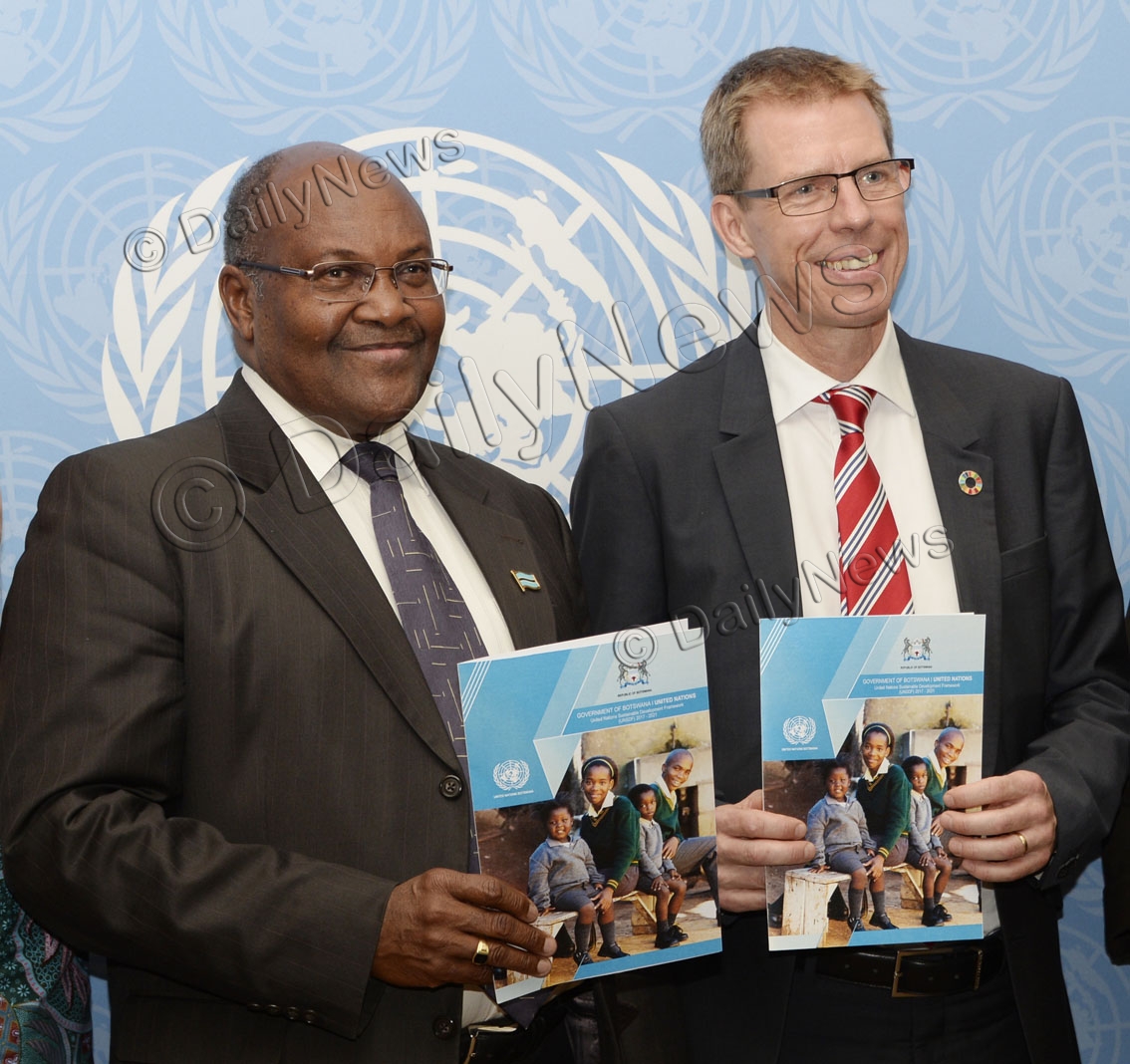
Minister of Finance and Economic Development, Mr Kenneth Matambo says Botswana has endeavoured to align the three developmental frameworks.
The three include the 2030 Agenda for Sustainable Development, the Vision 2036 and the eleventh National Development Plan 11 (NDP 11).
Speaking at the United Nations Sustainable Development Framework (UN-SDF) launch and signing ceremony recently, Mr Matambo said the development frameworks will guide partnership between government and the UN family in Botswana for the next five years from 2017 to 2021.
He said at the centre of the agreement was cherishing the ideal of “Leaving No One Behind” or “Inclusive Growth” with the hope that through the UN/Botswana Sustainable Development Framework, the UN Agencies would go a long way in supporting the country meet its development priorities.
He indicated that the United Nations/Botswana Sustainable Development Framework for 2017-2021 was developed through a consultative process that involved government officials, development partners, civil society organisations, academia and the private sector.
He added that consultations began in 2015 with the evaluation of the current Botswana-United Nations Programme Operational Plan, which is due to elapse at the end of this year (2016).
Again, he said through such engagement, three strategic priority areas were identified as needing UN support, which included strengthening the policy environment, eliminating implementation bottle necks, as well as enhancing access to and management of high quality data and statistics.
Further, he said the focus on policy environment aimed to strengthen the policy and programme development in order to make them more inclusive, adding that would include promoting more targeted social protection, economic opportunity, increasing resilience of societies to withstand shocks and uncertainties as well as to improving access to essential services, particularly by the poor.
“In the second area of eliminating implementation bottle necks the UN and Botswana will work together to strengthen systems to effectively implement the existing programmes,” he said.
The third area, which entailed high quality data and statistics, he said, included the importance of high quality, disaggregated and timely data which would be used inform planning, monitoring and evaluation in decision making.
“Strengthening demographic and other data sources like censuses, surveys, administrative and civil registration systems will ensure that programmes meet their intended objective and desired returns,” he said.
The minister also noted that Sustainable Development Framework would endeavour to be a coordinated approach that focused on reducing duplication of efforts and also provide a communication system that pulled resources together to deliver on the UN mandate.
“I hope that the UN system in Botswana will significantly increase its value addition to the development ambitions of this country so that at the end of the five years of the Sustainable Development Framework, progress in these three priority areas will have been made,” he said.
Meanwhile, the framework was formulated following the launch of the 2030 Agenda for Sustainable Development and its 17 Sustainable Development Goals by the UN General Assembly in September 2015 that would shape the global development agenda for the next 15 years.
On the other hand, UN resident coordinator, Mr Anders Pedersen said focus on SDGs required coherent efforts across government ministries and departments as well as administrative levels, and civil society organisations, private sector, citizens and other development stakeholders.
“While Botswana has created strong policies, programmes, and legislation, it is widely acknowledged that implementation is sometimes inadequate. This outcome will focus at national and district level on supporting government to identify bottlenecks to support effective implementation of existing policies, programmes, and legislation,” Mr Pedersen said.
He added that capacity-building, systems-strengthening and quality improvement, all informed by strong data, were critical parts of such outcome. ENDS
Source : BOPA
Author : Thuso Kgakatsi
Location : Gaborone
Event : Launch
Date : 29 Nov 2016
Related News
24 Aug 2026
Currency strength depends on diversified economy
24 Aug 2026
Government achieves core goals

25 Aug 2026