

How music glues Khekhenye
30 May 2013
Music experts often say the border between music and noise is culturally defined, which implies that, even within a single society, this border does not always pass through the same place
This reporter brings about how music brings harmony from discord in Khekhenye.
The setting is a settlement in the outskirts of Letlhakeng West constituency, poor economically, barren pastorally, arid weather-wise and descriptively close to Kgalagadi than it is to Kweneng- the parent district under which it is administered.
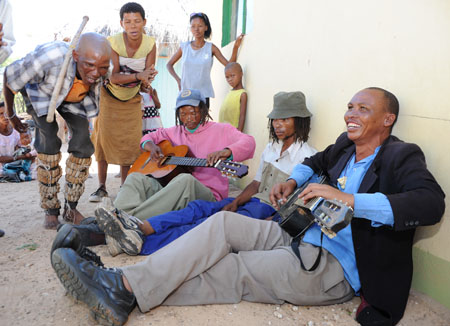
Abundance of talent at this settlement however, especially music, reverses all the negative shortcomings of life that residents experience. Any kind of music can be sung and performed impromptu by any gathering of more than three people, regardless of their age and this makes them forget their day to day hardships for a while.
Perhaps it is because Khekhenye is solely inhabited by Basarwa who by nature are a rhythm oriented people. When they speak Sesarwa for instance, the varying intonations of their speech, their emphasis on the syllables characterised by definitive clicks plus the release or brake of their breath points produce a rhyme that to a non Mosarwa seem musical.
And all these musical qualities are embedded on a threesome ensemble of Kadisa Balufi, Balefi Mosolomane and Kelatetse Mosupatsela who although not having a stage name, rock the small settlement day and night. Initially they played as solo guitarists, on an ad hoc basis, until Balufi gathered them after realising that unity was the best remedy.
“We started with one guitar sharing it among ourselves and our parents did not approve of us playing the guitar at all,” he says in an interview. In fact, he says, growing up he was admonished several times for playing the guitar.
“Nne ke omanngwa gotwe ke tlaa tsenwa ke go tshameka katara,” he says emphasizing that his parents believed playing the guitar would make him insane eventually. The three of them, he notes, have never studied music or learnt formally how to play the guitar.
Instead they acquired the skill through oral tradition from their parents who mastered motontonyane (home-made guitar). “Out of curiosity we started imitating them and later developed deep interest in both playing and composing songs,” Balufi says.
Being the most vocal in the group, Balufi says the love to nurture his talent at one point made him do crazy things that he is not proud of. “I stayed with a friend who owned a small keyboard while serving Tirelo Setshaba in Kanye back in 1998. Upon completion of the national service I stole his keyboard because I could not keep my hands off any musical instrument,” reminisces Balufi.
As things are, Balufi says their band is growing musically as they improve everyday but do not have enough equipment such as drums, keyboards, speakers, microphones and several other fully-fledged band equipment.
Right now the three of them play four string guitars which forces them to harmonise and as a result under utilise some of the strings. “We improvise with the little we have as one plays lead, the other bass and I do rhythm guitar.” The songs they compose are inspired by different life scenarios ranging from happiness to sadness or encouragement.
Their all time hit titled: Botswana go monate, gets the whole crowd into a frenzy as they dance to modern day rhythm while appreciating the natural expertise used in arranging the words motswako-hip hop style. The song talks about all villages and settlements along the Letlhakeng/Morwamosu road and describes what takes place in those villages.
Characterised by feats of alliteration, the lyrics of the song go: Ko Khekhenye ra khekheleza, ko Motokwe ra talker, ko Dutlwe ra dula, ko Takatokwane ra takataka, ko Maboane ra boaboa, ko Letlhakeng ra tlhakana, ko Molepolole ra lapologa fa ko Gaborone re di gabola.
The trio say they fear securing a loan with one of the banks to expand their equipment as they might not be able to religiously service the loan owing to insufficient cashflow.
In the meantime they will have to save their haphazard earnings so that they eventually reap the sweat of their brow.
ENDS
Source : BOPA
Author : Rebaone Tswiio
Location : Molepolole
Event : Interview
Date : 30 May 2013
Related News

19 Jul 2026

16 Jul 2026
Book Aims To Teach Safety And Break GBV Silence
16 Jul 2026
Batswana remember legend of guitar

16 Jul 2026
Collaboration key to creatives growth
16 Jul 2026
Artists Pay Tribute to Leburu
15 Jul 2026