

Small dams not to blame
17 Jun 2014
The lack of inflows that led to the drying up of Gaborone Dam cannot be blamed on the 300 small dams upstream.
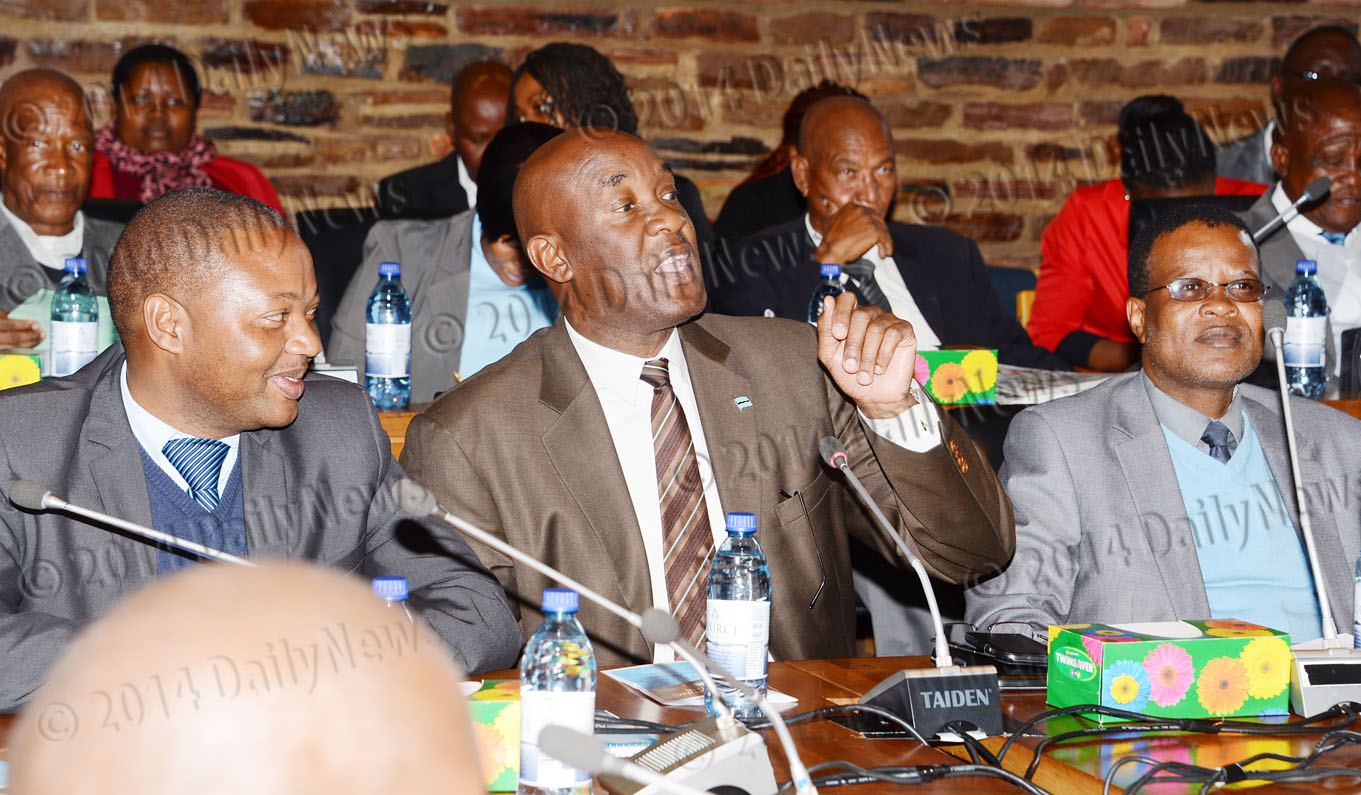
Briefing members of Ntlo ya Dikgosi on June 16, the Minister for Minerals, Energy and Water Resources, Mr Kitso Mokaila said instead, the small dams helped reduce silting at Gaborone Dam by five per cent.
He attributed lack of enough inflows to low rainfalls. He noted that Gaborone Dam overflowed in 2000 despite the existence of the small dams.
The dam, he said, was currently at 11 per cent, adding that it supplied 48 per cent which was half of what it could be supplying to the greater Gaborone and other areas. Gaborone is expected to rely on Molatedi Dam in South Africa for water supply.
Minister Mokaila also ruled out the possibility of diverting Segoditshane River to supply Gaborone Dam, saying the cost would be equivalent to constructing another dam.
He also told members of Ntlo ya Dikgosi that the government had decided to declare Okavango Delta a heritage site in order to conserve it, adding that drawing water from the delta was impossible because it required consultation with other countries from which the delta passed through.
Some members had asked why government was not considering to draw water from the delta than from Lesotho.
Water Utilities Corporation deputy chief executive officer, Mr Nginani Mbayi told dikgosi that Botswana faced huge challenges on water resource management since 2005 because rainfall had always been low while recurring erratic droughts were also common.
Mr Mbayi said there were high water loses of up to 40 per cent in most villages due to deteriorating pipe network, adding that another challenge was unsustainable use of potable water for watering livestock.
He explained that water restrictions and rationing as well as public education were some of the measures in place to save water. Mr Mbayi said the Malotwane boreholes would also be rehabilitated while at the same time connecting Thamaga, Kanye and Molepolole to the north south carrier project.
He said waste water recycling would also be another option while at the same time adopting water efficient systems. Mr Mbayi added that the government would also revert to the old system of water harvesting for non-potable use.
Meanwhile, the chief executive officer of Botswana Power Corporation (BPC), Mr Jacob Raleru also told members of Ntlo ya Dikgosi that the construction of the P11.5 billion Morupule B Power Station was almost complete, and that four of its six units were operation. He said unit five and six would be in full operation in 2017.
However, Mr Raleru said vandalism and fraudulent use of electricity resulted in loss of revenue, adding that scrap metal dealings were driving vandalism and equipment theft, adding that dealers accepted scrap metals without questioning.
Minister Mokaila noted that importing electricity from South Africa had always been cheaper, but admitted that Morupule B Power Station experienced some challenges in its initial stage of construction. ENDS
Source : BOPA
Author : Thamani Shabani
Location : GABORONE
Event : Ntlo Ya Dikgosi briefing
Date : 17 Jun 2014
Related News

21 Jun 2026


18 Jun 2026
Commission targets youth empowerment
18 Jun 2026
Countries commit to partnership

18 Jun 2026