New policy to strengthen migration governance
16 Nov 2026
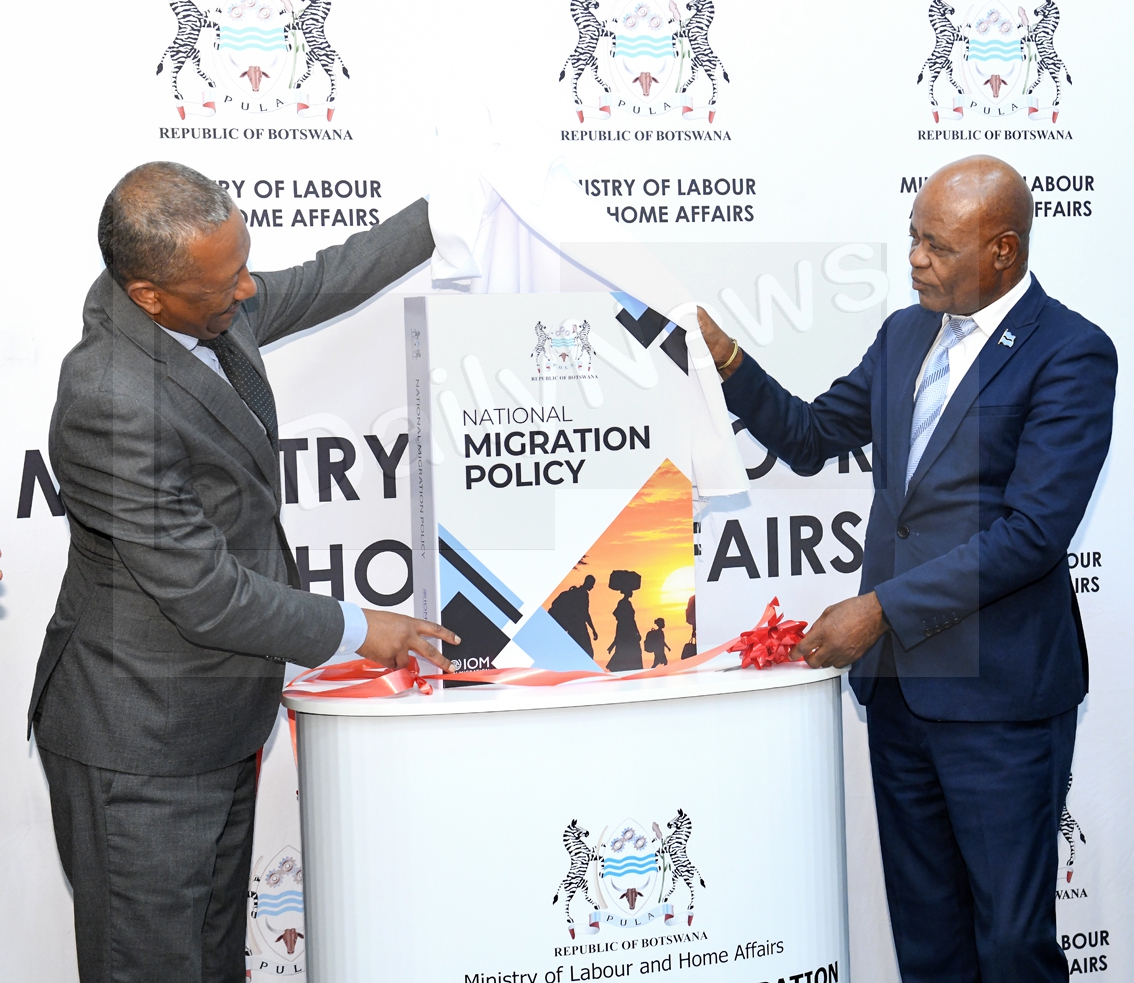
The newly launched National Migration Policy is expected to strengthen migration governance, promote safe, orderly and regular migration, protect human rights and harness developmental benefits of migration for national development.
Launching the policy in Gaborone recently, Minister of Labour and Home Affairs, Major General Pius Mokgware, said migration had become a national development issue that required a coordinated and strategic response, given its influence on economic growth, labour markets, education, security, public health and international relations.
Maj. Gen. Mokgware said the policy provided a comprehensive framework to manage migration, whilst maximising its developmental benefits, safeguarding national security and protecting human rights.
He said Botswana had experienced increasing migration flows as a country of destination, transit and origin, while internal migration continued to shape urban centres and public service needs.
Such developments, he said, brought opportunities for economic growth and skills development, but also challenges that required effective planning and management.
He explained that the policy sought to strengthen migration governance, improve coordination among stakeholders and integrate migration into national development planning.
“It also seeks to position Botswana as an attractive destination for investment, skills and innovation, while promoting inclusive migration governance by recognising the needs of women, youth, children, persons with disabilities and other vulnerable groups,” he said.
Additionally, he said the policy addressed a broad range of issues, including labour migration, border management, human trafficking, migrant smuggling, refugee protection, return and reintegration, migration and development, climate change and migration data management.
The policy, he said, also recognised that migration affected virtually every sector of society and therefore required a whole-of-government and whole-of-society approach.
“Migration is no longer solely an immigration matter; it is a national development issue that requires a coordinated and strategic response,” he added.
Further, the minister noted that no single institution could effectively manage migration alone, adding that success would depend on strong partnerships among government ministries and departments, security agencies, development partners, private sector, academia, civil society organisations and local communities.
He emphasised that effective collaboration and information sharing would be critical to achieving the policy’s objectives.
The minister also emphasised the importance of reliable migration data, saying evidence-based planning was essential to understanding migration trends, addressing emerging challenges and measuring the contribution of migration to national development.
He said he was happy that the policy would help ensure that migration was integrated into national development planning and that its contribution to national development was recognised and harnessed.
He acknowledged the International Organisation for Migration (IOM) for its technical and financial support throughout the development of the policy, as well as all stakeholders who participated in consultations and contributed their expertise.
However, he said the policy document alone could not deliver change, stressing that its success would be its implementation.
He said the policy was supported by an implementation framework, institutional coordination mechanisms, monitoring and evaluation arrangements to ensure accountability and measurable results.
“As we launch this policy today, we reaffirm Botswana’s commitment to balanced, responsive and forward-looking migration governance,” he said.
He said the country sought to facilitate legitimate movement, attract investment and skills, protect national interests, strengthen security and harness developmental benefits of migration for the prosperity of all.
The minister urged stakeholders to regard the launch not as the end of a process, but the beginning of a collective commitment to action.
He said collective efforts would help build a migration management system that supported national development, whilst contributing positively to regional and international migration governance.
He thanked the Technical Working Group, government institutions, development partners, civil society organisations, academia, the private sector and all stakeholders who contributed to the development of the policy before officially launching it. ENDS
Source : BOPA
Author : Lorato Gaofise
Location : Gaborone
Event : National Migration Policy launch
Date : 16 Nov 2026
Related News

16 Nov 2026
Explainer APEC comes to Shenzhen where