Dairy self-sufficiency in sight as Milk Valley scales up
09 Nov 2026
The Milk Valley Farm expansion plan aimed at scaling up operations to strengthen Botswana’s domestic milk production and support development of the agricultural value chain continues to make progress.
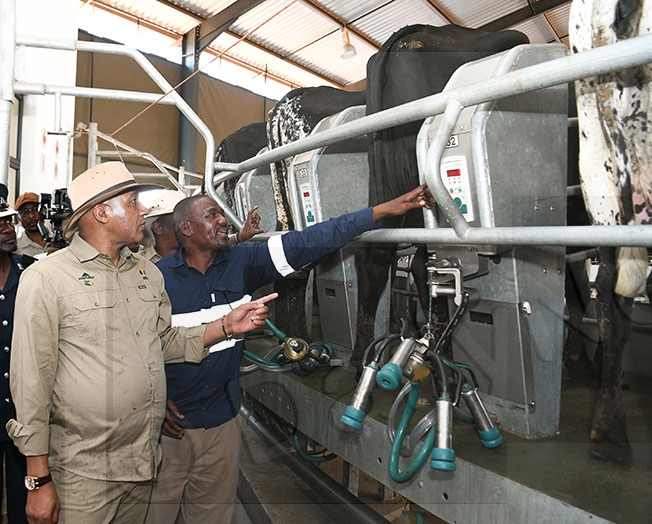
President Advocate Duma Boko embarked on a comprehensive tour of the Botswana Development Corporation (BDC)-owned commercial farm on Saturday following the recent herd expansion at the farm, key infrastructure upgrades and the ongoing farm optimisation programme.
BDC Managing Director, Mr Oteng Keabetswe, said 600 high-yielding Girolando dairy cows have arrived from Brazil so far.
He said the cows that were pregnant on arrival had produced 123 calves since August, adding to the farm's future herd of Girolando dairy cows.
Additionally, Mr Keabetswe said the farm was anticipating a lot of calving to take place in the months of November and December, which he noted would substantially increase the herd by an estimated 400 to 500 calves by the end of January 2027.
“We have started selling milk and the demand is very high, and we sell every single day. By the time we get to milking 400 cows, we will break even and support our daily expenses,” he said.
In an interview, the interim Milk Valley Chief Executive Officer, Mr Botshelo Mokotedi said BDC invested in key infrastructure upgrades which included construction of three cow sheds with the capacity to hold 400 dairy cows each.
He said a further investment was made on improving water reticulation systems, additional cow housing, fodder production initiatives, and staff training programmes to support operational readiness and future growth.
Mr Mokotedi said the new cow sheds had been upgraded by equipping them with climate control and manure handling facility as well as improved cow comfort.
He said currently, Milk Valley Farm had 811 cows including other existing breeds at the farm which include the high yielding Red Friesland, Gernsey, Jersey, Brown Swiss and Ashires.
Each dairy cow, he said had the capacity to produce 25 litres of fresh milk per day.
He said so far, 750 Girolando embryos and 2000 sexed semen had been procured aimed at improving the herd quality, productivity and long-term breeding efficiencies.
Mr Mokotedi underscored that these efforts were expected to enhance milk output and contribute meaningfully toward reducing Botswana’s reliance on imported dairy products.
In an interview a Girolando dairy cattle and genetics supplier, international director of Fazenda Floresta from Brazil, Mr Rogerio Barros said they were currently providing expertise toward establishment of an advanced cattle reproductive IVF technology laboratory that would see Milk Valley Farm produce Girolando embryos and sexed semen, adding that they provided technology transfer training.
He said a Girolando was a cross breed of a Gir and Holstein, where the Gir carried dexterity, and versatility qualities while the Holstein carried productivity. He said it was the best breed created for tropical, arid and semi-arid areas.
Additionally, he said Brazil conditions were similar to those of Botswana, therefore, the Girolando dairy cows would succeed under the conditions.
President Boko, Minister for Lands and Agriculture Dr Edwin Dikoloti, Assistant Minister of Trade and Entrepreneurship, Mr Baratiwa Mathoothe, Permanent Secretary to the President, Ms Matshidiso Bokole and senior government officials toured the dairy farm and appreciated its expansion plan. ENDS
Source : BOPA
Author : Calviniah Kgautlhe
Location : Lobatse
Event : Milk Valley Farm tour
Date : 09 Nov 2026
Related News