


Japan donates over P1m for classrooms construction
22 Oct 2026
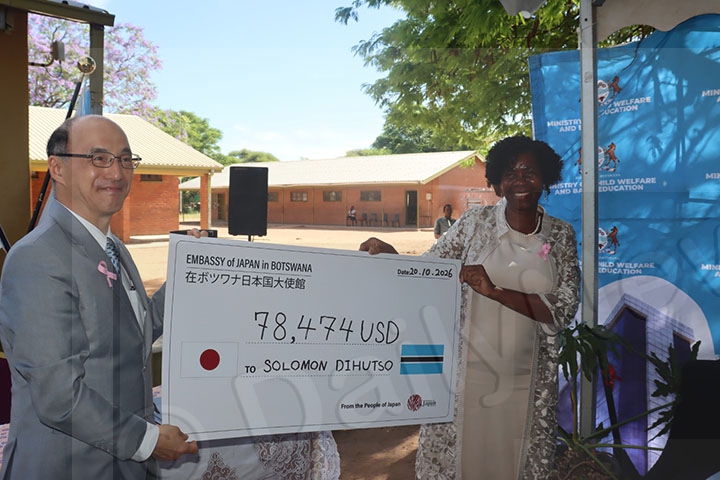
The government of Japan has donated approximately P1.08 million (US$78,474) to Solomon Dihutso Primary School in Mogoditshane to construct three classrooms aimed at easing overcrowding and improving learning conditions.
Japanese Ambassador to Botswana, Mr Shindo Yusuke, said the grant provided under Japan’s Grant Assistance for Grass-Roots Human Security Projects (GGP), demonstrated the country’s commitment to promoting quality education and community development.
Speaking during the grant contract signing and ground-breaking ceremony on Tuesday, Mr Yusuke said investing in education was among the most important contributions to children’s future and the development of society.
He said the school was experiencing a serious shortage of classroom space, particularly for Standard Four learners, who numbered approximately 167 across five classes but had access to only two classrooms.
“This situation has compelled the school to introduce a double-shift system, with each group receiving only four hours of teaching per day,” he said, adding that the three new classrooms would enable learners to return to a full school day.
Mr Yusuke said the project reflected the importance of collective responsibility in addressing community challenges.
He said governments, schools, parents, local authorities and development partners all had important roles to play in creating better educational opportunities for children.
The Ambassador added that Japan’s GGP scheme supported community-based initiatives in education, health and social welfare, focusing on practical interventions that improved people’s daily lives.
He noted that the project came as Botswana and Japan celebrated 60 years of diplomatic relations, describing the milestone as an opportunity to strengthen cooperation founded on friendship, mutual respect and shared development goals.
Mr Yusuke urged learners to make the most of the new facilities by embracing education, discovering their talents and pursuing their ambitions.
He also called on school management and the Mogoditshane-Thamaga District Council to ensure that classrooms were properly maintained.
Acting Regional Education Officer, Ms Margaret Koko said the school’s classroom shortage had been a longstanding concern raised by its management during engagements with the regional education office.
She said the school had 22 classrooms, but faced a shortage of approximately 12, leaving learners overcrowded and compromising the provision of a conducive learning environment.
Ms Koko explained that the Ministry of Child Welfare and Basic Education, together with the school management and district council, had explored possible interventions before Japan responded to the request for assistance.
She said double-shift learning, although used as a temporary measure to accommodate rising enrolment, disadvantaged learners by reducing their contact time with teachers.
“Today, I am delighted that the vision communicated by the school to the regional office and district council has become a reality,” she said, expressing gratitude to the Japanese government and people for their support.
She added that the classrooms would help restore learners’ dignity and provide a more suitable environment for academic achievement.
Mogoditshane East MP, Mr Letlhogonolo Barongwang, commended the Japanese Embassy for investing in the future of Botswana’s children.
He said the partnership demonstrated the value of international cooperation and community participation in addressing local development needs.
Mr Barongwang also thanked traditional leaders, church leaders and community representatives for their continued guidance and support, urging stakeholders to work together to strengthen schools and empower young people. ENDS
Source : BOPA
Author : Keetile Bontsibokae
Location : Mogoditshane
Event : Donation
Date : 22 Oct 2026
Related News

23 Oct 2026
UB confer honorary doctorate on Sesana

22 Oct 2026