Move beyond govt tenders - Boko
08 Oct 2026
President Advocate Duma Boko has urged the private sector to transform Botswana’s economy through innovation, production and genuine entrepreneurship rather than relying heavily on government tenders.
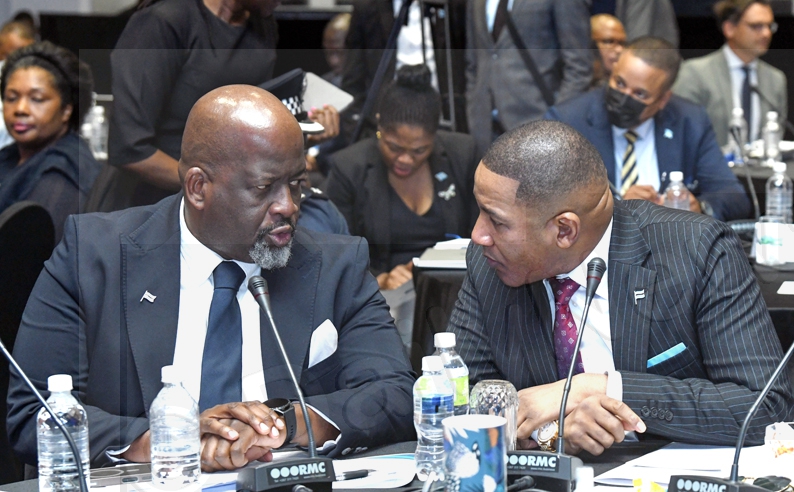
Addressing the Presidential Business Roundtable in Gaborone on October 8, President Boko said Botswana needed businesses that developed intellectual property and invested in productive sectors such as manufacturing.
He said many local businesses had traditionally relied on government tenders without contributing significantly to production or value addition.
“The vogue style of business is to be a middle man, ‘tenderpreneurship’. Meaning, you are not doing any manufacturing, or any production or value addition. All you do is to access from a point, inflating prices then selling to the government at extortionate prices. This has been the dominant mode of business in this country,” President Boko said.
He urged the private sector to focus on genuine entrepreneurship, innovation and the utilisation of intellectual property and local resources to establish a domestic manufacturing base.
“If you are manufacturing, then under existing legislation, you are entitled to be empowered even if you are charging slightly higher than others. Because if you have internalised the manufacturing and intellectual property in country, then we are prepared to deploy the government’s purchasing power to favour you unapologetically,” he said.
President Boko said it was important to redefine what doing business meant at the current stage of Botswana’s economic development.
“Doing business now means production, farms, and industries manufacturing produce, so that at scale we could take advantage of the African Continental Free Trade Area (AfCFTA) among other opportunities,” he said.
He explained that under AfCFTA, manufactured goods could qualify for duty-free preferential treatment if their raw materials were sourced locally or within the region.
Speaking on behalf of Vice President and Minister of Finance, Mr Ndaba Gaolathe, Minister of Local Government and Traditional Affairs, Mr Ketlhalefile Motshegwa, said the Presidential Business Roundtable sought solutions from key stakeholders, particularly the private sector, to improve the country’s economic outlook.
“We are not here to present government directives. Instead we are pioneering an open floor, fireside dialogue, and we need your voice, your critique and insights. This marks a deliberate shift towards proactive engagement, state leadership will talk less and listen more, absorbing the realities of the market before formulating policy response,” he said.
Mr Motshegwa said the Ministers of Trade and Entrepreneurship, Lands and Agriculture, Minerals and Energy, Labour and Home Affairs, as well as Local Government and Traditional Affairs, had been tasked with translating the vision into measurable action.
He said bringing the portfolios together was intended to address bureaucratic silos that delayed investment and strengthen executive accountability.
“The ultimate goal is to co-author our next step, we will convert your industrial feedback into a binding framework of policy updates delivered straight to the ministry executives for a 24 week implementation cycle,” Mr Motshegwa said.
Launched by President Boko in March 2026, the Presidential Business Roundtable brings together regulators, parastatals, funding institutions and private sector leaders.
Business Botswana President Mr Neo Nwako said the private sector was committed to developing practical solutions and ensuring that commitments made through the business roundtable produced measurable outcomes.
“We made a commitment as the private sector that we would come up with solutions and enable the public sector and the Presidential Business Roundtable to have a monitoring tool to observe the commitments we have made,” he said. Mr Nwako said six months after the inaugural meeting, sectoral meetings had been held in 10 of the 18 identified sectors, with work continuing towards measurable outcomes.
He identified visas, work permits and land tenure as some of the critical areas requiring attention to improve investment and the ease of doing business.
Following the opening remarks, public and private sector leaders engaged in a closed-door brainstorming session aimed at identifying practical solutions to the country’s economic challenges. ENDS
Source : BOPA
Author : Pako Lebanna
Location : GABORONE
Event : Address
Date : 08 Oct 2026
Related News
08 Oct 2026
08 Oct 2026
Ikageng graduates build VDC houses
08 Oct 2026
Road re-construction project at 34 per cent