


Unions decry lack of consultation
13 Aug 2026
Public service unions have raised concerns over the consultative process surrounding the proposed Public Service Bill of 2026, arguing that inadequate engagement could undermine workers’ rights and labour relations.
The unions argued that the Bill sought to overhaul the regulation of the public sector through reforms including the modernisation of dispute resolution, promotion of workplace equity and expanded powers for the Directorate of Public Service Management (DPSM) and the Permanent Secretary to the President (PSP) in matters of discipline and recruitment.
However, the unions have expressed reservations about the consultation process, accusing government of limiting employees’ participation in decisions affecting their employment and potentially undermining stable labour relations, fair remuneration and safe working conditions.
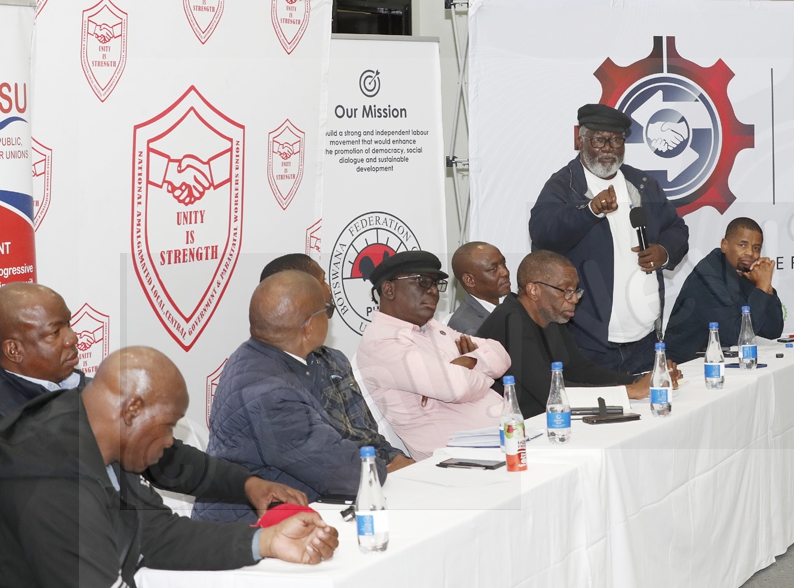
Speaking at a media briefing in Gaborone, Botswana Federation of Public Sector Unions (BOFEPUSU) President Mr Gotlamang Oitsile said the unions had made several unsuccessful attempts to engage government on aspects of the proposed Bill.
“We will not agree with the government on the position they intend to take with the proposed Bill because the current economic conditions do not allow us to keep quiet when workers’ rights are being breached.
We will continue to advocate for the right structures to be in place before the Bill turns into law,” he said.
Reiterating the position, TAWU President Mr Allan Keitseng said the unions would remain relentless in mobilising their members to use their collective and institutional power to influence public policy.
Mr Keitseng said among the unions’ concerns was what he described as an unfair expansion of the authority of central government offices.
“Through this Bill, the DPSM and the Permanent Secretary to the President have control over recruitment, policy execution and discipline within the civil service, resulting in the loss of institutional neutrality, reduced bureaucratic independence and an overall weakening of the system of checks and balances that was fundamentally meant to protect workers and employers alike,” he said.
According to Mr Keitseng, proposition (ii) of the Bill, which proposes changes the architecture of the bargaining process, was averse to the reality that Public Service Bargaining Council (PSBC) membership is voluntary hence mandatory imposition of its decisions through statutory provisions is a violation of the law that protects freedom of association, right to self-determination and the right to bargain effectively.
“Effectively, the will of a voluntary, convenient structure cannot be imposed on those who choose not to associate with such a structure.
Doing so also violates ILO Conventions which guarantee workers the fundamental rights to freely organise unions, engage in collective bargaining without employer or state interference, also extending these democratic labour protections into the public sector.” He said.
The labour movement’s concerns were further outlined in a letter dated August 10, 2026, addressed to DPSM, in which the unions expressed dissatisfaction with the consultation process.
The unions stated their unequivocal objection to government’s intention to amend the Public Service Act and any associated legislation, arguing that the proposed changes would be detrimental to public service unions and employees.
The labour movement remained resolute in opposing the proposed Bill but maintained that it was willing to re-engage with government in an effort to reach common ground.
“Should the government arbitrarily proceed, the Progressive Recognised Public Service Trade Unions shall take the necessary steps to restore the rights and dignity of Trade Unions and the Workers of the Republic of Botswana,” the letter stated. ENDS
Source : BOPA
Author : Mpho Mosojane
Location : GABORONE
Event : Media briefing
Date : 13 Aug 2026
Related News
06 Oct 2026

06 Oct 2026
Access to sign language critical
06 Oct 2026
Boko hails Royal visit

06 Oct 2026