


At least 14 static AI camps support livestock improvement
28 Jul 2026
Agriculture operated 14 static Artificial Insemination (AI) camps across the country during the 2025/26 breeding season.
Answering a question in Parliament on July 27, the Assistant Minister of Lands and Agriculture, Mr Motsamai Motsamai said 14 of the 16 camps were operational, with the exception of Makalamabedi and Ncojane, which did not admit cattle.
“The Makalamabedi AI camp faced a shortage of grazing resources due to extensive veld fires, while the Ncojane camp was constrained by saline water conditions that negatively impacted cattle conception rates,” Mr Motsamai said.
He said the static camps were spread across 14 districts to ensure farmers in both rural and peri-urban areas could access breeding services closer to home.
Mr Motsamai said the network included Goodhope AI in Goodhope District, Tsatsu AI camp in Kanye District and Ramoalosi AI camp in Letlhakeng District. He said in the south-west, services were available at Sekgwasentsho AI camp in Jwaneng/Mabutsane District and at Kgainyane and Phuduhudu AI camps in Hukuntsi District.
The assistant minister said Farmers in the west could access Chobokwane AI camp in Gantsi District and Ncojane AI camp in Charleshill District.
In the central region, he said the camps were located at Dibete AI camp in Mahalapye District, Morupule AI camp in Serowe District and Makoro AI camp in Palapye District.
The eastern part of the country was served by Sefhophe AI camp in Bobirwa District, he noted.
Mr Motsamai said in the north, the ministry ran Makoba and Makalamabedi AI camps in Boteti District, with an additional Makalamabedi camp under North West District, as well as Nokaneng AI camp in Okavango District.
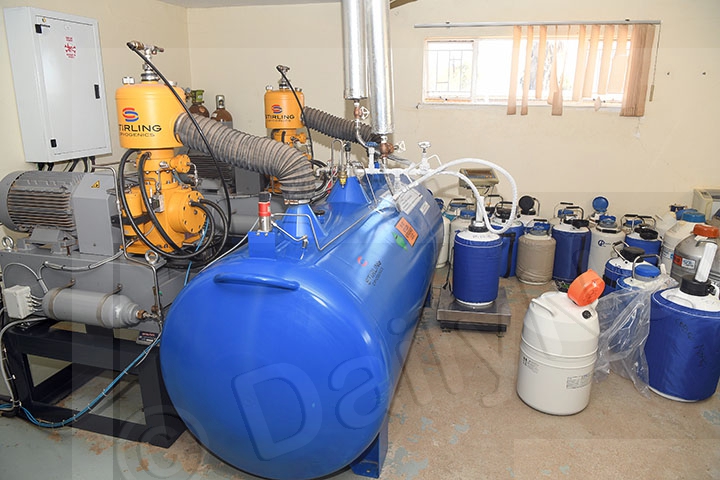
On the availability and pricing of semen, Mr Motsamai said the Ramatlabama National Artificial Insemination Laboratory (NAIL), maintained a robust genetic resource base with a total of 474,384 semen straws in storage.
“Local semen accounts for the majority, comprising 207,739 straws for beef cattle and 115,929 straws for dairy, alongside 127,460 straws from bulls originally imported from the United States and Australia but now produced locally,” he said.
Mr Motsamai said foreign semen, directly imported, included 21,606 straws for beef and 1,650 straws for dairy.
He said local semen was sold at either P30 per straw or P75 per straw depending on the genetic origin of the bull.
“Foreign semen is sold strictly at its import cost, with no markup applied, a deliberate policy designed to cushion farmers against the high expenses of international procurement,” Mr Motsamai said.
He said the dual sourcing and pricing model ensured that Botswana farmers had equitable access to both domestic and global genetics, while safeguarding affordability and strengthening the national livestock improvement programme.
On accessibility, Mr Motsamai said Ramatlabama NAIL and the AI centres provided nationwide access to advanced livestock breeding services. “The AI centres are located strategically across Botswana to reach out to small scale farmers. Whilst Ramatlabama operations are structured to combine centralised laboratory functions with decentralised district support,” he said.
He added that farmers could access services through frontline extension officers, while genetic material from Ramatlabama bulls was distributed via a comprehensive semen catalogue available in district offices.
“In addition, the laboratory facilitates the sale of semen and AI accessories, and runs structured training programmes for AI technicians to build national capacity,” Mr Motsamai said.
He said farmers might also directly engage with Ramatlabama NAIL by telephone or through physical visits to procure semen of their choice, purchase insemination consumables, refill semen flasks with liquid nitrogen and undergo hands-on AI training.
Mr Motsamai was responding to a question from the MP for Mogoditshane West, Mr Galenawabo Lekau, who had asked the minister to update the House on Artificial Insemination Centres and to state how many were functioning, how many semen straws were available and at what price, and how Ramatlabama farm was accessible to Batswana and AI technicians. ENDS
Source : BOPA
Author : BOPA
Location : Gaborone
Event : Parliament
Date : 28 Jul 2026
Related News

07 Oct 2026