Kgosi Mosadi turns tradition into fortress for women
27 Jul 2026
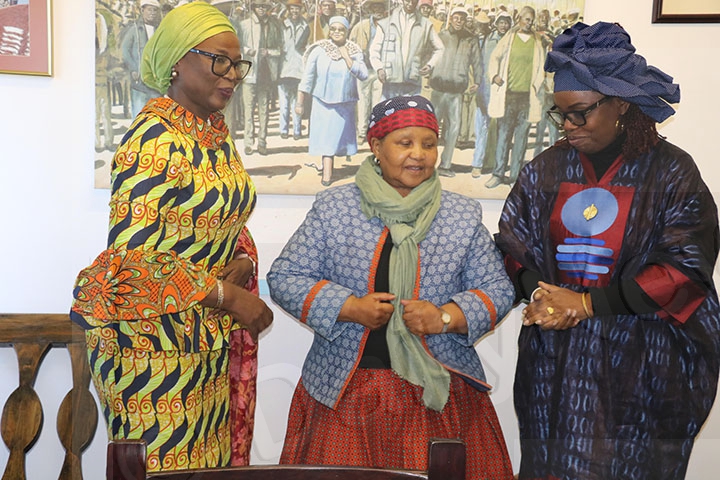
As both the custodian of her tribe’s heritage and a vocal advocate on the continental stage, Kgosi Mosadi Seboko of Balete carries a conviction that true African culture must protect and never harm.
Now, as Botswana joins hands with the African Union to end violence against women, Kgosi Mosadi, is leading from the front, mobilising custom, community and leadership to turn ancient tradition into a shield for her people.
This personal mission took centre stage on July 17, when the African Union Technical Assistance Mission paid a courtesy call to her royal court in Ramotswa.
The visit provided a major continental boost to Botswana’s drive to eradicate gender-based violence to accelerate the country’s ratification, domestication and implementation of the landmark AU Convention on Ending Violence Against Women and Girls (AU-CEVAWG).
Welcoming the delegation, Kgosi Mosadi spoke not just as a diplomat, but as a leader deeply attuned to the quiet heartbreaks inside her people’s homes.
She reflected on a painful truth facing the continent, saying despite Africa’s significant progress in advancing gender equality through progressive laws, policies and continental commitments, violence against women and girls remains one of its most pressing challenges.
For her, gender-based violence is not an abstract policy statistic, but a destructive force that fractures human dignity, weakens families, erodes social cohesion and steals the promise of peace and prosperity from future generations.
“As Africans, we are united by a vision of a continent where every individual enjoys equal opportunity, security and dignity. This vision, embodied in the AU’s Agenda 2063, cannot be realised while women and girls continue to experience violence,” she said.
Critics often point to traditional customs as rigid barriers to women’s rights.
But Kgosi Mosadi refuses to let culture be blamed for cruelty.
Instead, she draws on the deepest roots of African heritage to fight back, firmly believing that true customs and traditions were always meant to uplift and protect human dignity.
“Our cultures are rich in values of respect, compassion, justice and communal responsibility. These are the values we must preserve and promote. Practices or beliefs that perpetuate violence or inequality have no place in the Africa we are striving to build,” she said.
Sitting in a unique position of trust as a custodian of culture, a mediator and a role model, she feels the personal weight of that responsibility acutely.
She believes traditional leaders must be the first to step into the gap, challenging harmful practices and building communities where no woman or girl has to walk in fear.
“For far too long, the scourge of gender-based violence has fractured our communities, acting as a major barrier to every developmental outcome we seek. Traditional leaders cannot remain passive observers. The kgotla must not merely be a place of dispute resolution but also a fortress of protection,” she said.
True cultural preservation, she explained, required the courage to evolve and eliminate harmful social attitudes, nurture positive masculinity and ensure that customs serve as a shield for women and never a weapon against them.
As such spirit, she hailed the adoption of the AU-CEVAWG as a watershed moment for Africa, building directly on commitments like the Maputo Protocol, which Botswana ratified in 2023.
Kgosi Mosadi’s moral clarity resonated deeply with the visiting continental delegates, illustrating what happens when grassroots traditional leadership meets global human rights advocacy.
African Commission on Human and Peoples’ Rights commissioner, Ms Janet Sallah-Njie, reaffirmed the commission’s commitment to standing shoulder-to-shoulder with Botswana to implement the convention.
She noted that while the road ahead was daunting, the continent’s collective resolve was even stronger.
Ms Sallah-Njie praised Kgosi Mosadi, who also served as the Southern African Caucus of the Pan-African Parliament vice chairperson and a member of the Committee on Gender, Family, Youth and Persons with Disabilities, for her relentless crusade to end violence against women and girls.
Expressing confidence that engaging passionate traditional leaders was the key to real change, Ms Sallah-Njie honoured Kgosi Mosadi as a true ambassador of African culture, emphasising that her voice must continue to echo across the Pan-African Parliament to lift up Southern Africa and the continent as a whole.
The emotional urgency of the moment was matched by UN Women Representative to the African Union Commission and UNECA, Ms Doris Mpoumou.
Ms Mpoumou acknowledged the painful reality that culture had sometimes been distorted to strip away women’s hard-won freedoms.
Yet, looking around the room in Ramotswa, she saw a path forward grounded in mutual respect and shared humanity.
Engaging traditional leaders like Kgosi Mosadi, Ms Mpoumou highlighted that it offered an irreplaceable opportunity to forge partnerships that ensured that every single woman and girl can live in safety, walk with respect and realise her full and unhindered potential. ENDS
Source : BOPA
Author : Baleseng Batlotleng
Location : Ramotswa
Event : Interview
Date : 27 Jul 2026
Related News

06 Oct 2026
Envoy pledges continued support for Botswana

06 Oct 2026
Access to sign language critical
06 Oct 2026
Boko hails Royal visit