Tragedies must shape public policy - First Lady
22 Jul 2026
National tragedies carry profound lessons that must actively shape public policy, First Lady, Ms Kaone Boko has said.
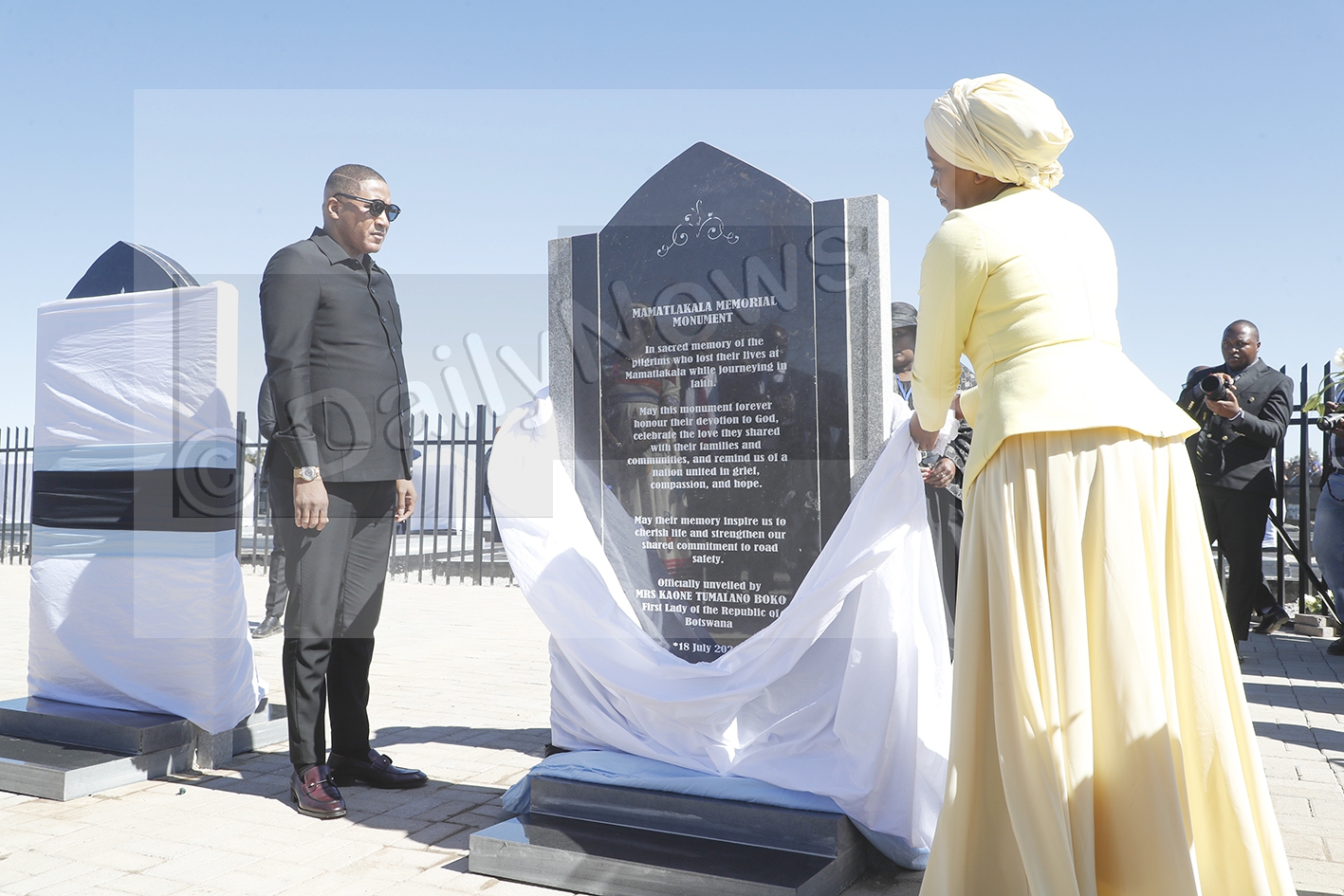
Officiating at the National Healing, Remembrance and Closure event held in Molepolole last July 18, Ms Boko emphasised that remembrance must leave positive and lasting impact on the country.
The solemn event was organised to unveil the tombstones of 45 Batswana who perished in a devastating road accident, while also continuing the ongoing mission to honour victims and heal survivors of past tragedies, including the Matsha College truck accident.
Ms Boko noted that healing did not demand that individuals forgot the past, but it allowed them to remember differently and effectively transforming grief into compassion.
“On the 28th of March 2024, we remember 45 Batswana travelling on an Easter pilgrimage as members of St. Engenas Zion Christian Church in Molepolole. They lost their lives in the devastating Mmamatlakala bus accident in Limpopo, South Africa. What began as a journey of faith became one of our darkest memories,” she said.
Despite the heavy aftermath of the tragedy, Ms Boko stated that grieving families and the nation must emerge with deeper understanding that the true measure of a nation was found not only in its economic prosperity, but also in the compassion extended to those who suffered.
She commended the extraordinary bilateral cooperation witnessed between Botswana and South Africa during the crisis, calling it a powerful reminder that compassion knows no borders. She also praised the resilience of the affected families, noting how remarkable it had been to witness men and women carrying immense pain yet continuing to pull themselves together to guide their families towards a better future.
To the sole survivor of the crash, who was just an eight-year-old girl at the time, Ms Boko said the nation still heldher close to its heart as a miraculous symbol of hope.
“To our girl, I say that may God continue to show His miracles through you, may God continue to bless you, may God shine His light upon you and may God give you peace,” she said.
Ms Boko observed that Botswana had historically found its greatest strength not in the absence of hardships, but in how it united during trials. She noted that when one family sufferred, the entire community felt diminished and when one person was lifted, the whole nation grew.
Accordingly, she explained that the unveiling ceremony spoke not only to the memory of the victims but as a directive to those who were still alive.
“This is why we have taken it upon ourselves to also visit and talk to the survivors and their families to make sure that they are okay, to make sure that Matsha College is well equipped, so that it is not only remembered when we speak of the tragedy. We are going to remember them for the good grades they are going to get,” she added.
Ms Boko revealed that her office was working tirelessly alongside the Office of the Chief of Staff to ensure that the survivors and the families left behind preserved their dignity and received the support they needed to heal.
She emphasised that the greatest tribute the nation can pay to the departed was to build a safer Botswana where preventable tragedies became fewer, where communities were better equipped to respond with compassion and where every child and family can look to the future with genuine hope.
By doing so, she said remembrance became call to action and healing as well as the foundation for a more caring nation.
“We must thank God even when it is painful, even when we are mourning the loss of our loved ones, even when we do not understand,” Ms Boko said, offering words of spiritual comfort.
“I have learnt to trust in God, I have learnt to believe everything He says, because God is not a man that can lie. God does not say one thing and do another. God in all His power will heal and restore you,” she said.
Conversely, the First Lady likened nations to families, stating that a confident future cannot be built by leaving the deepest wounds unattended.
True healing, she said, required the courage to stand together in the presence of sorrow without looking away.
She noted that the National Healing and Closure programme was born from the important realisation that the responsibility of a government did not cease when emergency responders left the scene, when investigations concluded or when headlines faded from public attention.
“Our duty is not fulfilled merely by responding to disaster. It is fulfilled when those who continue to carry grief know that they have not been abandoned, forgotten, or left to bear the burden alone,” she said. ENDS
Source : BOPA
Author : Moshe Galeragwe
Location : MOLEPOLOLE
Event : National Healing, Remembrance and Closure event
Date : 22 Jul 2026
Related News
06 Oct 2026

06 Oct 2026
Envoy pledges continued support for Botswana

06 Oct 2026
Access to sign language critical
06 Oct 2026