


Living between vigilance and hope

05 Mar 2026
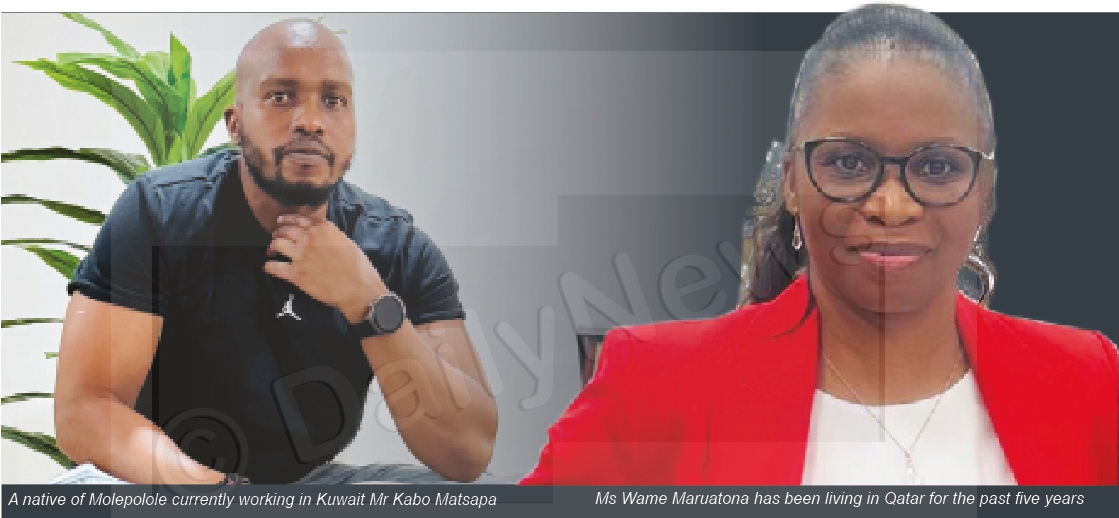
For Wame Maruatona, mornings in Qatar often begin with a quiet moment of reflection before the day’s routine starts. Like many expatriates, she moved abroad in search of opportunity and stability. But in recent days due to the war between Israel/United States of America and Iran, life has taken on a different rhythm one shaped by vigilance, uncertainty and resilience.
For the Motswana who has lived in Qatar for the past five years, daily life still appears calm on the surface. Supermarkets remain stocked, communication networks function normally and people continue with work, often from home. Yet beneath this sense of order lies a subtle but persistent tension.
“Coming from a place where I am not accustomed to war, missiles or interceptors, hearing loud bangs sometimes early in the morning or while asleep is emotionally draining and very unsettling,” she says in an interview with BOPA.
For Ms Maruatona, the sounds are often the most unsettling part. When buildings tremble and windows rattle, instinct takes over.
She explains that when buildings shake and glass rattles, her first reaction is often shock, followed by prayer and a quick check of official updates.
Authorities in Qatar have urged residents to remain indoors when necessary, avoid standing near windows and rely only on verified information. While such guidance is meant to ensure safety, Ms Maruatona admits it does little to ease the emotional strain.
“Every little sound can make you jump.”
Despite the anxiety that occasionally surfaces, life continues with a degree of normalcy. Supermarkets operate around the clock, pharmacies remain open and many businesses have shifted to remote work arrangements.
“There are no visible shortages of food or medicine,” she explains. “The biggest change is movement. People are encouraged not to go out unnecessarily, so like many others I work from home.”
But beyond the routines of daily life lies the psychological weight of living in a region experiencing heightened tensions.
“It is the heightened awareness, the unexpected sounds, the occasional fear and panic. Even watching the news can increase anxiety,” notes Ms Maruatona.
In moments like these, community has become a vital source of comfort.
Among Batswana living in Qatar, there is a strong sense of solidarity. Social media platforms and messaging groups have become lifelines, connecting people who check on one another regularly.
Botswana’s embassy in Doha has also remained accessible, coordinating with citizens through communication platforms and providing updates where necessary.
“On a daily basis we check on one another, which is reassuring,” says Ms Maruatona , adding that colleagues at the Qatar National Bank where she works and members of her church have also provided emotional support.
Yet amid the reassurance, an unspoken question lingers among many expatriates: what would happen if tensions escalate further?
Still, she says one of the most striking aspects of her experience has been the empathy shown by ordinary people.
“Most people I interact with clearly distinguish between military targets and civilians. There is a shared understanding that ordinary people are often caught in broader geopolitical tensions beyond their control.”
While uncertainty remains, she believes the situation is being managed responsibly.
Her hope, like that of many others, is for diplomacy and de-escalation.
“Clear and sustained de-escalation would allow us to feel fully at ease again,” she quips.
Until then, life continues structured, cautious and supported by community, even as the background hum of uncertainty persists.
Thousands of kilometres away in Kuwait, another Motswana shares similar feelings.
Mr Kabo Matsapa, originally from Molepolole, has spent years working across the Gulf region, including time in Saudi Arabia. Like many expatriates, he travelled abroad seeking better economic opportunities. But the reality of living in a region facing security tensions has been far more challenging than he anticipated.
“It is a disheartening experience to find yourself in a war-torn place. We came here for greener pastures, but now we are living in fear.”
Mr Matsapa works as a professional firefighter attached to a refinery, a job that already carries significant risks even in stable conditions.
“Working at a refinery where there are gases and oils, we must ensure that no fire breaks out,” he explains. “It is already a dangerous environment, and it is even more worrying now.”
Although he has been trained to respond to emergencies, the uncertainty surrounding the broader security situation is something he finds difficult to manage.
“As firefighters we are trained to deal with crises, but this is different. Sometimes when we go to sleep we do not know if we will wake up safely the next day.”
When sirens sound, instinct and fear collide.
“You find yourself looking up, trying to understand what is happening and at the same time looking for somewhere to hide,” he said.
Returning home, however, is not a straightforward option.
Like many expatriates, Mr Matsapa says economic realities remain a powerful factor in the decisions people make about where to live and work.
“The truth is we came here because opportunities are limited back home. With the unemployment rate in Botswana, going back would make it very difficult for us to survive.”
For now, hope remains the thread holding many expatriates together, hope that tensions will ease, diplomacy will prevail and life will once again feel ordinary.
Until then, people like Ms Maruatona and Mr Matsapa continue to navigate daily life between vigilance and hope, holding on to the belief that stability will eventually return. ENDS
Source : BOPA
Author : Lesedi Thatayamodimo
Location : Gaborone
Event : Interview
Date : 05 Mar 2026
Related News


10 Oct 2026
Feature Reliving the Long March 90 years on

09 Oct 2026