Jesse Jackson - Towering Voice For Civil Rights And Justice
23 Feb 2026
“When an old man dies, a library burns to the ground,” the old African adage goes.
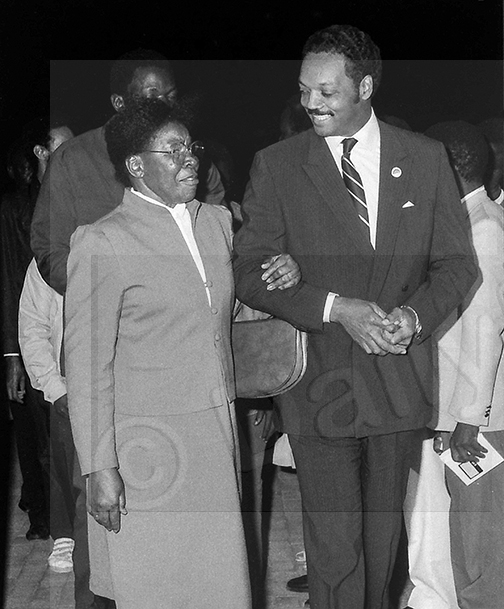
The death on February 17 of American civil rights icon Rev. Jesse Jackson, aged 84, leaves the world bereft of a man whose life of service led to him being a living embodiment of the struggle for racial equality both in the United States as well as Southern Africa.
It was his relentless pursuit for racial equality and freedom that took him on a tour to Botswana and other Southern African states in the mid 1980s. Familiarising himself with the region, he drummed up global support against an apartheid South African system that held the region hostage-ruling South West Africa (Namibia), supporting rebel movements in Angola and Mozambique and occasionally conducting cross border raids into neighbouring states such as Botswana.
Rev. Jackson’s August 1986 visit to Botswana, came at a point when the country had been in the unenviable position of having to walk a tightrope.
Having gained independence two decades earlier as one of the world’s poorest and least developed countries, and a labour reserve for South African mines, Botswana was economically dependent on goods and services from the highly industrialised apartheid neighbour, yet politically opposed to that country’s pariah white minority regime.
As Rev. Jackson’s flight descended upon the runway tarmac of Sir Seretse Khama International Airport, according to a Los Angeles Times report of the time, ‘trailed by a crowd of reporters eager to tell people back home about the plight of Southern Africa,’ he immediately felt home.
He shook the hands of the welcoming party lined up, Minister of External Affairs, Dr Gaositwe Chiepe, her permanent secretary, Mr Samuel Mphuchane, Gaborone North Member of Parliament, Mr Maitshwarelo Dabutha, Gaborone mayor, Mr Paul Rantao as well as the Nigerian high commissioner, Mr Rufus Omotonye.
“We come here, most of us as African Americans, we are American citizens with African heritage,” Rev. Jackson told BOPA upon arrival, cited in the Daily News of Tuesday August 19, 1986.
Critical of the foreign policy approach of the then US president Ronald Reagan and his assistant secretary of State for African Affairs, Chester Crocker, Rev. Jackson lamented that the US approached European nations with an aura of mutual respect, while regrettably still viewing Africa with a prism of neo-imperialism.
“We must as we do in Europe, respect African nations. The commitments we made to our allies in Europe we must make to Southern Africa, a new American policy on Africa that would gain us favour with God and the world,” Rev. Jackson said at the time.
During the visit, Rev. Jackson met Botswana’s second president Sir Ketumile Masire and Minister Chiepe for talks, addressed a public lecture at the University of Botswana, held a service with fellow Christians and clergymen at the Catholic Christ the King Cathedral in Gaborone, and also got to visit the border and no man’s land between Botswana and South Africa.
At the time, Rev. Jackson paid tribute to Batswana as a unique nation that has remained principled while living ‘in the belly of the beast’. Appreciating Botswana’s difficult circumstances, he pledged US$10,000, then equivalent to P20,000, as a grant from his Rainbow Coalition to the country as humanitarian aid.
He called on the US government, aid agencies and business to assist the Frontline States become less economically reliant on South Africa. In a joint statement at the end of the visit, President Masire and Rev. Jackson said apartheid was the root cause of the problems in South Africa and in the Southern African region, and that peace would only be attained if apartheid had been completely eradicated.
“The evil system of apartheid must not be reformed but completely abolished, and all countries should pursue policies consistent with the attainment of this objective. More concerted pressure should be brought to bear to bring about conditions towards genuine negotiations among all South Africans for the achievement of a just and free society,” the statement read.
Born Jesse Louis Burns on October 8, 1941 to an 18-year-old mother in Greenville, South Carolina, USA, Rev. Jackson was raised by his mother who later married Charles Henry Jackson, a post office maintenance worker who adopted Jesse as his stepson and thus changed his birth surname.
Having grown up in the segregated South, Rev. Jackson rose to national prominence in the US while working with fellow Baptist minister, Rev. Dr Martin Luther King and Congregational clergyman Rev. Andrew Youth in the civil rights movement.
Mentored by Dr King, Rev. Jackson focused his efforts on civil rights, on improving the economic conditions of the Black community in the US, negotiating with business to secure jobs for unemployed Blacks, finding markets for African American owned enterprises, promoting literacy and agitating for voting rights.
In the 1980s, Rev. Jackson twice campaigned for the Democratic Party presidential nomination. Initially dismissed as a fringe candidate he surprised most, coming third in 1984 and second in 1988, at the time the furthest any African American had come to running for US president.
As tributes poured in this week, former US President Barack Obama stated, ‘For more than 60 years, Rev. Jackson helped lead some of the most significant movements for change in human history. Advocating for freedom and democracy around the world, he was relentless in his belief that we are all children of God, deserving of dignity and respect. In his two historic runs for president, he laid the foundation for my own campaign to the highest office of the land. We stood on his shoulders.”
The Nelson Mandela Foundation wrote, "Reverend Jackson was a steadfast contributor to the global anti-apartheid movement. His solidarity with South Africa's liberation struggle and his support for Nelson Mandela will always be remembered. Jackson was present at Madiba's release from prison in 1990 and their paths continued to cross over the next two decades."
Having constantly battled illness for a decade, Rev. Jackson succumbed on Tuesday in Chicago, USA , survived by wife Jacqueline, whom he married in 1962, and six children. BOPA
Source : BOPA
Author : Pako Lebanna
Location : Gaborone
Event : Interview
Date : 23 Feb 2026
Related News
08 Oct 2026