Constitutional Court A Must - Boko
02 Dec 2025
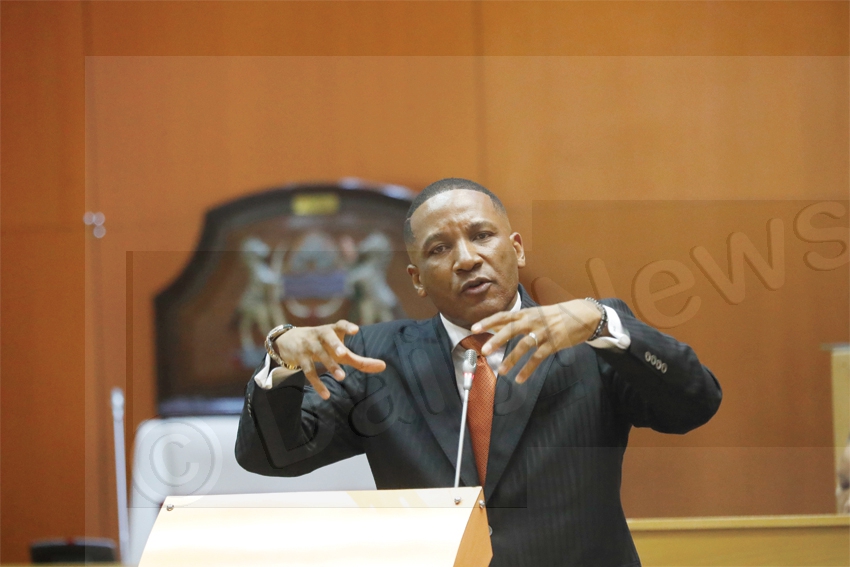
The establishment of a Constitutional Court is an important step in developing Botswana’s constitutional democratic system, and in strengthening the judicial process, President Advocate Duma Boko has said.
Contribution to the Constitutional Amendment Bill that has been tabled before Parliament on Monday, President Boko ventilated the argument that the Constitutional Court would be an important instrument in developing the nation’s legal process.
The President said the court was essential to the protection of the rights and providing an avenue for recourse of everyone resident in Botswana.
It would clearly delineate a legal route and platform where constitutional matters were handled with urgency, consistency, and authority, the President Boko said.
He added that by ensuring that institutions operated within the confines of the constitution, such an institution would uphold the rule of law and further provide strong protection for vulnerable groups, promote fairness in governance and ensure accountability.
In countering the argument that not sufficient consultation had been done with the public and societal stakeholders, President Boko pointed out that among the findings of the 2022 report presented by the Presidential Commission into the Review of the
Constitution, the Dibotelo Commission, was that public opinion was in favour of establishing a Constitutional Court.
Outlining the historical path Botswana undertook towards its constitution, President Boko said the Order in Council of May 9, 1891 declared Bechuanaland a British Protectorate, and over the following century, the British Parliament proclaimed in August 1966 to grant Bechuanaland independence as the Republic of Botswana.
This was after the 1963, Lobatse Conference and the Malborough House Conference held in London in February 1966 agreed to the terms of Botswana’s independence and basic tenets of her constitution.
But, minority ethnic groups and vulnerable groups including women were not represented at Lobatse and Malborough House, President Boko argued and the country thus needed a broader, inclusive constitutional review process that would involve the views of a diverse sector of society.
He said the Constitutional Court would be the first step in creating an avenue where any party felt aggrieved by the constitutional review process could find a fair arbitrary process. President Boko noted that the Botswana constitution had a Bill of Rights, Section 3 to 16, which protects the fundamental rights and freedoms of the individual, including the rights to life, personal liberty, protection from inhuman treatment and the freedoms of conscience, expression, movement, association and assembly.
This, the President pronounced was international best practice flowing from the Universal Declaration of Human Rights and other international instruments that provided for life, liberty and equal protection before the law.
Such are sacrosanct clauses that needed to be protected as the constitution is amended, President Boko said, in order to ensure that as the country became more inclusive, basic rights remained protected.
He saod Section 18 of the Constitution already provided for the enforcement of protective provisions.
“Furthermore, the past precedent of the judgment flowing from Attorney General of Botswana versus Unity Dow case is that the Section 3 provision that ‘every person in Botswana is entitled to fundamental rights and freedoms’ is legally binding and not a mere preamble.
Nonetheless, Botswana still requires a Constitutional Court,” the President argued, pointing out that the Aguda Commission led by Justice Akinola Aguda (1923-2001), a Nigerian jurist and former Chief Justice of Botswana had also recommended that there should be a Supreme Court established in the country; with the Dibotelo Commission later pointing to public opinion being in favour of a Constitutional Court. ENDS
Source : BOPA
Author : Pako Lebanna
Location : GABORONE
Event : Parliament
Date : 02 Dec 2025
Related News
13 Oct 2026

13 Oct 2026
First aid vital in mining operations
13 Oct 2026
New Employment Act milestone for Botswana

12 Oct 2026