


BOU UNISA implement strategy
20 Sep 2022
Botswana Open University (BOU) and University of South Africa (UNISA) recently hosted a joint two-day regional model symposium as part of implementing their internationalisation strategy and partnership.
The symposium, held in Maun, attracted experts from other universities to discuss reflections on the regional models, exchange experiences on the regional model establishment, operation and keys to success within a specific context.
It involved sharing and interrogation of nine regional models, typical case studies from universities from Botswana, the Caribbean, India, Namibia, South Africa, Turkey, United Kingdom, Zambia and Zimbabwe.
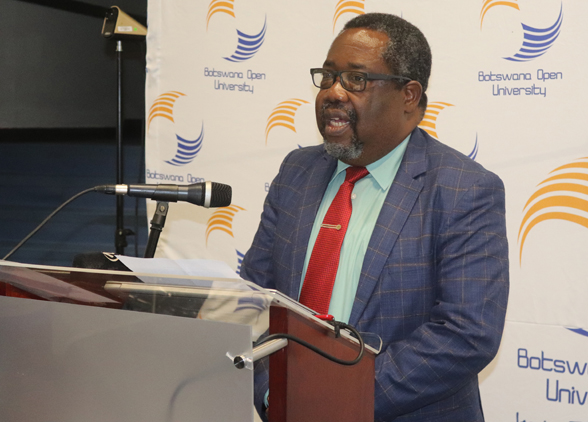
Giving an overview of the symposium, Botswana Open University deputy vice chancellor, Student Services, Dr Godson Gatsha said it was conceptualised during the quality audit of University of South Africa Registrars’ portfolio, where the need for further benchmarking of University of South Africa’s regional model was discussed, in light of a fast changing teaching and learning environment due to several factors.
He mentioned factors such as the impact of the current disruptive technologies, COVID-19 pandemic, which ushered in the new normal, the changing learner profiles, expectations and needs, the Sustainable Development Goals (SDGs) calling for not leaving anyone behind as well as the emergence and demands of the 4th and 5th Industrial Revolutions.
Participants, he said, would learn from sister universities, benchmark and get takeaways that could make a difference in promoting excellence in the academic project of any of the participating universities.
In addition, Dr Gatsha said the forum would enhance quality and credibility of programme offerings and learner support services within a context-bound regional model.
Botswana Open University deputy vice chancellor; Academic Services, Prof. Kgomotso Moahi said the university’s regional model had always played a major role in the delivery of open distance learning (ODL) in Botswana.
ODL, she said, was by nature designed to contribute to social and economic development by reaching far and wide, and seeking to address inequalities in access to quality education.
Furthermore, Prof. Moahi said open distance learning in Botswana found a fertile ground as in the country’s educational system and practice, the regions had always played pride of place, both in the way resources were shared and also in the way educational programmes were implemented, using regional representation as a pivotal point.
She noted that to that end, education centres were geographically dispersed across the nation, as regional educational zones, adding that regional directors thus provided leadership and pushed the agenda of the Ministry of Education and Skills Development.
She said the symposium came at a time when major growth had been seen in the fortunes of open distance learning across the globe.
Prof. Moahi said even before COVID-19 struck, with its own rationale for the mandatory use of ODL as an educational route, a report on a 12-country study they had conducted had indicated that 23 million students were studying various courses through ODL.
With such high enrolment figures, she said exploring regional models became an appropriate area of discourse.
Prof. Moahi said there was no doubt that the use of information and communications technology had a lot to do with ODL growth and enhancement.
The COVID-19 emergence, she said, had undoubtedly promoted online learning in many parts of the world, noting that it would be interesting to see how the growth and the related promotion of the 4IR expectations informed the regional models of practice in the ODL institutions across the globe.
Botswana Open University, she said, had increased use of technology in the academic delivery process, adding that the issue at hand, therefore, was to interrogate the impact and implications presented by the use of technology to the current regional model.
Vice principal, Strategy, Risk and Advisory Services from UNISA, Prof. Khehla Ndlovu implored sister universities to provide substantive interventions to address challenges faced by open distance learners.
He said at University of South Africa they experienced challenges such as increased dropout, noting that students enrolled were unemployed, while some came from disadvantaged families.
Lack of access to technology, he said, disadvantaged students, especially those from rural areas, where there was no connectivity.
Prof. Ndlovu also called for regional hubs of learning to be configured in a manner that improvedd learning processes.
The symposium was held under the theme: Refining Regional Models in a Changing Teaching and Learning Academic or University Environment. ends
Source : BOPA
Author : Esther Mmolai
Location : MAUN
Event : Symposium
Date : 20 Sep 2022
Related News

03 Aug 2026

03 Aug 2026
Child Support Grant commences
03 Aug 2026
Taskforce assesses social protection programmes
03 Aug 2026
BCL liquidation costs near P2bn

03 Aug 2026