


Online GBV needs conclusive action
04 Sep 2022
Ending gender based violence (GBV) has been among the top of government’s priorities and now collaboration and action remains key in conclusively dealing with the new, yet not-so-new challenge of its online form.
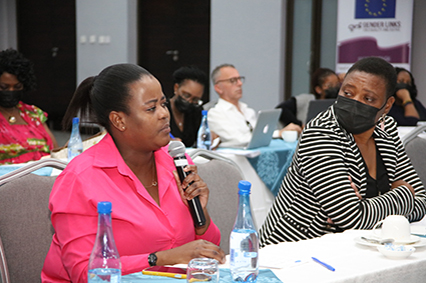
Speaking at a roundtable hosted by Gender Links and Cybersmart Botswana recently, deputy permanent secretary in the Ministry of Communications, Knowledge and Technology, Mr Cecil Masiga said the seriousness of online GBV on victims and society as a whole, challenged all to take action and curb it once and for all.
The roundtable was hosted to look at the study on the prevalence of online gender based violence (OGBV) and move toward curbing it.
“GBV is already a matter of serious concern to government and its prevalence in digital spaces, only worsens an already worse situation,” Mr Masiga said.
He thus commended Gender Links for seeing the need to embark on the study on prevalence of OGBV in Southern Africa, a foundation on which he said all must stand to put an end to the social ill.
He said findings of the study, which was conducted in Botswana and seven other African countries, should give an understanding of the depth of OGBV in Botswana.
He added that in his development agenda; the Reset Agenda, President Dr Mokgweetsi Masisi had prioritised digital transformation as a vehicle through which he sought to advance the nation towards being a knowledge-based society.
“It is for this reason that government has embarked on a digitalisation drive that includes several initiatives such as Internet connectivity projects in rural areas and schools around the country as well as e-government services,” said Mr Masiga.
However, he said, as much as it can contribute to societal advancement, the Internet, if not used meaningfully, can present serious risks to the society.
“Whether it is as a result of cyber bullying, body shaming, sexual harassment or hate speech, OGBV can be far reaching and have dire effects on victims.
There is a common saying that ‘what goes online, stays online’.
This means victims of online abuse can suffer damage for long periods of time, if not forever, because of the nature of the Internet,” he said.
Mr Masiga indicated that in the digital era, the economic growth was dependent on a safe and secure cyberspace.
“Our learners must use the Internet to learn and grow without the fear of being violated.
The business community must carry out their transactions without worrying about cyber criminals and we must all enjoy the convenience of technology unhindered and without fear,” he said.
As such, he said government had come up with interventions meant to protect the society in the digital space, and therefore challenged all to make meaningful contributions, saying, ‘it is only through joint efforts that we can truly end OGBV’.
For her part, the Chargee d’Affairs at US Embassy in Botswana, Ms Amanda Jacobson also highlighted that OGBV was endemic as it affected all communities, not just in Southern Africa, but globally, including in the United States.
Ms Jacobson said in the US, about one in four women and nearly one in 10 men reported being impacted by sexual or physical violence, and/or stalking by an intimate partner.
“Globally, one in three women across their lifetime are subjected to physical or sexual violence by an intimate partner or sexual violence from a non-partner,” she said.
She also indicated that growing up we did not know that alongside its many positive attributes, the Internet would become another vector for violence against women because it did not exist or was in its infancy.
“To address online abuse and harassment, domestically and globally, we will convene a US government task force and seek input from leading experts to produce recommendations for preventing and improving the response to technology-facilitated gender based violence,” she said.
Such efforts, she said, would include focusing on addressing cyber stalking, non-consensual distribution of intimate images as well as the use of the Internet as a tool of abuse, to intimidate and silence women, including politics, journalists and activists.
Ms Jacobson, therefore, urged all to continue working together to develop and strengthen national and global policies to end the scourge of OGBV, support survivors through comprehensive service provision and intensify prevention efforts. ENDS
Source : BOPA
Author : Naomi Leepile
Location : GABORONE
Event : roundtable
Date : 04 Sep 2022
Related News

05 Aug 2026
05 Aug 2026
More women join ranks of game rangers

05 Aug 2026
Prisons harvest exceeds P2million
05 Aug 2026