


Zimbabweans on jailers training mission
25 Jul 2022
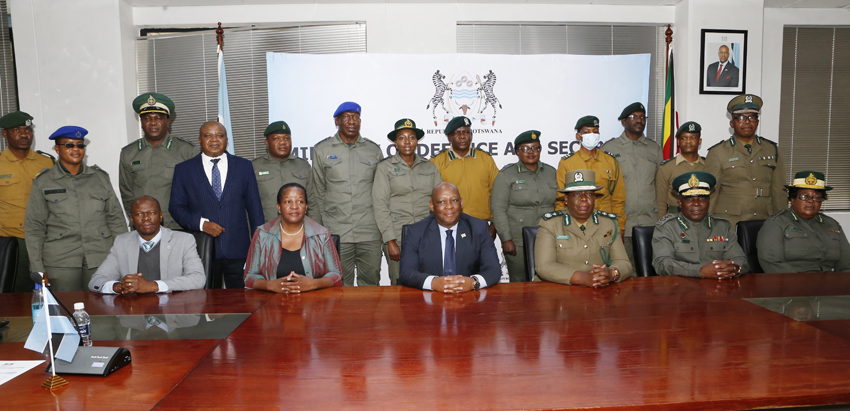
Botswana is aiming for zero recidivism and will continue to introduce programmes aimed at improving prisoner rehabilitation and reintegration of ex-offenders into mainstream society, justice minister Mr Kagiso Mmusi said Friday. He was speaking to a delegation from Zimbabwe Prisons and Correctional Services, which was led by commissioner Mr Moses Chihobvu that paid him a courtesy call.
The Zimbabweans are in Botswana, for a four-week period, during which they will train Botswana Prisons Service officers. Minister Mmusi said the collaboration was one among many existing between Botswana and Zimbabwe.
The two countries had been working well together to curb crime and close security gaps facing them, the latest of which was dealing with cattle rustling in Bobirwa. No country could succeed on its own without the support of its neighbours, he said.
“We believe that working together will enhance our capabilities as we learn from each other,” said Minister Mmusi, who also called on the Zimbabwean trainers to not simply train, but to also learn in the process as well as provide advice beyond their scope of engagement.
“Go the extra mile, do not only focus on what you are here for, pinpoint areas that need improvement,” he said. The minister added that Botswana was determined to transform its correctional services to world class standards and enhance rehabilitation, and was eager to receive any input that could help in that regard.
Earlier on, prison’s commissioner Ms Diana Marathe had said when receiving the team to her office, that they would be responsible for capacitating her officers in detecting security breaches, closing gaps as well as handling internal threats that needed immediate response. “We want to smoothen our operational capabilities,” said Ms Marathe with regard to the training that will be held at prisons college in Mahalapye.
She added that crime was evolving and rejuvenating anti-crime systems and strategies was necessary, and in the case of prisons, ensuring that criminals changed their ways. Ms Marathe said the training would further create some level of awareness, help officers to handle challenges as well as strengthen mechanisms to ensure that both prisoners and officers were safe.
She said as neighbouring countries and SADC member states, Botswana and Zimbabwe were committed to supporting each other through available structures and programmes for prisoner rehabilitation, hence the collaboration. Commissioner Marathe said the training would also include protocol and etiquette as well as establishment of a prison police unit, which she said was necessary to address internal challenges.
For his part Mr Chihobvu said when responding to Minister Mmusi that his team were in Botswana to also learn. “[We’re] here to equally learn from our counterparts in Botswana,” he said. He added that despite limited resources, Zimbabwe had introduced a raft of promising rehabilitation programmes. Among these was the introduction of open prisons. He said the programme was introduced to remind convicts that they were not being cast out of mainstream society, but were rather undergoing rehabilitation to prepare them for a better life after prison.
He said the open prison rehabilitation programme gave inmates an opportunity to continually interact with society as they were attached to various organisations where they acquired skills that would help them to re-integrate into society.
Mr Chihobvu said through the programme, inmates were offered opportunity to visit their families during holidays. Security at open prisons was minimal and this was both a sign and assurance to inmates that incarceration was not punishment as perceived, but rather a platform for rehabilitation.
This went a long way in reshaping prisoners and thus reducing the number of repeat offenders. However, he explained that the programme was designed for inmates jailed for minor offences and who were deemed to be not a threat to society.
Mr Chihobvu also said the open prisons programme was particularly effective for female inmates, some of whom were nursing mothers. The platform offered them an opportunity to nurture their babies with the support of their families. Because the programme allowed families to be part of prisoner rehabilitation, it helped to lessen the burden of care on correctional services. ENDS
Source : BOPA
Author : Moshe Galeragwe
Location : GABORONE
Event : keynote address
Date : 25 Jul 2022
Related News

06 Aug 2026
05 Aug 2026
Zim foreign currency earnings rise sharply in H1
05 Aug 2026
More women join ranks of game rangers
05 Aug 2026