


KAZA elephant count next month
24 Jul 2022
The Kavango Zambezi Trans-frontier Conservation Area (KAZA-TFCA) will conduct the first ever Africa’s coordinated elephant aerial survey from August to October.
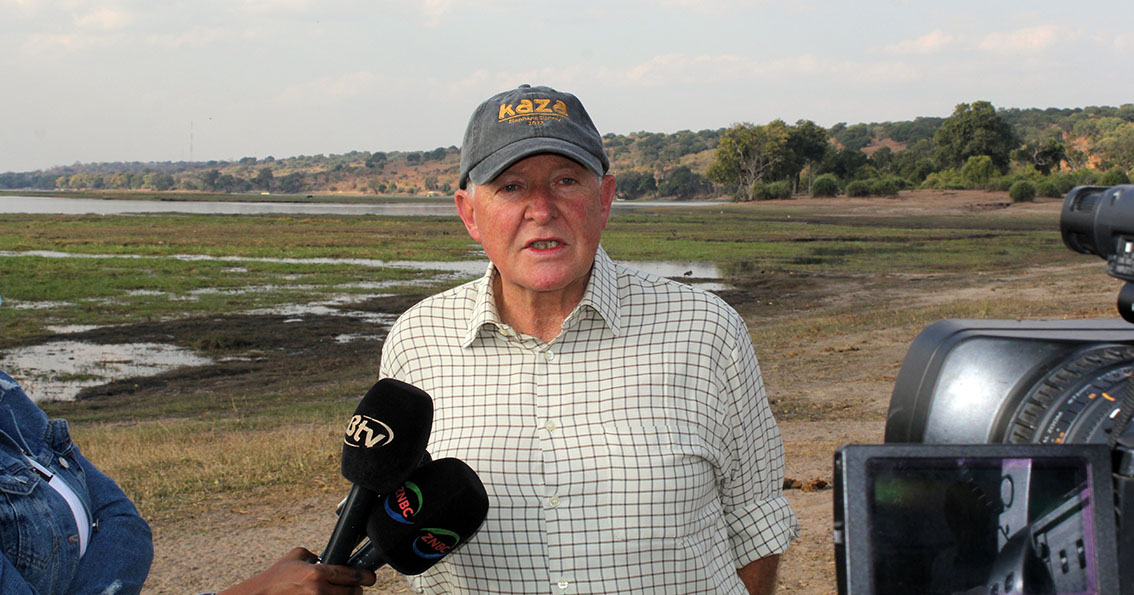
In an interview on the sidelines of a week-long preparatory workshop for a team of experts from the KAZA partner states, Namibia’s senior conservation planning advisor with World Wildlife Fund (WWF), Dr Russell Taylor, said the survey would determine the numbers and seasonal distributions of elephants and other large herbivores.
Dr Taylor said the survey, which was a priority action from the KAZA Strategic Planning Framework for elections, was developed following the 2019 Kasane Elephant Summit.
He said one of the objectives of the framework was to conserve and manage KAZA elephants as one contiguous population across the KAZA partner states, hence a synchronised aerial survey was a priority.
KAZA partner states are Angola, Botswana, Namibia, Zambia and Zimbabwe. He said the aerial survey was an immediate priority as its implementation was delayed by COVID-19 restrictions.
Dr Taylor said while individual countries conducted their own surveys at different times it was possible that some elephant were missed or double counted as they migrated across the KAZA landscape and counting them all at once would get the correct estimated number.
“Knowing the KAZA elephant population will inform management decisions by partner states and each country will better manage its animals because the survey will determine their distributions. The survey Is designed to cover all areas where elephants are, including communal land, forest land, protected areas, national parks, game reserves and safaris,” he said.
Dr Taylor added that during the survey, all known elephant ranges in KAZA would be sampled in proportion to the amounts of elephants, and intensive sampling would be done for high density areas while low density areas would have less intensive sampling.
He said since elephant population grew between four to five per cent per annum, it was advisable not to do the survey every year but at five to seven yearly intervals.
“A good time for conducting wildlife survey is during the dry season as animals are found concentrated at water sources and as leaves have dropped, the visibility is improved, unlike during the wet season when the vegetation is thick,” he said.
He also said in the upcoming survey use of aircrafts, cameras and other improved methods would be used unlike in the past 10 years where 200 telemetry colours were used on elephants across the landscape to monitor their movement.
He said the telemetry colour survey was done to find out where the elephants preferred to move in order to establish longer term corridors that were respected by people and elephants.
“It was established that veterinary fences in Botswana and Zimbabwe were a major deterrent to elephant movements, especially for the females and the young ones, as the male easily go across the fences,” he said.
He said the re-alignment of the fences would assist in depopulating elephants in areas such as Chobe and Hwange in Zimbabwe, adding permanent removal of the fences was not an option as the control of livestock diseases was also important.
Botswana’s survey focal person, Ms Malebogo Somolekae from the Department of Wildlife and National Parks (DWNP) said the outcome of the survey would assist partner states in land use planning and conservation of elephants and other large herbivores.
Ms Somolekae said the workshop would train nominated observers from the five partner states.
She said the workshop an earlier one held in August 2019 where the aerial survey standard was designed to ensure everything was systematic in terms of the actual counting and equipment used. KAZA secretariat programme manager, Ms Netsai Bollman said the survey was a significant undertaking in terms of the required level of coordination and integration between the partner states.
Ms Bollman said the survey was fundamental to KAZA as its outcomes would help in dealing with conservation issues and tourism development.
She said the KAZA population was one of the most significant in the world as the landscape was home to more than half of the African savannah elephant with an estimated population of 220 000. “The survey will give accurate estimated population as the management of KAZA elephants require a certain level of detail and understanding,” she said.
She added that the KAZA Strategic Management Framework was aimed at promoting peaceful and successful co-existence of people and wildlife and the outcome of the survey would assist in achieving such.
For his part, Mr Darren Potgieter, who is the aerial survey coordinator, said during the survey, seven aircrafts would be flying at the same time starting in Zimbabwe sifting across the 519 000 square kilometre KAZA landscape. Ends
Source : BOPA
Author : keamogetse Letsholo
Location : Kasane
Event : Interview
Date : 24 Jul 2022
Related News

06 Aug 2026
05 Aug 2026
Zim foreign currency earnings rise sharply in H1
05 Aug 2026
More women join ranks of game rangers

05 Aug 2026