


Women in Surgery Botswana walks the talk
13 Apr 2022
After giving birth to her first child, Ms Chedza Segakolodi felt dizzy, disoriented and weak.
However, she was soon released from a private health institution and since it was her first labour experience, she thought she would get better with time.
After two days of no change and being told that she looked pale, she was taken to Princess Marina Hospital, where she was immediately admitted and told she had lost a lot of blood.
A blood transfusion did the trick as she felt much better the following day.
Ms Segakolodi has been donating blood ever since.
She also knows that there is a shortage of blood in the country and has encouraged his friends, family and relatives to donate blood.
Statistics has shown Botswana needed at least 45 000 units of blood per year, but the country is struggling to meet the demand.
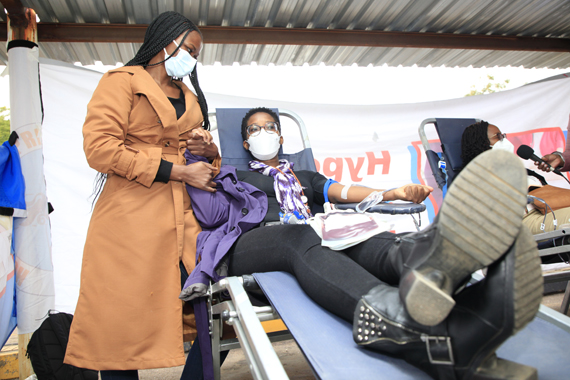
Having observed the trend in their line of profession, Orthopaedic surgeon, Dr Kefilwe Benjamin and general surgeon, Dr Nkhabe Chinyepi, who are members of Women in Surgery Botswana, have launched a mission to fill the country’s blood reservoirs.
As such the two have launched an initiative to collect blood for the National Blood Transfusion Services (NBTS) and hospitals.
They came up with the blood drive initiative to encourage other healthcare workers and the public at large to normalise donating blood.
In an interview during a blood drive campaign at recently, Dr Benjamin said blood transfusion was a crucial component in the management of patients injured in road accident and having surgical conditions, malignancies, pregnancy complications and other medical conditions.
Dr Benjamin also said they had had to postpone surgeries because of unavailability of blood in store.
She said as first hand users of blood, they organised the blood drive to lead by example.
Dr Chinyepi noted that she was once forced to cancel some operations because there was no blood in the bank, adding that there was no alternative to human blood.
For her part, an autologous at Princess Marina, Ms Kelebogile Molatlhegi said donating blood was not resonating well with many Batswana.
Ms Molatlhegi said some people cited the fear of needles as reason for not donating.
She, however, stressed that adequate supply of safe blood was needed in all healthcare facilities to meet the demand.
“Some patients are forced to wait for blood and it is worrisome,” she said.
She said patients needed blood for different medical conditions such as cancer.
She added that the need was high during holidays as there were many road accidents.
She urged Batswana to donate blood at least three times a year.
She also called for a healthy lifestyle, saying good nutrition would help people to be in a good position to donate blood.
She highly recommended eating food rich in iron.
Ms Molatlhegi said donating blood was also beneficial to the donors as they were educated on living a healthy life and that they went through a screening process where their hemoglobin, blood pressure and weight were checked.
For Mr Nametso Sebele of Tlokweng, the sight of his friend suffering because of low blood condition motivated him to be a blood donor.
As for Ms Bokang Kegorogile, 27, she only hopes to be able to donate sometime in the future as her weight precludes her from donating blood.
For one to donate blood they have to be between 50 and 120kg.
Ms Kegorogile highlighted that people taking antibiotics or anti-fungal medication were not allowed to donate blood during the course of administration.
She, however, said those on contraceptives or nutrition tablets were allowed to donate blood.
Ms Kegorogile also noted that men were donating blood more than women.
She said there were circumstances that hindered women from constantly donating blood such as pregnancy and the bleeding they endured when giving birth.
Furthermore, she said women were not allowed to donate blood while menstruating, adding that even if one had a miscarriage in the past six months they were excluded from donating blood.
Asked why they did not provide monetary incentives to encourage donors, Ms Kegorogile said the World Health Organisation protocols stated that blood donations were to be in all circumstances voluntary and non-renumerated.
“One is giving a patient something that cannot be bought with money,” she said.
She said they gave donors incentives such as caps and t-shirts if they were available and biscuits and juice after donating to boost their energy.
Principal scientific officer at NBTS, Ms Chandapiwa Kefilwe said they managed to collect 23 000 units of blood in 2020 and 24 000 units in 2021.
If all Batswana could emulate the example of Ms Segakolodi and Mr Sebele by donating blood at least three times a year, the country would easily store enough blood for any eventuality. ends
Source : BOPA
Author : Lesedi Thatayamodimo
Location : GABORONE
Event : campaign
Date : 13 Apr 2022
Related News

07 Aug 2026
Xiplomacy Hosting the world building the future

07 Aug 2026
Xiplomacy Pursuing the greater good for all
06 Aug 2026
Gaolathe inspires learners to aim high
06 Aug 2026