


President Masisi Reflections on four years inoffice
05 Apr 2022
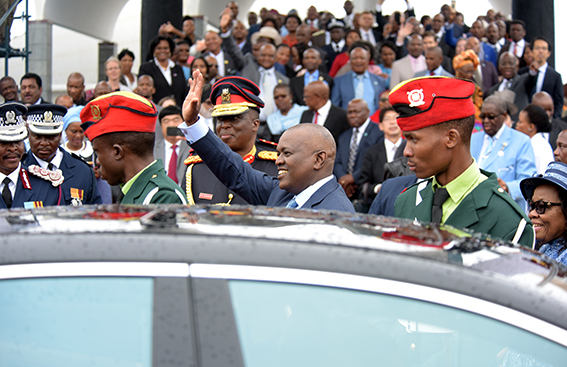
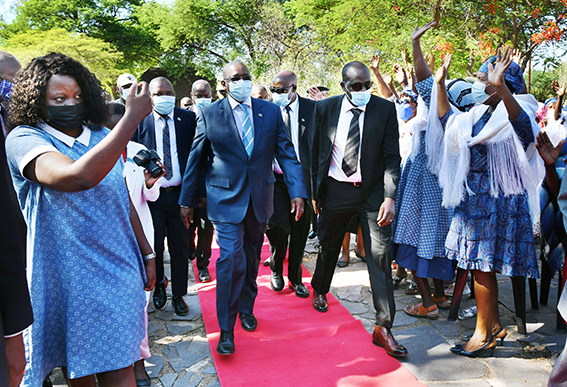
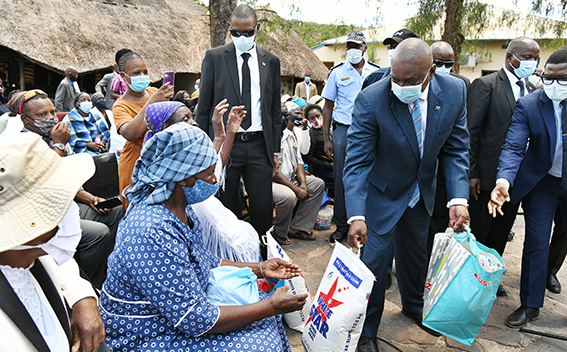
Four years on from President Dr Mokgweetsi Masisi’s swearing in ceremony, which ushered him into State House as Botswana’s fifth President, we reflect on the key moments of the president’s time in office so far; And his achievements since that rain soaked Easter Sunday morning in 2018.
To help us in reflect we spoke to Acting Permanent Secretary, Government Information and Communication Systems, Mr John Dipowe.
Half of the four years of the President’s time in office, were really taken up by the COVID-19 challenge. Nonetheless, under his leadership the country has managed to arise from that gloomy situation and is moving on, in the right direction. The President, he said, had provided a roadmap for the country to follow.
“During his inauguration address on April 1 2018, he outlined some of his priority areas, and again in 2019 at his second inauguration after the general elections he reiterated them with additions,” Mr Powe told BOPA in a wide-ranging interview.
Transformatio Agenda
He said the President prioritised a transformation agenda, including the setting up of the National Transformation Strategy Team to work on a plan for the country to improve its outlook with regard to partaking in the Fourth Industrial Revolution and achieving the goals of the National Vision 2036.
To that end the President Masisi had placed digitisation high on the national agenda, to drive government, economy and society towards the use of digital technology through SmartBots and egovernment initiatives.
These would in the long term lead to most government services being offered online, Mr Dipowe said. The country has also had an extensive digital investment, with Botswana Fibre Networks (BOFINET) investing P170 million in the provision of wifi networks in schools, clinics and dikgotla, complimented by large-scale rural electrification project, he said.
Participatory democracy has improved and women empowerment has been taken up on the agenda, with the appointment of the country’s first female Finance minister, first female Permanent Secretary to the President, First female Deputy Permanent Secretary to the President and first female Prisons Service commissioner among other high profile appointments.
The President and First Lady, Ms Neo Masisi, have also been on the forefront of the public battle against the scourge of gender-based violence, Mr Dipowe noted. Through the Reset agenda, one of the priorities became saving Batswana from the Covid-19 pandemic, with the government mobilising resources to that end.
This has seen government procuring enough vaccines to cover the whole population. The result: Botswana, according to the World Health Organisation, has one of the highest vaccination rates in Africa.
Consequently, the number of deaths from COVID-19, at about 2600 people, though sad and regrettable, is roughly 0.1 percent of the population.
That represents one of the lowest Coronavirus death rates globally both in real numbers and percentage of the population since the onset of the pandemic, he said.
Employment
“Employment, particularly for the youth is a priority area, which is why the President has vigorously pursued foreign direct investment (FDI). The government has looked to support the creative industry, including the establishment of the National Arts Council; a State Theatre is due to be constructed,” Mr Dipowe said.
We also spoke to University of Botswana lecturer and political analyst, Mr Leonard Sesa who said President Masisi has always stressed the importance of adherence to the rule of law, and consultative participatory democracy from the beginning of his tenure in office.
It was not surprising therefore when made consulted with various stakeholders in society, such as the media fraternity, trade unions, political organisations, conservation groups and communities affected by human-wildlife conflict.
“Now, the nation has opportunity to express how they feel about the constitution through the constitutional review exercise”, Mr Sesa noted.
He believes the President’s Reset Agenda, can achieve the desired mindset change for the civil service and broader society that would ensure better, more efficient service delivery.
“It’s also important to note the presidents focus on infrastructural projects that can yield high value addition to the economy, such as improving water and road linkages which will boost trade as well as improve livelihoods,” he said
These projects include among others, the improvement of the North-South water carrier pipeline, the Mmamashia-Gamononyane-Molepolole and Lobatse water projects. Not only would these provide potable water to communities that have had serious shortage of water for many years, but they will also enable industries such as the Lobatse Leather Park and Milk Africa to take off and generate jobs and income.
Road linkages include the conclusion of the Kazungula Bridge, which will boost trade in the Southern African region, as well as the improvement of domestic roads, such as the Gaborone-Boatle road, and the KT Motsete Road (Western Bypass) separated interchanges.
Mr Sesa said President Masisi has also gone out to rigorously seek foreign direct investment;
‘”the President recently opened the NantBotswana vaccine manufacturing plant, which is expected to generate jobs and lead to skills transfer. The Khoemacau Copper Mine and Selibe Phikwe Citrus project are examples of other job creation initiatives that were established as government boosts the investment climate and enables private sector participation, “he said.
Government has also introduced a new horticulture scheme where it pays 50 percent grant for agricultural initiatives to improve farming countrywide. At the same time government had offered protection to local farmers by suspending suspension of certain agricultural products to allow framers to grow their market.
He further noted the President unwavering support for the country’s small stock trade so much so that he secured an international market for that business. To further encourage small stock farming, he has been providing small stock farmers with rams and bucks by leading to better numbers and quality, and positively changing rural economies.
However, there have been challenges, said Mr Sesa.
In particular COVID-19 led to negative regression in the 2020-21 financial year, necessitating an Economic Recovery and Transformation Plan (ERTP) to resuscitate the country’s development path, he said.
“Unemployment, in particular youth unemployment has remained a challenge. With the price of food, fuel, electricity and other commodities having increased, there is also clearly a need for a better wage structure and improved income for both the public and private sector workers in order to withstand changes in the cost of living,” Mr Sesa said. ENDs
Source : BOPA
Author : Pako Lebanna
Location : GABORONE
Event : Moments of the president’s time in office
Date : 05 Apr 2022
Related News

07 Aug 2026
Xiplomacy Hosting the world building the future
07 Aug 2026
Xiplomacy Pursuing the greater good for all
06 Aug 2026
Gaolathe inspires learners to aim high
06 Aug 2026