


Commission weekly summary
06 Mar 2022
Batswana in the villages that the Presidential Commission of Enquiry into Review of the Constitution has so far consulted have been hailed for their positive response to the call to make an input in the constitutional review exercise.
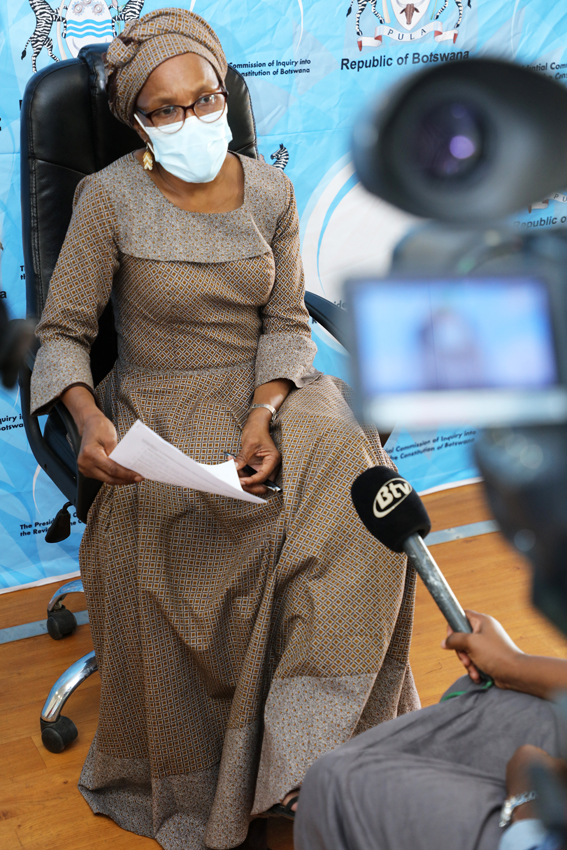
Summing up the work of the commission for the past week, head of its secretariat Ms Pearl Ramokoka said Friday that Batswana continued to turn up in good numbers for the consultative meetings.
Ms Ramokoka, who was speaking at the end of the two meetings held in Goodhope, said the good turn up by citizens was indicative of their desire to participate in reshaping the future of their country.
Highlighting some of the issues that arose in the past week, she cited care of children living with disability; polygamy and same-sex marriages; Gender-Based Violence (GBV) and the overall plight of women in society, as well as the role of bogosi as an institution.
Ms Ramokoka stated that in Kanye, parents and caregivers of children living with disability pleaded for the constitution to be alive to the challenges surrounding the upbringing of such children and therefore provide for ways to make their lives bearable and ease the burden of their care.
She said in Seherelela, caregivers decried the treatment that some people in communities extended to such children as some had been found to be unlawfully employing mentally challenged children as herdboys.
She said residents had thus proposed that the constitution should encompass issues of the welfare of children living with disability so as to protect them from undue suffering as well as unfair treatment from some within society. Still on children and their rights, the head of the secretariat noted that in some meetings some speakers had called for the law to provide for DNA testing upon the birth of a child to put to bed any doubts that may in future arise pertaining to its paternity.
She said the speakers had argued that doing so would, in addition to freeing men from having paternity forced on them, generally work in the best interests of the child.
On polygamy and same-sex marriage, Ms Ramokoka indicated that in the past week, the voice against the legalisation of the two practices had come out more vocal. Further to that, she said Batswana had also spoken against cohabitation and had stated that given its often-undesirable consequences, the law should shun the practice and disallow it altogether.
Ms Ramokoka said speakers in the meetings also complained about the rape of women and children and had proposed that upon conviction, perpetrators be sentenced to either life imprisonment or death.
On bogosi, she said, a plea was made for constitution to recognise the institution. She observed that speakers had indicated that while the constitution recognised Ntlo ya Dikgosi, it did not do the same about dikgosi and bogosi.
The proposal therefore, she noted was that dikgosi should be recognised and their role clearly spelt out.
Moreover, she said there had been calls for land administration to revert to dikgosi as well as for stocktheft cases to be put under the purview of the customary court system only. She added that some Batswana had also proposed that in cases where customary courts had sentenced offenders to flogging, the strokes should be administered on the backs as was in the past and not on the buttocks.
She indicated that proponents of the suggestion were of the view that ‘thupa ya mokwatla e ka thusa go laola tlhoka-kutlo’, meaning flocking on the back was more effective than on the buttocks, and could therefore bring under check the rampant lawlessness being experienced by communities. ENDS
Source : BOPA
Author : Keonee Kealeboga
Location : GOOD HOPE
Event : Tshekatsheko ya molaomotheo
Date : 06 Mar 2022
Related News

07 Aug 2026
Xiplomacy Hosting the world building the future

07 Aug 2026
Xiplomacy Pursuing the greater good for all
06 Aug 2026
Gaolathe inspires learners to aim high
06 Aug 2026