


New constitution should make Botswana safer
27 Feb 2022
While some sections under chapter two of the Constitution of Botswana state that everyone has the right to life and is entitled to fundamental rights and freedoms it seems majority of Batswana feel insecure and deprived of freedom due to the rising incidents of gender based violence, murder and rape among others.
This emerged during the ongoing consultative meetings into review of constitution held at Manyana, Moshupa, Suping and Molepolole’s Matlhalerwa ward espectively.
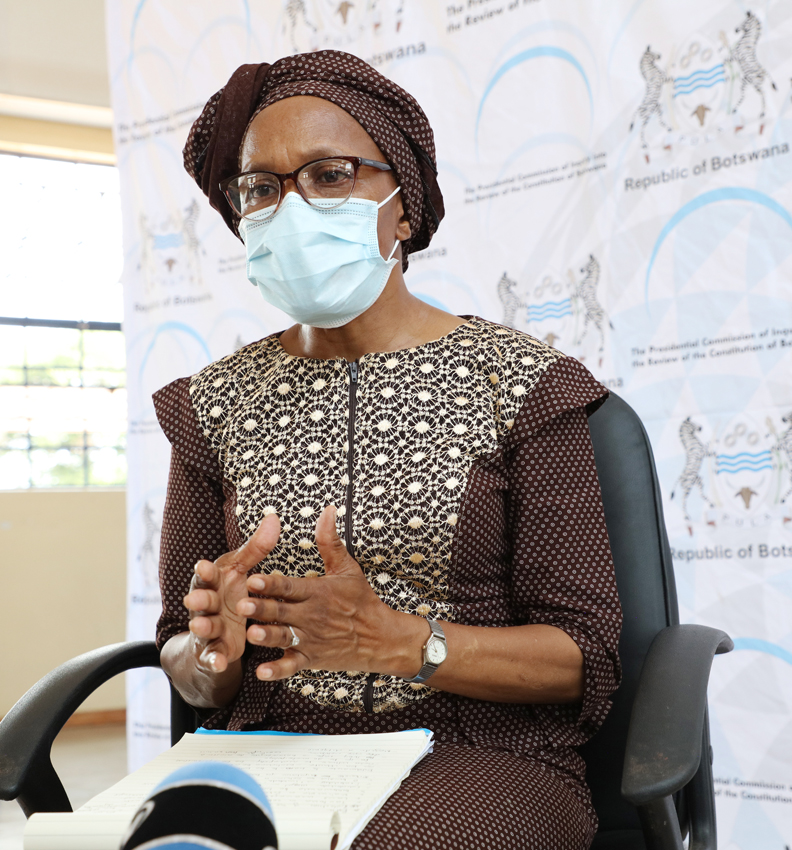
Giving a brief summary of the forth week of the meetings, the secretary to the Presidential Commission of Enquiry into the Review of the Constitution, Ms Pearl Ramokoka said the majority of residents expressed serious concern about their safety and called for the new constitution to promote security and protection of human rights.
In every village, she said, the twin issues of murder, and rape came up with residents proposing that the new constitution should consider castrating rapists.
She said while a few people wanted the death penalty scrapped because they felt it was not a deterrent, the majority of Batswana wanted the country to maintain it.
She said there were also repeated calls for review of the Children’s Act with a view to bringing back corporal punishment to curb rising delinquent behaviour among children.
Ms Ramokoka revealed Batswana felt children had become unmanageable and abusive to their parents. This was largely owing to what they perceived as too permissive a Children’s Act.
Therefore they needed a revised Act that would set limits to children’s rights.
Parents she said, made it clear they were the first line of defense of their children’s rights but it seemed the children’s rights were now violating theirs.
Ms Ramokoka mentioned that residents of Moshupa expressed concern that many of them were forced to abandon their fields because of a spate of attacks on elderly women and rising incidents of rape.
This, they said, did not augur well for food security that the government wanted the country to achieve. Residents wanted the envisaged constitution to provide absolute assurances for their protection from crime.
On other issues, she said residents called for the constitution to standardise bogadi across all tribes to curb cohabitation.
Residents expressed worry that bogadi had become expensive and created disputes between families as some parents charged too high.
While originally, the bride-price was a token of appreciation given by men who wished to appreciate the bride’s parents for providing them with a well-bred wife some parents had turned it into a business, they said.
Ms Ramokoka said two diametrically opposed schools of though emerged over the burning issue of DNA testing. The first comprised men who wanted the constitution to provide for compulsory DNA testing of every father.
The second comprised women who opposed the idea as unnecessary, except where the father denied paternity.
Ms Ramokoka also acknowledged that interest groups also came in good numbers.
Among these were people living with disability. These called for inclusion of specific sections in the constitution that catered to their needs and rights.
She said they argued that they were left behind in many areas of life and proposed that the constitution should have a provision of their representation in both councils and Parliament so that their voice could be heard and be incorporated in decision-making.
She said they complained about lack of services and restricted accessibility to available ones and suggested that the constitution should take into account their specific needs such as access when providing services.
Lastly, she appealed to traditional leaders to continue mobilising their communities to attend the scheduled consultative meetings in their respective areas. BOPA
Source : BOPA
Author : Esther Mmolai
Location : MOSHUPA
Event : Consultative meetings
Date : 27 Feb 2022
Related News

07 Aug 2026
Xiplomacy Hosting the world building the future

07 Aug 2026
Xiplomacy Pursuing the greater good for all
06 Aug 2026
Gaolathe inspires learners to aim high
06 Aug 2026