


Lentsweletaus peculiar perspectives
14 Feb 2022
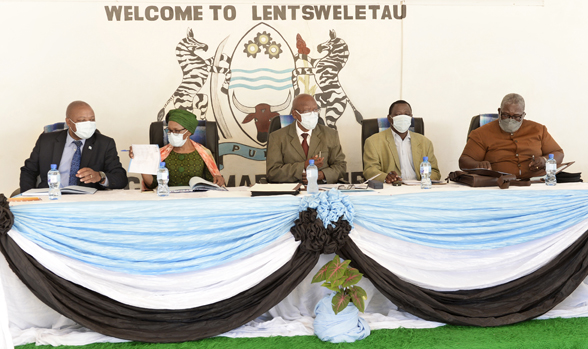
On its ninth day of consultative meetings, the Presidential Commission of Enquiry into Review of the Constitution of Botswana yesterday went 60 kilometres North of Gaborone, to Bakwena’s second ranked royal village of Lentsweletau, to get their thoughts on the constitution and how they wanted it enhanced.
The people at this kgotla meeting were from Lentsweletau itself and its satellite villages and settlements of Kopong, Kgope, Mahetlwe, Ramankhung, Ditshukudu, Hatsalatladi, Medie, Dikgatlhong and Kweneng, and the director allowed at most two speakers from each village to speak.
The suggestions were for the most part similar to those made by Batswana in the previous eight villages that the Commission has so far consulted. However, a few altogether new ones or occasionally repeated suggestions were brought forward.
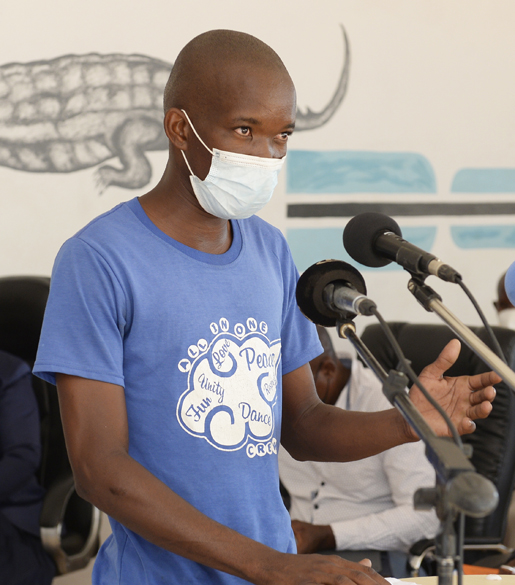
Mr Ntsima Ntsima of Medie, who identified himself as a young person called for independence of government media from the Office of the President, and for it to convert into a statutory body.
“A bobegadikgang ja puso bo tswe mo Ofising ya ga Tautona, go re bo tle bo kgone go bega dikgang tsa jone bo sosologile e bile bo sa tshabe sepe,” he said, explaining that releasing public media from direct government control would allow it to report freely and without fear of victimisation.
Government media includes, Daily News, Kutlwano, Radio Botswana 1 and 2 as well as Botswana Television. Mr Ntsima also called for a law on declaration of assets by anyone holding a position of leadership in government.
“ A yo mongwe le yo mongwe hela yo o tsenang mo pusong, yo o etellang lehatshe le, a supe gore o na le eng ga a na eng; E se re ka tsela nngwe hela re ntse re itse gore o na le tshimo e le nngwehela ko Medie, e re ha a tla go tswa mo pusong o bo o hitlhela e le gore Medie ole wa gagwe otlhe,” He said. The nub of his suggestion was that a declaration of assets law would make it mandatory for leaders to account for any extraordinary amassing of property during their tenure. The law would therefore help to prevent corruption and looting of state property.
Mr Ntsima also repeated calls made by Batswana in other villages, namely that the Independent Electoral Commission (IEC) should not report to the Office of the President and that Section 41, which forbids prosecution of the President under any circumstances, should be repealed.
It was a suggestion that Lentsweletau Kgosi, Morulaganyi Makgasane had also made earlier on when welcoming everyone to the meeting. As has been the case in all the other villages, Mr Ntsima’s suggestions on the IEC and presidential immunity received resounding applause from the meeting.
Kopong resident, Mr Edwin Lunga proposed that Botswana should be divided into provincial governments, tasked with development of their jurisdictions.
He suggested also that former presidents should be altogether barred from active participation in politics, as they remained public officers, whose welfare was the responsibility of the state.
He also called for a time limit on regency, which he suggested should be a maximum of two years after attainment of legal age by the rightful kgosi or after he or she had adequate capacity to lead.
Mr Lunga also suggested that Ntlo ya Dikgosi should be accorded the same respect as Parliament. He pointed out the fact that Parliament deliberated for a longer time while dikgosi had a very short time to meet, as proof that Ntlo ya Dikgosi was not given the same respect.
Another speaker, Mr Mothibi Keanyaditse of Kgope suggested that the Vice President, and the two ministers of Foreign Affairs and International Cooperation and Finance and Economic Development, should not be required to have a constituency.
He explained the Vice President, as the number two citizen, deputised the Head of State during his absence. Therefore, the Vice President should not divide his attention between national duty and his constituency, he said. The two ministers should similarly be unfettered by constituency duty for them to be effective in their duties.
“The minister of Foreign Affairs spends a lot of time travelling. The person has no time to attend to their constituency…the minister of finance being responsible for the public purse also might be biased towards his or her constituency,” he said. Mr Benjamin Ramogapi said the current constitution gave a sitting president too much executive power, which he said pervaded sections 30 through 127 of the constitution.
“Almost 90% of the constitution talks about his executive powers. Giving a sitting president so much power is dangerous,” he said.
“Jaaka a itlhopetse lekoko ga re itse gore a report ena e tlaa katelwa ka fa tlase ga mmu jaaka re ne ra bona kgang ya segosi jwa Sekwena fa ba ne ba lwa le Bakaa. Report ya teng e gatilwe. Kgang ya Kgomokgwana le yone e epetswe ka mmu. A lekoko le bege ko Palamenteng go supa fa re batla go gatela pele,” he said, indicating that previous reports of presidential commissions had died a natural death, and the only assurance the nation could get that such commissions were up to any good, was if they reported to Parliament.
Mr Ramogapi said the courts had disregarded Section 3 of the constitution that stipulated fundamental rights and freedoms of individuals when delivering judgment in the landmark same-sex relationship case, as they failed to consider public interest.
Further, he said it was also in the public interest to maintain the death penalty regardless of the international community’s objections.
He spoke strongly against a ‘toothless’ Ntlo ya Dikgosi, which he said had no legislative powers, and suggested it be given such.
Mr Oletile Serebotseng of Dikgatlhong suggested that members of the winning party, and not the Head of State should vote for the Vice President, and not the President, as was currently the case.
“No one understands the criteria used in the appointment of the Vice President. It also encourages corruption as one of two scenarios may play out: perhaps the President appoints him/her on the basis of friendship or he or she bribes the president to appoint him,” he said.
Lentsweletau resident Mr Lobbi Makgasane supported Mr Ramogapi’s suggestion that Botswana should maintain the death penalty, which many of ‘our neighbouring countries envy us for’. He also proposed against direct election of the President because, “where the President comes from a Parliamentary minority, he still must endorse decisions of the house, and he may simply be reluctant to do so, which will stall development.”
He further suggested that Members of Parliament should serve for only two terms as anything beyond that resulted in ineptitude. Kgosana Ms Goitseone Mhaladi-Kokole of Ditshukudu recommended that the law must recognise that although magosana were ranked the same, those in outlying villages had much more work than those in major villages.
“Where the requirement is that we should work two days a week, those of us working in smaller villages do not have that luxury. We work throughout the week, yet we receive the same allowance,” she said, and suggested the government should duly rank and compensate such magosana.
She argued that in assigning villages and settlements a status, the constitution should not only consider that the immediate settled-up area comprising the school, clinic and kgotla had a population of 500 people.
“A go akarediwe batho ba ba tswang mo metseng ya masimo, le metsana e e dikologileng motse oo,” she said, meaning consideration must also be given to smaller settlements and villages whose residents received assistance from the main village. This, she argued, would help in determining proper ranking of those villages’ chiefs.
Other recurring suggestions were that dikgosi should be given back the power to allocate land, or at a minimum, work together with land boards in land distribution; that corporal punishment on the bare back be reintroduced for expeditious dispensing of justice, curbing wayward behavior as well as to reduce the number of people sent to prison; that the constitution should be translated to Setswana and be made accessible to people; and that the government must criminalise same sex-relationships. Ends
Source : BOPA
Author : BOPA
Location : Lentsweletau
Event : Commission Review
Date : 14 Feb 2022
Related News

07 Aug 2026
Xiplomacy Hosting the world building the future
07 Aug 2026
Xiplomacy Pursuing the greater good for all
06 Aug 2026
Gaolathe inspires learners to aim high
06 Aug 2026