


Policy in place to improve quality of life
25 Nov 2021
Government will implement a National Population Policy to improve the quality of life and standard of living for Batswana in January 2022.
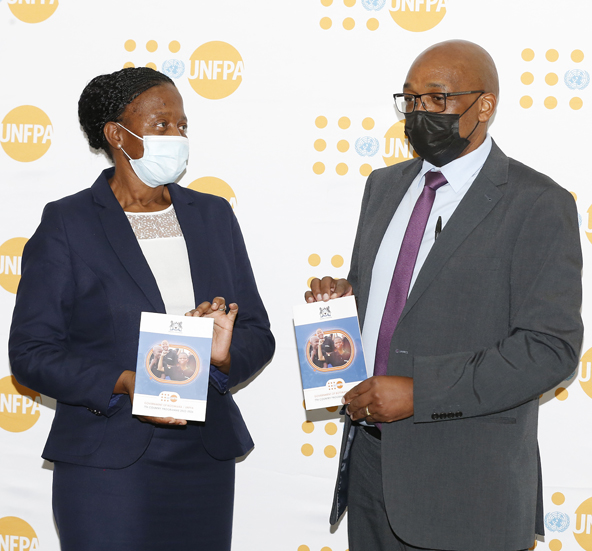
Speaking at the launch of the Botswana/ United Nations Population Fund (UNFPA) Document 2022-2026 in Gaborone on Wednesday, finance and economic development ministry’s- Macro Economics Policy, deputy permanent secretary, Ms Boitumelo Gofhamodimo said the policy was target was to reduce in population growth, lowering fertility, morbidity and mortality as well as balancing population distribution rates.
This, she said, was successfully done with expert advice and guidance from United Nations Population Fund (UNFPA).
“At the time of developing the policy, population growth was considered too high, growing at the rate of 3.4 per cent during the period 1981 – 1991. This was considered detrimental to economic development, threatening government’s capacity to adequately deliver services, such as education and health to its people,” she said.
Ms Gofhamodimo said between 1991 and 2001, and 2001 and 2011, the rate of population growth declined by 2.4 per cent and 1.9 per cent respectively which marked a milestone in efforts aimed at restraining population growth, economic growth, improvement in service delivery and other aspects to improve the quality of life and standard of living.
She further said as a result of the tremendous investment made in Sexual Reproductive Health and Rights, the country undergoing a window of opportunity to reap a demographic dividend from its population due to the total fertility decline in the country.
In line with the goal of attaining high income status by 2036 as articulated in the country’s vision, government was currently in the process of developing a Demographic Dividend Roadmap to help the country to not only reap a dividend, but also to maximise efforts to do so, she said.
She indicated that despite having made strides in restricting population growth, the Revised National Population Policy of 2010 continued to acknowledge the importance of sexual and reproductive health as one of the key population issues.
“We are therefore grateful that the seventh Botswana/United Nations Population Fund Country Programme document, will prioritised the sexual and reproductive health and rights, advancement of the gender equality agenda and population development for the next five years,” she said..
For his part, UNFPA Botswana, official, Mr Innocent Modisaotsile said the overall vision of the country programme document was to achieve universal access to sexual and reproductive health and rights with emphasis on young women, adolescent girls, persons with disabilities, sex workers amongst others.
According to Mr Modisaotsile this year marked the end of sixth cycle of cooperation between Botswana and UNFPA which started in 2017.
“One of the critical milestones in these past five years included the “march” to Nairobi in 2019, where the country joined 163 United Nations member states to recommit to the extra ordinary vision of the Programme of Action set forth at the International Conference on Population and Development in Cairo in 1994,” she said.
He said the country had committed at the Nairobi Summit on ICPD25 to continue addressing the topical issues and prioritised four areas, namely family planning, maternal health, gender based violence and data for accelerated action.
Mr Modisaotsile said that those commitments were aligned with the UNFPA transformative goals; ending preventable maternal deaths, unmet need for family planning, gender based violence and other harmful practices.
While progress had been made to improve sexual reproductive health and rights, Mr Modisaotsile said more still that to be done to be on track to achieve Sustainable Development Goal targets.
“We need to ensure that sexual reproductive health and rights,is a reality to everyone including a 10-year-old girl in Maitengwe, a 25-year-old disabled woman in Etsha 6 and a 30- year-old mother of five in Jao Flats,” he said.
However, Mr Modisaotsile said they were disheartened by signs of reversals of hard won gains in sexual reproductive health and rights, mainly due to the COVID-19 pandemic and had witnessed rising in Gender Based Violence and further marginalization of disadvantaged populations.
“I must hasten to point out that, the 2022-2026 country programme places gender equality and women’s empowerment at the center of the response as we do believe that SDGs cannot be achieved without fair inclusion of 50 per cent of the population,” he said. ends
Source : BOPA
Author : Taboka Ngwako
Location : GABORONE
Event : Launch
Date : 25 Nov 2021
Related News

07 Aug 2026
Xiplomacy Hosting the world building the future

07 Aug 2026
Xiplomacy Pursuing the greater good for all
06 Aug 2026