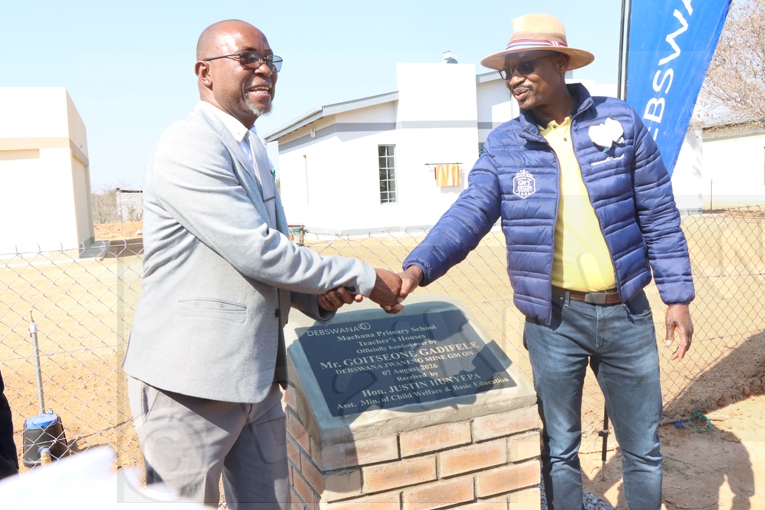
Policy review key to addressing challenges
27 Oct 2020
The tertiary education sector is experiencing challenges including low transition rates from secondary as well as mismatch between critical skills required by the economy and those produced by the education system.
Assistant Minister of Tertiary Education, Research, Science and Technology Mr Machana Shamukuni told a kgotla meeting at Tati Siding this week that to address the challenges and increase access to tertiary education, the Tertiary Education Policy had to be reviewed.
Additionally, he said, there was need to match training with industry needs together with retooling of skills in areas that had been identified as critical to improve the performance of the economy.
“There is also an urgent need to increase the utilisation of ICT especially in view of introducing online mode of teaching as recently dictated by COVID-19 responses,” he said.
Mr Shamukuni explained that his ministry was tasked with the development of human capital to ensure generation of knowledge, skills and competencies to power and drive economic growth for Botswana targeting youth aged between 16 and 35.
Botswana had therefore invested significantly in education and skills development with more than 25 per cent of the total annual budgets being allocated to education sector over the past two decades.
He said over five years, the Department of Tertiary Education Financing had spent an average of P2.4 billion annually on both tuition and students’ living allowances.
In terms of policy and legal framework, the ministry was in the process of developing a policy to guide and support tertiary education financing a well as to create a favourable policy environment.
Currently, he said, a draft had been developed and would be progressed to stakeholder consultations and ultimately submitted to cabinet.
Mr Shamukuni said access to tertiary education improved during NDP 10 with gross enrolment rate increasing from 47 889 in 2008/09 to 60 583 in 2015/16.
The increase compared favourably with the 17 per cent target for NDP 10 for ages 18 to 24, he said.
For this year, Mr Shamukuni said sponsorship was offered to a total of 8 543 new students out of which 1 002 were in the orphan and vulnerable children, remote area communities and special education needy categories.
He said the re-engineered process flow had resulted in the introduction of sponsorship award boards for improved process management and integrity.
The assistant minister said new developments and improvements to placement cycle included establishment of a centralised receipt centre for sponsorship applications and dispatch of sponsorship letters through unique tracing of each application.
Another new development is the introduction of electronic signature for improved turnaround time on issuance of sponsorship letters.
Mr Shamukuni said the ministry’s placement cycle was interrupted by COVID-19 lockdowns while restrictions on workplace numbers resulted in delayed processing of applications.
“One of the challenges was late submission of Orphans Vulnerable Children (OVC), Remote Area Communities (RAC), Special Education Needy (SEN) categories,” he said.
Another area of concern was that there has been a significant decline in loan recovery collections mainly due to challenges in tracking of beneficiaries and staff capacity to compile training costs. Ends
Source : BOPA
Author : Goweditswe Kome
Location : Tati Siding
Event : kgotla meeting
Date : 27 Oct 2020
Related News
10 Aug 2026
10 Aug 2026
MoU to drive innovation and investment
10 Aug 2026
First Lady urges support for teenage mothers
10 Aug 2026
Gaolathe hails partnership for HIV response

10 Aug 2026