



Framework to harmonise programmes
02 Sep 2020
National Social Protection Framework (NSPF) is to consolidate and harmonise social protection programmes.
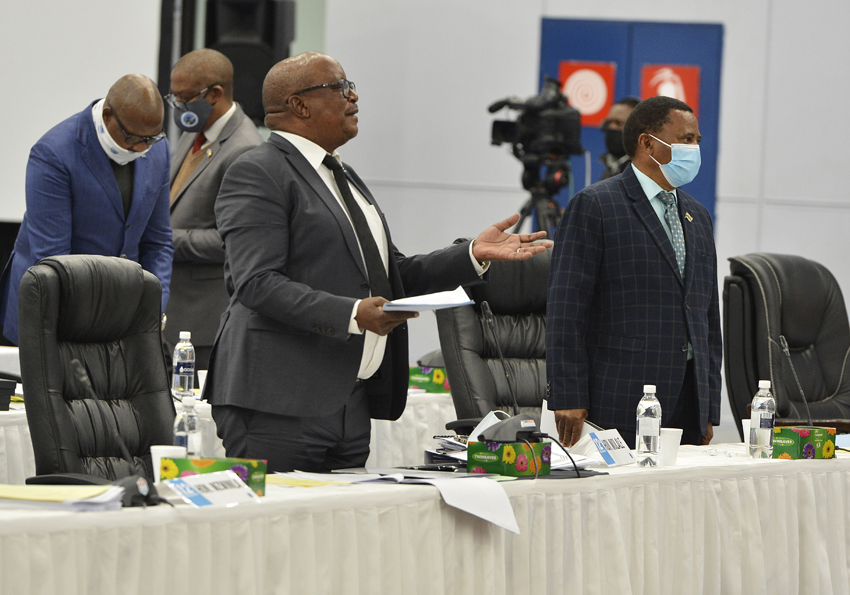
This was said by Minister of Local Government and Rural Development, Mr Eric Molale when delivering presentation of the ministry’s NDP 11 Mid-term Review under the thematic chapter of social upliftment.
He said the NSPF sought to achieve coordination and harmonisation of social protection programmes, adding that the critical component of the NSPF would be development of Single Social Registry.
Mr Molale said Single Social Registry would be the ministry’s priority for the remaining period of NDP 11, as it focused on consolidation of the existing social protection programmes around the NSPF Life-Course structure and the improvement of common systems to increase the resilience of the system and the immediate institutional arrangement to implement the reform.
“The Single Social Registry will assist in achieving this urgent and desired consolidation, as it will provide integrated information on beneficiaries and benefits delivered,” he said.
Furthermore, Mr Molale said all ministries that provided social protection services would be invited to participate in the Single Social Registry project. He also stated that through the framework, local government ministry would rationalise and consolidate the existing 29 social protection programmes across government into Five Life Course programmes being; infancy, school going, youth, working age and old age and the indigent.
“It will further assist us to build a stronger, more responsive and efficient social protection system for the future. This will help Botswana to ‘build back better’ post COVID-19. The added advantages are cost effectiveness, being customer centric as well as improved targeting to avoid double dipping and wastage,” he emphasised. Regarding Local Economic Development (LED), he said the ministry was developing it alongside decentralised service delivery as an effective instrument that focused on promoting local investment, sustaining economic growth and diversifying and enhancing sustainable livelihoods across localities and communities.
He said the framework aimed at helping rural economies to identify their development challenges, understand their resource endowments and exploit them sustainably to grow and diversify the local economy, with government supporting them through Citizen Economic Empowerment (CEE) and the Economic Diversification Drive.
Mr Molale also informed Parliament that the ministry had committed to ensuring that procurement was in line with all the CEE initiatives.
Such initiatives provide an opportunity for farmers and other SMMEs to sell their produce to schools, which is not only facilitating market access for the farmers, but also revitalising local economies through a homegrown school feeding programme and supplementary as well as direct feeding to avert malnutrition among the under-five children.
Therefore, he said the ministry would fast-track implementation of LED during the remaining part of NDP 11 to enable district councils to drive the growth and diversification of their local economies. “It is against this backdrop that, during the remainder of the plan and going forward, my ministry will ensure coordinated efforts across government towards creating an enabling environment for leveraging resources from existing programmes and other initiatives to facilitate implementation of LED at the local level,” he said.
The ministry was allocated a total estimated cost over P11.2bn for development during NDP 11. Out of this, over P5.2bn has been spent, translating to 46 per cent. He said for the remainder of NDP 11, over P6.1bn would be required to complete projects and programmes across all four thematic working groups, which the ministry was part of. Ends
Source : BOPA
Author : Mmoniemang Motsamai
Location : Gaborone
Event : Parliament
Date : 02 Sep 2020
Related News

25 Aug 2026
Forensic audit generates 90 priority actions
25 Aug 2026