



Ministry on transformational agenda
01 Sep 2020
In an endevour to transform all sectors of the economy, the Ministry of Transport and Communications places emphasis on the National Fourth Industrial Revolution Strategy and National Smart City/Village Strategy (Smart Nation Strategy).
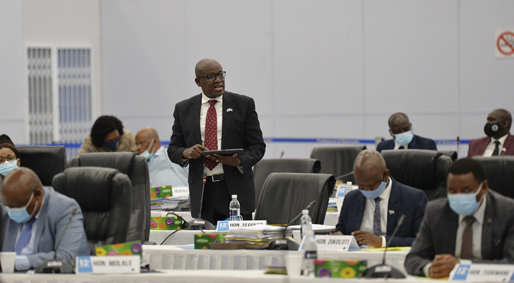
This was said by Minister of Transport and Communications, Mr Thulagano Segokgo when presenting the ministry’s NDP 11 Mid-term Review under the thematic areas of economy and employment in Parliament.
He said through the strategy, government would accelerate the adoption of industry-related technologies in response to the Fourth Industrial Revolution.
He said the National Smart City/ Village Strategy would also address complex urban/rural problems such as traffic congestion, water leaks, power cuts, poor planning, and access to health and medical facilities.
Furthermore, Mr Segokgo said in future, the ministry would develop a draft National Cyber Security Strategy that would ensure protection of national interests in the cyberspace.
As part of the Economic Recovery and Transformational Plan, he said the ministry had earmarked the School Connectivity Project, under ICT programme, as a low hanging fruit, with the highest impact.
“This is because the new normal has necessitated the use of ICT, as a way of improving on service delivery in a smart and efficient way.
Other ICT projects entail the School Connectivity Project, together with the private sector, as a spring board for the growth of ICT use from the grass roots of the economy.
Regarding infrastructure development, Minister Segokgo said major infrastructural developments in the country included the road, railway and airport infrastructure.
Some of the ongoing road infrastructure projects entail the greater Gaborone Urban Transport Infrastructure Improvement projects, which comprise traffic signals improvement and Centralized Traffic Control (CTC), traffic signals maintenance as well as the upgrading of three roundabouts along the Western Bypass to become interchanges, which will ease traffic flow.
Mr Segokgo said work to design and reconstruct the A3 road from Francistown to Nata and Maun-Mohembo had also begun, following the withdrawal of a loan from the Chinese government by the government of Botswana due to the terms of the loan.
“The A3 road plays an important role in linking Botswana with Central Africa, as the country is anticipating an increase in freight transport, due to the construction of the Kazungula Bridge,” he stated.
Mr Segokgo further said that the ministry was implementing two 10-year pilot Output and Performance Based Road Contracts (OPRCs) in the Southern District.
The projects cover parts of the A10 and A2 roads from Mmankgodi junction to Jwaneng through Kanye, together with the associated access roads.
With regards to air transport, he said, Air Botswana had embarked a restructuring project following a benchmarking exercise that was undertaken as part of migration of best practice in the industry.
The focus of the project is to optimise the level of resources being deployed against the fleet in operation, to a level where the business remained sustainable and operationally efficient.
Regarding rail transport, Parliament learnt that Botswana Railways had developed a growth strategy for the period 2019/2020 - 2023/2024.
The Strategy contained a balance between short-term actions to address immediate priorities and longer-term actions to ensure sustained creation of value for Botswana Railways and its customers.
The strategy is expected to turn around Botswana Railways into profitability in terms of tonnage and revenue growth.
My ministry was allocated a total estimated cost of P12.8 billion for development during NDP 11.
Out of this, he said over P6 billion was spent in the first half of NDP 11, leaving a balance of P 6. 8 billion, which denotes a 47 per cent expenditure of the total estimated cost as at end of July. Ends
Source : BOPA
Author : Mmoniemang Motsamai
Location : Gaborone
Event : Parliament
Date : 01 Sep 2020
Related News

25 Aug 2026
Forensic audit generates 90 priority actions
25 Aug 2026