



Ministry reforms primary school curriculum
28 Jul 2020
Ministry of Basic Education intends to reform the primary school assessment over the next three years in line with the provisions of the recently developed draft General Education Curriculum and Assessment Framework (GECAF).
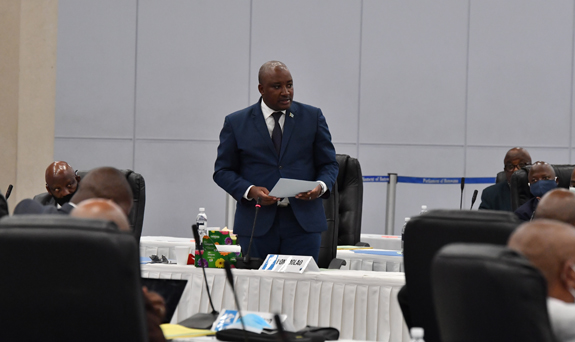
This was said by Basic Education Minister, Mr Fidelis Molao, when answering a question in Parliament on July 27.
He said GECAF, which the ministry was currently consulting with various stakeholders, was an outcome-based curriculum framework that was aligned to the global skill index framework.
Furthermore, he said the GECAF was accompanied by the National Policy on Assessment (NPA) for General Education and Tertiary and Vocational Education and Training, which guided assessment and examinations in an outcome-based education environment.
Minister Molao said the initiative was part of the major reforms arising for the Education and Training Sector Strategic Plan (ETSSP), which aimed to provide all overall policy and strategic sector framework for education sector that will play a pivotal role in the development of a modern, sustainable, knowledge-based economy that supports incisiveness and diversity.
Further, he said one of the key decisions yet to be made in considering the draft GECAF related to the discontinuation of the primary School Leaving Examinations (PSLE), which was in line with international trends, in order to replace it with a robust school-based assessment system.
“This will entail giving more time to learning than teaching with emphasis on continuous standardised school-based assessment for progressive learning,” he said.
Mr Molao said the ministry would be introducing standardised school based continuous assessment so that learners were constructively and continuously assessed as they progressed with their learning.
Moreover, he said the progressive learning would provide valuable information on the achievement of learners in various content domains as they continued with the course of study and thus strengthen remedial teaching to ensure that learners acquired the necessary skills and competencies.
He said the type of continuous assessment would provide comprehensive guidance to learners as they transit to an outcome based education and pave way for the introduction of multiple pathways at secondary school level.
The minister said it would also assist in providing relevant information about each learners’ strength and weakness as they were placed in relevant pathways.
Mr Molao also said the ministry did not anticipate any access baggage from replacing the PSLE with school-based assessment because all standard seven learners would have acquired the necessary skills and competencies as a result of having spent more time learning and being assessed continuously on a broader range of learning outcomes.
He said currently, the PSLE only assessed a limited number of skills and competencies, whilst the proposed school-based assessment would assess all the skills and competencies comprehensively across the entire primary level curriculum.
“This will give a holistic and accurate performance of the learner.
It will also provide and accurate learner profile for secondary school subject placement,” he stated.
Therefore, he said standards seven leavers would be adequately prepared to cope with the next level of their education.
He was answering a question from Tonota MP, Mr Pono Moatlhodi, who had asked the Minister of Basic Education to confirm or deny if there was intention to do away with PSLE and the reasons and time frame.
Mr Moatlhodi had also asked the minister if he was aware of the unwarranted excess baggage that would be caused to the education system as well as the nation at large. ends
Source : BOPA
Author : BOPA
Location : GABORONE
Event : parliament
Date : 28 Jul 2020
Related News

25 Aug 2026
Forensic audit generates 90 priority actions
25 Aug 2026