



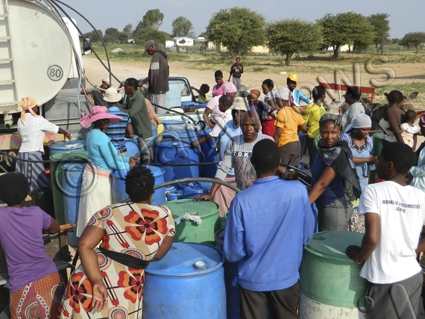
Mahotshwane supplied by water tankers
18 Feb 2020
Mahotshwane is currently supplied by water tankers following failure of the village borehole in 2014, Parliament has heard.
Land management, water and sanitation services minister, Mr Kefentse Mzwinila said the village was supplied with four loads per day amounting to 0.048 litres.
Mr Mzwinila said as a short-term intervention, Debswana mining company assisted the ministry to undertake geophysical investigations and sited three boreholes for Mahotshwane.
Moreover, Mr Mzwinila said Water Utilities Corporation (WUC) completed drilling of two boreholes with a combined yield of 2.16 million litres per day and was commissioned in August 2019.
He said the yield of the two boreholes exceeded the total water demand of Mahotshwane of 0.132 litres per day.
Also, Minister Mzwinila said the project for equipping the two boreholes and construction of a 30km pipeline to Mahotshwane was at tender stage and required a budget of P55 million.
He said a design and construction contract for the project was expected to be awarded by April this year. “The project is expected to be completed in 18 months,” said Mr Mzwinila.
The Member of Parliament for Jwaneng-Mabutsane, Mr Mephato Reatile wanted to know when the villages of Thankane, Sese, Itholoke, Khakhea, Keng, Khonkhwa and Samane would expect reliable potable water supply.
Mr Reatile also asked whether Botswana would achieve the Sustainable Development Goal of clean water and sanitation to ensure access to water and sanitation for all.
As for Thankane and Samane, Mr Mzwinila said the two villages were supplied through an interconnected water scheme sourcing water from two boreholes which were both located at Samane.
Mr Mzwinila said the two boreholes yielded 0.24 million litres and 0.19 million litres per day respectively which translated to a total supply of 0.432 million litres per day. He said the boreholes yield was able to meet the daily demand of the two villages of 0.195 million litres.
He also noted that the standby borehole for the villages had been out of service for four weeks as the engine was in a poor condition, adding that a new replacement engine would be procured by April this year.
With regard to Sese, Minister Mzwinila said as a result of its proximity to the mining town of Jwaneng, the village was experiencing speedy increase in population, thus increase in water demand. He said the village was currently supplied from Jwaneng township water supply system.
Currently, he said Sese water demand per day was 0.418 litres against the current daily supply of 0.58 litres.
Minister Mzwinila also noted that as a result of the rapid growth, a portion of the village was not serviced and therefore a polyvinylchloride (PVC) had been strategically erected to supply water to those residing in the un-serviced localities.
Residents of the un-serviced location received 0.036 million litres of water through bowsing per day. Currently, Mr Mzwinila said there was no funding to upgrade water supply to Sese.
Mr Mzwinila further revealed that the villages of Itholoke and Khakhea were supplied by two boreholes with a combined low yield of 0.41 million litres per day while the total demand for the two villages was 0.45 million litres per day translating to a deficit of 0.046 million litres per day.
He said supply for Khakhea was augmented by bowsing to address the shortfall while Itholoke with a demand of 0.076 million litres per day was supplied with water through bowsing.
He noted that the demand for Itholoke was not met as the village was only supplied with 0.024 million litres per day due to shortage of water bowsers.
Mr Mzwinila added that the ministry was in the process of procuring 20 bowsers by June this year, one of which would be allocated to Itholoke and Khakhea.
As a short-term intervention, Mr Mzwinila said the ministry was working on rehabilitating and connecting boreholes BH10292 and BH281 into the existing system to augment water supply to the villages of Itholoke and Khakhea.
“The total combined yield for these two boreholes is 0.192 million litres per day. The project is currently at tendering stage and expected to be completed by November this year,” said minister Mzwinila.
As a long-term measure, he said the ministry would consider interconnecting Khakhea, Itholoke and Kanaku to Phuduhudu-Mabutsane water supply scheme during the 2021/2022 financial year.
With regard to the villages of Keng and Khonkhwa, Mr Mzwinila said the two villages were inter-connected to Sekoma.
The three villages were supplied from Sekoma well field consisting of four boreholes namely; BH5073, BH10388, BH10295 and BH10304.
He said total water supply from the wellfield was 0.210 million litres per day against the three villages total daily demand of 0.271 million litres.
That, he said, translated to a deficit of 0.061 million litres of water per day. He said the deficit in water supply was mitigated by rationing of water between Keng and Khonkhwa.
Furthermore, he indicated that a long-term intervention was to interconnect the three villages to Mahotshwane wellfield which had a total yield of 2.16 million litres.
However, the minister said the intended long-term solution with a total cost of P30 million was not funded. “Request for funding will be proposed during the 2021/2022 budget,” he said. ENDS
Source : BOPA
Author : BOPA
Location : GABORONE
Event : parliament
Date : 18 Feb 2020
Related News

25 Aug 2026
Forensic audit generates 90 priority actions
25 Aug 2026