KAZA ministers optimistic about summit
07 May 2019
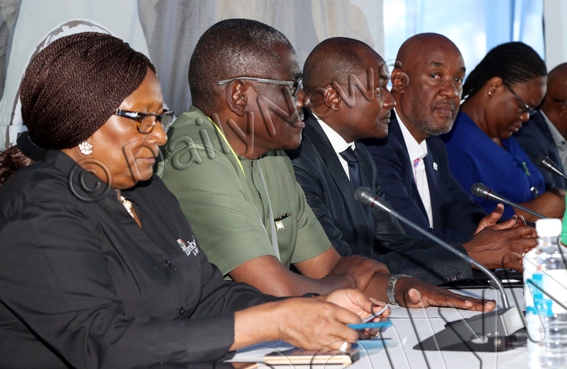
Ministers of the countries represented at the just ended elephant summit have expressed optimism about the outcomes of the conference.
Zambian Tourism and Arts minister, Dr Charles Banda has said the outcomes of the summit would help open doors that the region had been looking forward to.
Commenting after a presentation of the technical meeting outcomes on May 6, Dr Banda said speaking with one voice would help the world see how the region wanted to manage its elephants.
He observed that the international community wanted to dictate to the region on the management of elephants therefore tackling the issue in unity would make it clear to the rest of the world how the region wanted the issue approached.
Namibian Minister of Environment and Tourism, Mr Pohamba Shifeta said he was happy that the summit would create a platform for the region to come up with a united voice on issues surrounding elephant management.
Mr Shifeta said previously the region had divergent voices that made it difficult for the outside world to understand.
The region had a challenge of local communities having to live side by side with troublesome animals yet some members of the international community viewed Africa as a zoo and cared more about wild animals than communities, he said.
Mr Shifeta said having the largest elephant population was a clear indication that the region was knowledgeable about conservation of the animals and should therefore be given an opportunity to manage them. “Animal rights groups have no understanding of the reality on the ground therefore speaking with a united voice will help in taking a clear message across to the international community on Southern Africa’s concern,” he said.
Minister Prisca Mufamira of Zimbabwe said it was imperative that people who lived with the animals benefitted from them hence the need for home-grown solutions. For his part, Minister of Environment, Natural Resources Conservation and Tourism, Mr Kitso Mokaila assured the region that Botswana would start to play a pivotal role in KAZA conservation issues. Mr Mokaila called for thorough engagement of the international community on market issues and the formulation of a communication strategy. Earlier, when presenting the technical meeting outcomes, Dr Russell Taylor indicated that the southern African elephant range states were subjected to constant media scrutiny at the ignorance of the plight of rural communities who bore the brunt of living with the animals.
The KAZA impact monitoring spatial tool, he said, indicated that Botswana and Zimbabwe had large elephant population with the Namibian and Zambian populations increasing while Angola had a small population.
Dr Taylor said one of the technical meeting’s resolutions on elephant populations was to ensure continuous assessment of elephants’ impact in relation to settlement developments and address human wildlife conflict using the key principles of consultation/dialogue, information and communication particularly in relation to value-based differences.
On the legal trade and use of live elephants and their parts, Dr Taylor said the meeting resolved that there should be engagement of transit and destination countries for illegal ivory at bilateral and multilateral levels to address issues of demand reduction, to lobby support for proposal to review Convention on International Trade in Endangered Species (CITES) and to increase community participation in CITES.
Dr Taylor said human-elephant conflict was a challenge for most KAZA states due to the competition of limited resources and the effects of climate change.
The technical meeting, he said, resolved that there should be integrated land use planning and harmonisation of land use policies at KAZA level and communities should be provided with incentives to opt to farm outside wildlife corridors. On the hunting, cropping and culling of wildlife issue, Dr Taylor said it was resolved that benefits from hunting should reach all people in the communities to alleviate poverty.
KAZA should adopt community conservation policies and practice with structures that devolve participatory decision making processes to the local level in human-occupied wildlife areas by for instance allowing communities to utilise income from hunting. ENDS
Source : BOPA
Author : Keamogetse Letsholo
Location : KASANE
Event : Elephant Summit
Date : 07 May 2019
Related News

15 Aug 2026
15 Aug 2026