



Education ministry to implement reforms
04 Mar 2019
The Ministry of Basic Education is keen on implementing reform programmes aimed at enhancing access and quality of education in line with local and global demands.
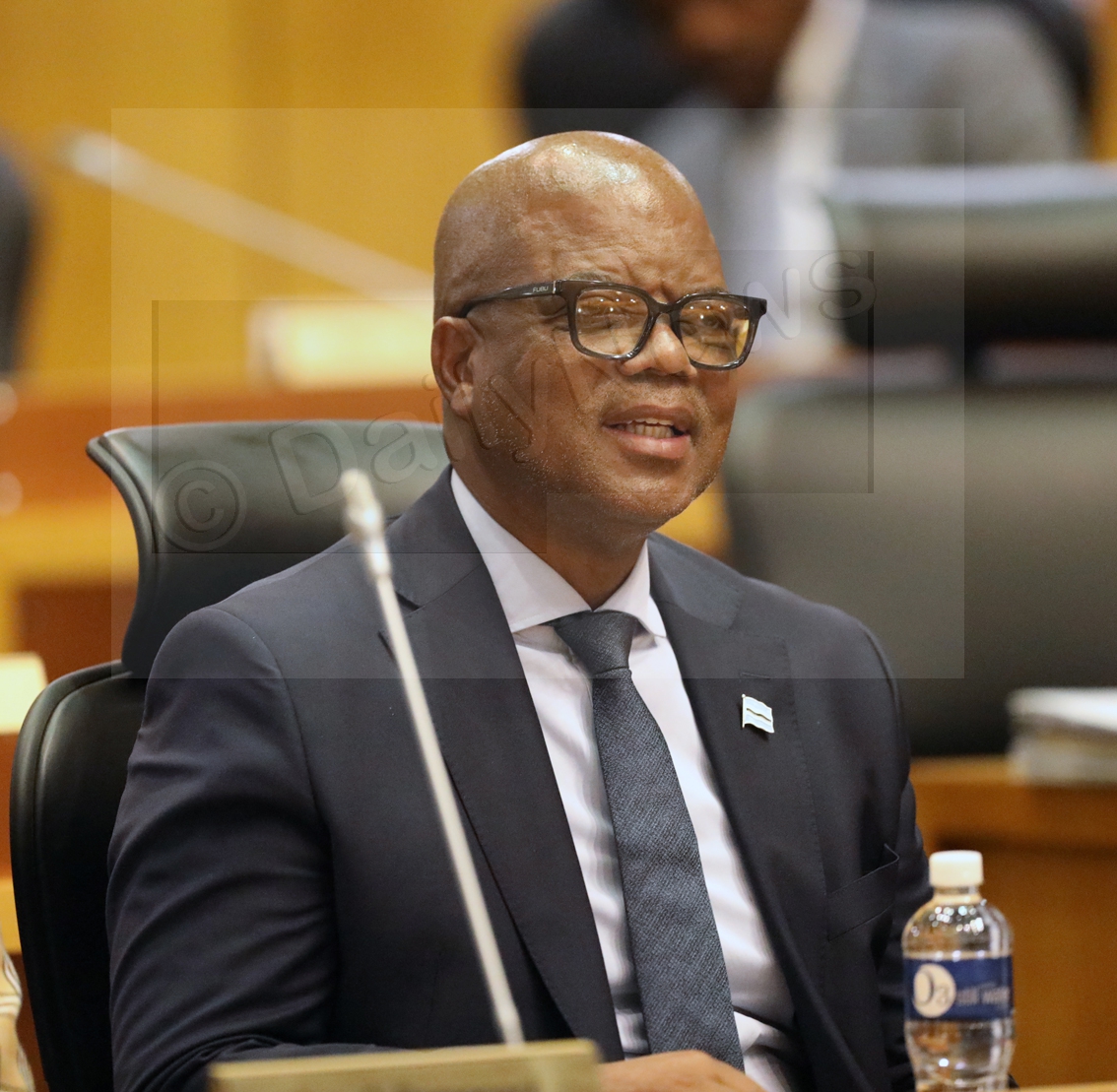
Presenting the ministry’s consolidated and development funds estimates to Parliament recently, Minister of Basic Education, Mr Bagalatia Arone stated that central to those reforms was the introduction of multiple pathways at senior secondary level where pupils would pursue subjects of their interests and capabilities through an outcome based curriculum.
Mr Arone said these curriculum reforms aimed at transforming the country from a resource based to a knowledge based economy.
He stated that his ministry’s total budget proposal amounted to P8.9 billion, of which P8.2 billion was for recurrent budget while P744 million was for the development budget.
Mr Arone stated that the largest proportion of the recurrent budget was allocated to personnel emoluments amounting to P6.1 billion while the subvention of Botswana Examination Council (BEC) was allocated P226 million.
The remaining P1.9 billion, he said, was for other operational costs of the ministry’s departments, regional officers, running offices of schools as well as the welfare of students including their feeding, procurement of and payment of utilities.
Regarding development budget break down, Minister Arone noted that P40 million was being requested for the on-going procurement of ICT equipment for 182 junior secondary schools and expansion of local area network for 100 secondary schools.
“The project will ensure that all schools are equipped with the latest technology and internet to enhance teaching and learning outcomes. The ministry is also in the process of procuring education management system to deliver timely, reliable and accurate information to measure performance in the education system,” he said.
He said P27 million would be allocated to consultancy projects while P635 million would be shared upon projects such as electrification of primary schools outside the power grid, construction of ESO staff houses, junior secondary schools’ cyclic maintenance and furniture procurement for new schools.
Mr Arone further indicated that the Department of Curriculum Development and Evaluation continued to develop learning programmes for all 31 subjects offered at senior secondary level so that they become outcome based to achieve global competencies in the school curriculum.
Minister Arone expressed delight over strides made in improving pre-primary education, stating that his ministry continued with the incremental roll out of pre-primary education in primary schools.
“An additional 51 primary schools will offer reception classes in 2019 bringing the total to 590, translating to 78 per cent school uptake,” he noted.
He indicated that the 2018 primary school leaving examination results continued to show a steady improvement in candidates attaining grades A to C, adding that the overall results reflected an increase of 1.20 per cent from 71.62 per cent in 2017 to 72.82 in 2018.
The results from evaluation of primary education, he said illustrated that the syllabus congestion with little time reserved for literacy and numeracy programmes at primary level.
Furthermore, he stated that the overall performance of 2018 junior secondary school certificate examination cohort showed some improvement from that of 2017 with a slight increase of 1.52 per cent for grade C and better.
He also reported a 0.56 per cent improvement on the 2018 BGCSE results compared to the 2017 results. ENDS
Source : BOPA
Author : Thato Mosinyi
Location : GABORONE
Event : Parliament
Date : 04 Mar 2019
Related News

25 Aug 2026
Forensic audit generates 90 priority actions
25 Aug 2026