



Treaties for water with SA guide ministry
11 Feb 2019
Ministry of Land Management, Water and Sanitation Services’s stance is guided by the treaties with South Africa for water usage from Madikwe and Limpopo rivers for various purposes.
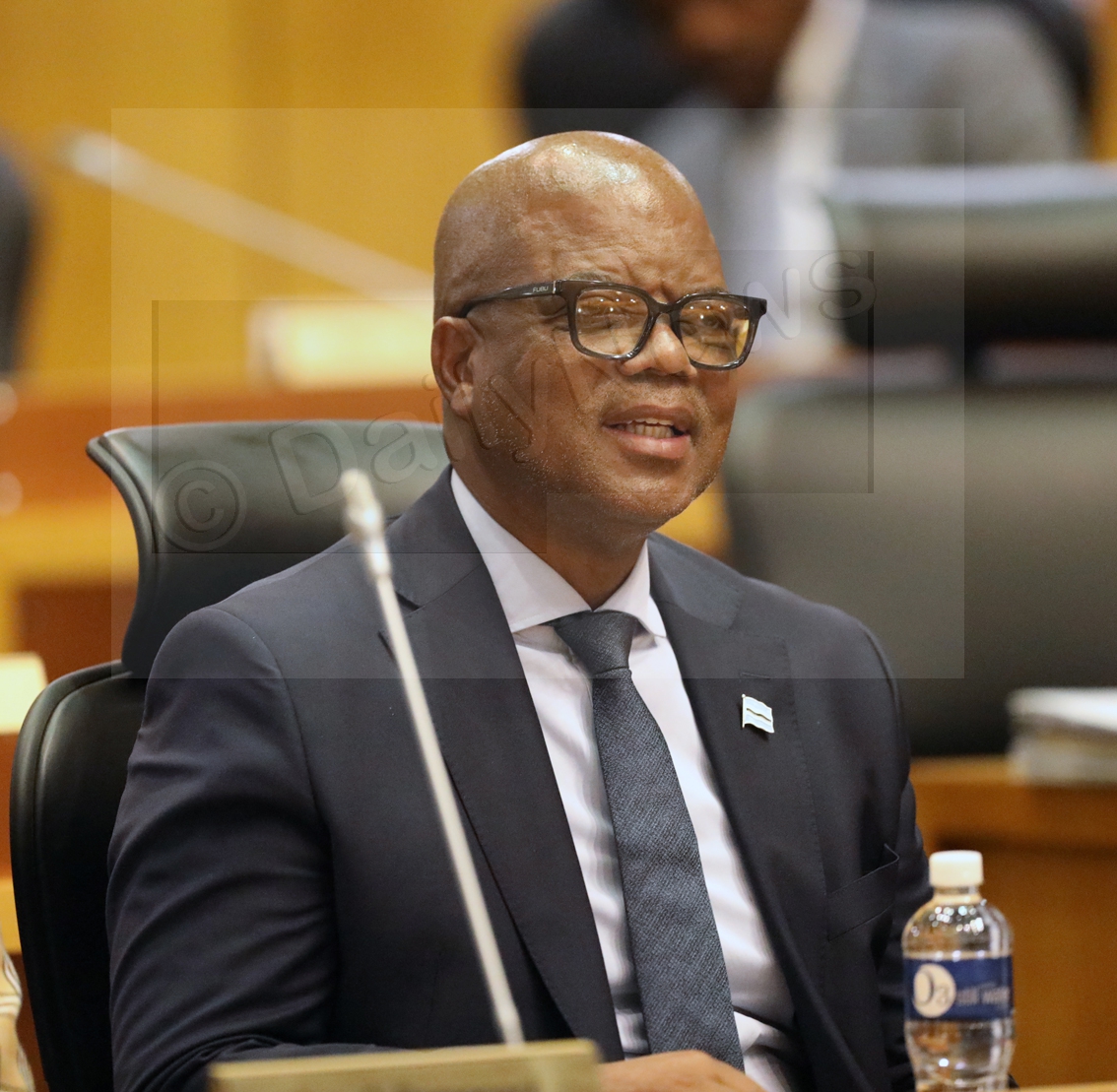
Responding to a question in Parliament recently, Minister Kefentse Mzwinila said that the revised TSWASA agreement (2014) was one such a treaty.
Mr Mzwinila said the agreement was between Sedibeng Water Board of South Africa and Water Utilities Corporation (WUC) in Botswana, and relates to the supply of water from Molatedi Dam in the Marico River.
Explaining the purpose of the Revised TSWASA agreement, Mr Mzwinila said it was to ensure that there was a common understanding on the operation and maintenance of the scheme as well as assign responsibilities to concerned parties in that regard.
He said the other understanding was with regard to the supply of water made available in the Marico River by virtue of the Construction of the Scheme.
Mr Mzwinila pointed out that under the agreement, Botswana had been allocated 5.03 million cubic metres for domestic supply and 0.12 million cubic metres of irrigation water per annum, depending on the dam levels.
On another issue, Mr Mzwinila stated that the pre-feasibility study of potential dam sites and off-river storage on the lower-Notwane river was undertaken in 2009 to ascertain potential water use.
He said several sites were considered inclusive of the Thagale–Notwane confluence.
The minister further mentioned that the study identified three possible dam sites; being Lethekane ridge, Oodi weir and Mochudi weir, saying that the first two sites had been recommended for further investigations.
He therefore stated that the detailed studies of identified potential sites would need to be carried out before a decision could be made to dam Notwane River for irrigation or any other purpose.
Furthermore, Mr Mzwinila pointed out that the project to improve water situation at Ramotlabaki was completed and commissioned in December 2018 at a cost of P623 912.
He explained that the project entailed drilling, construction, development and test pumping of a replacement borehole (BH11328) at Ramotlabaki.
Mr Mzwinila said the borehole was the only one supplying the village at a yield of 100 cubic metre per hour against a village demand of 76 cubic metre per per day after the original borehole (BH4271) collapsed.
Mr Mzwinila as such the village demand was adequately met.
“Despite Ramotlabaki plant being old, it is operating efficiently as it is adequately maintained,” stated Mr Mzwinila.
He further said the last major replacement of filter membranes and pumps was during the 2015/16 financial year, adding that there were no plans to establish a new source at Ratlokwa area at the time.
On another issue, Mr Mzwinila said the water tariffs were reviewed periodically and they were influenced by the actual operation costs.
The minister stated that the water was charged according to usage, adding that ‘the tariffs were stepped’ meaning that the more water used, the more the charge.
He further pointed out that government had no plans to reduce the prevailing water tariffs as they were already highly subsidised and were not cost reflective, saying the standing charge was discontinued in 2017.
Mr Mzwinila mentioned that the first 5 000 litres were billed at P3.50 per 1 000 litre and did not attract VAT, adding that such was a deliberate decision by government to ensure affordability.
He said high bills vary from customer to customer and could not be addressed by reducing water tariffs.
“Each case can be managed on its merit with the customer bringing it to the attention of WUC,” he said
Mr Mzwinila stated that WUC was responsible for the repair of the leaking meters, adding that the leakage of the meter did not influence water the bill as it would not be recorded as water consumption by the customer.
He however mentioned that the leakages beyond the meter were the responsibility of the customer and therefore encouraged customers to check their meters regularly so that they may be able to notice unusual behaviour and report it.
Member of Parliament for Mochudi East, Mr Moagi Molebatsi had asked the minister to state the ministry’s position on the treaties signed with South Africa for water usage in Madikwe and Limpopo rivers for irrigation by Batswana.
MP Molebatsi also wanted to know if it was not time for Notwane River to be dammed for agriculture purposes.
He also asked when the water situation in Ramotlabaki would be improved by establishing a well field around the Ratlokwa area instead of the distillation plant, which was now old.
MP Molebatsi further wanted the minister to state when the exorbitant water charges meted out to people who hardly have constant water flow in their compounds would be addressed.
Furthermore, he asked the minister to state if he would consider for WUC as the supplier to be held responsible for the meter leakage charges. ENDS
Source : BOPA
Author : BOPA
Location : GABORONE
Event : Parliament
Date : 11 Feb 2019
Related News

25 Aug 2026
Forensic audit generates 90 priority actions
25 Aug 2026