


201920 another year of deficit
18 Sep 2018
The Ministry of Finance and Economic Development has forecast a P5.11 billion budget deficit for the 2019/20 financial year.
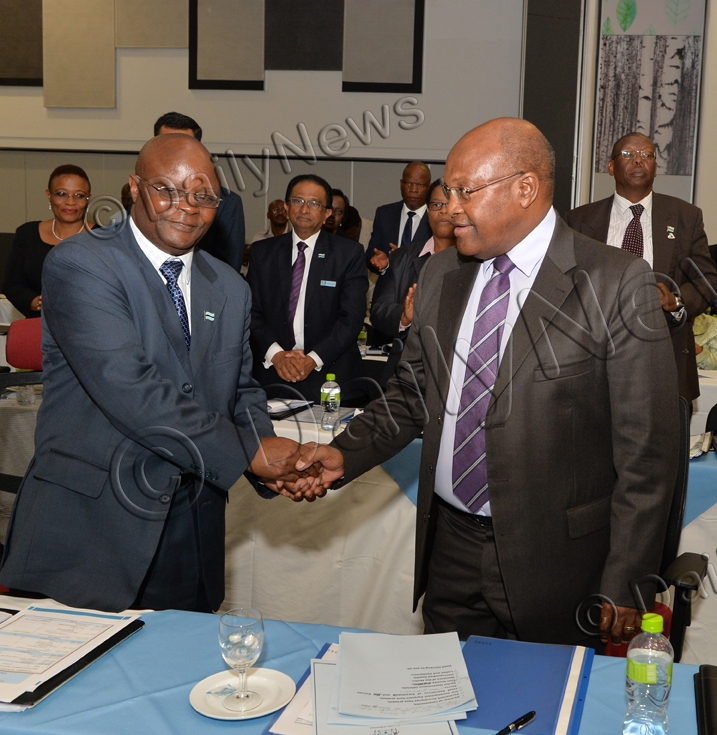
A Budget Pitso held in Gaborone on September 18 learnt it would be the second year in a row that the country would be experiencing a deficit following the P4.574 billion anticipated for the current financial year.
The last time government recorded a surplus was in the 2017/18 financial year which stood at P220.3 million.
According to the Budget Strategy Paper presented at the pitso, projected total revenue and grants for 2019/20 is estimated at P61.28 billion, while the proposed total expenditure allocations amount to P66.40billion.
The ministry says the deficit would be financed through borrowing both domestically and externally.
Domestic borrowing would entail issuance of government debt securities such as treasury bills and long term government bonds, the ministry explained.
Mineral revenue is projected to contribute the largest share of revenue at P21.09 billion or 34.4 per cent, followed by customs and exercise at P14.97 billion or 24.4 per cent. Non-mineral income tax is the third largest revenue contributor.
Finance minister Mr Kenneth Matambo said persistent budget deficits were not ideal.
He said government would therefore control expenditure in the medium term in pursuit of financial sustainability.
Mr Matambo further said government would deliberate on various ways of raising domestic revenues in order to avoid over-reliance on the volatile mineral revenues.
He pointed that budget preparations for the next financial year were being undertaken at a time of uncertainties in the global market.
“Usually such uncertainties in the global market result in profound negative externalities to our domestic economy, particularly through the mining sector. "
Hence, due to these uncertainties in the global economy, growth in our economy remains vulnerable,” he said.
Minister Matambo however said positive economic growth rates were expected in the 2018/19 financial year driven largely by the non-mining sector, explaining that this underscored the importance of the private sector in leading future domestic economic growth.
He also said the economy was doing well in terms of inflation which had remained stable around the lower objective range of three to six per cent.
“Low inflation is supportive of our economic growth objective, which envisages more goods and services being produced by the private sector, and as a result increasing employment opportunities,” he said.
Presenting the paper, deputy secretary for Macro-economics Policy Mr Kelapile Ndobano pointed that the strategic thrust for 2019/20 would continue to be centered around the broad national priorities of developing diversified sources of economic growth, human capital development, social development, sustainable use of natural resources, good governance and strengthening of national security as well as monitoring and evaluation.
He said through the 2019/20 budget, government would streamline policies and regulations to improve on the business climate for private sector development within the country by continuing to invest in infrastructural development, education and training, especially technical and vocational education, to achieve sustained economic growth and employment creation.
Furthermore, government would continue to implement social welfare programmes as part of efforts to address poverty among the most vulnerable groups of the society, Mr Ndobano said. ENDS
Source : BOPA
Author : Jeremiah Sejabosigo
Location : GABORONE
Event : Budget Pitso
Date : 18 Sep 2018
Related News

18 Aug 2026
Men lead conversation on GBV root cause

18 Aug 2026
Botswana and US conclude Southern Accord 2026
18 Aug 2026