


Motswagole Ratogomane see beyond disability
25 Mar 2018
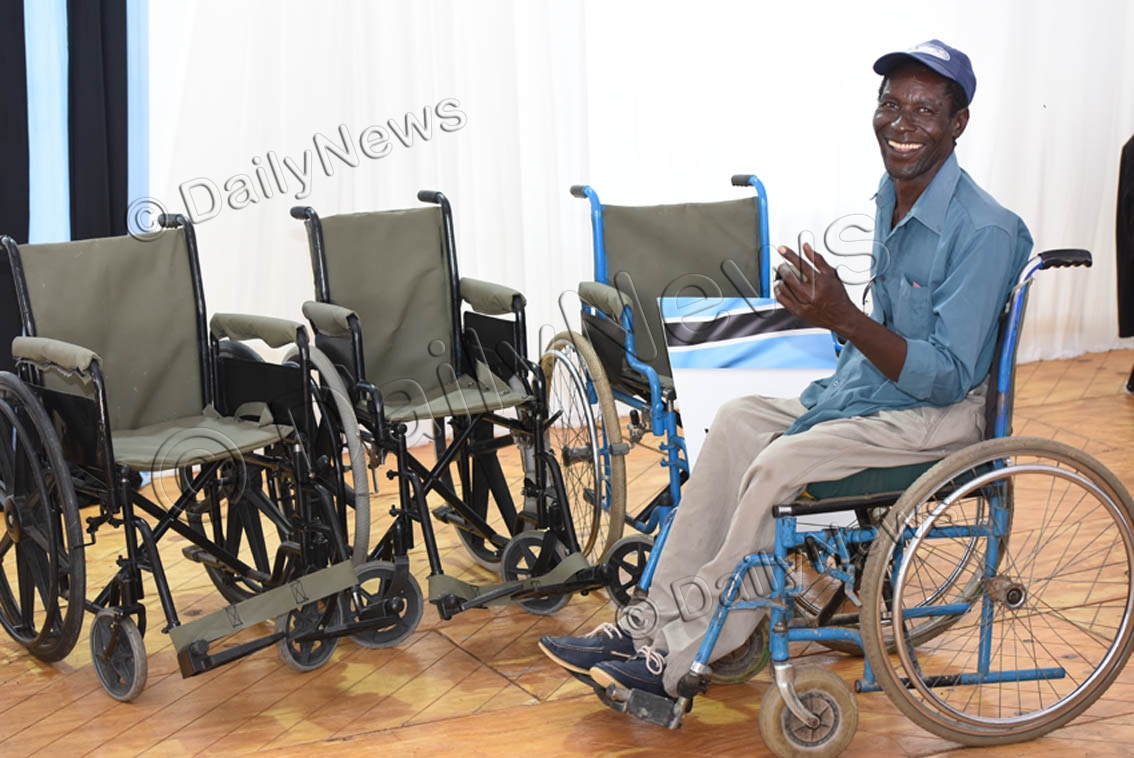
When he lost the use of his legs due to a road traffic accident in 1991, 50 year-old Matlhomola Motswagole of Mosu knew that his life would change permanently.
While he could have allowed that agony to swallow him, he chose to quickly come to terms with his new plight. He realised that he could not forever be stuck in a pity party that would not in any way restore him to his original being.
Mr Motswagole, a father of four, saw the need to find ways to earn a living despite being confined to a wheelchair.
It was during this search for a vocation through which he could sustain himself and his children that an idea to make wheelchairs cropped up in his mind, borne out of the challenges that wheelchair-dependent people encountered in their lives.
He knew first-hand how it felt to need a wheelchair and not have it, and thus resolved to manufacture wheelchairs for sale, a move that would empower him financially as well as help those whose forms of disability warranted the use of wheelchairs.
Though initially he had no idea where he would source funding to embark on his project, the Gender Affairs department came to his rescue funding him with P50 000.
After sourcing materials, the self-taught wheelchair maker started his project, and government turned out to be the main buyer of his products.
Although the business has a few challenges, Motswagole’s main concern is lack of a good market for his wheelchairs despite one or two wheelchair producers locally.
In fact, in Boteti district alone, he knows of no other wheelchair maker apart from himself.
It appears the challenge of market on Mr Motswagole’s side is due to some factors among them donations of wheelchairs to government by international donors.
His other concern is the high cost of materials, most of which he sources from the neighbouring South Africa. As for competition, he is not worried much as the sole competitor that he is aware of, a company in the same line of business, has its wheelchairs priced about twice the price of his, something that he believes gives him an edge.
In the same boat with Mr Motswagole is 71-year-old Mr Magogwe Ratogomane of Ramotswa. Ratogomane, who like Motswagole, was among the batch of exhibitors who showcased their goods and services at the international poverty eradication conference held recently in Gaborone, also lives with disability.
Though he was born healthy, Mr Ratogomane lost his sight in 1972 while working in South Africa.
He would some days momentarily lose his sight, and regain it afterwards. This cycle kept repeating itself, its frequency increasing every time, until his then employer terminated his contract.
Mr Ratogomane, then aged 25 had no choice but to trek back home to Ramotswa. One day, after his return to his motherland, his sight bid him farewell, this time around for good.In hopes that this was nothing but just one horrific dream, he went to Deborah Retief Memorial Hospital in Mochudi to seek medical help and it was there that his fate was sealed when the doctor told him that, “monna, matlho a gago a sule,” meaning there was no magic that the medical profession could perform to restore his sight.
Mr Ratogomane found himself in a dark abyss, literally and every other way. He was dejected and no amount of consoling could lift off the despondency that engulfed him.
However, one gloomy day, he made a decision to stop crying over spilt milk and summoned the very last ounces of strength that he could muster and made a resolve to start living again.
It is then that Mr Ratogomane heeded the doctors’ advice and began to undergo rehabilitation, a process that entailed him being taught new skills at the hospital.
He chose basketry, which later when Pudologong Rehabilitation Centre was set up, saw him being engaged as an instructor to teach others in his position life skills.
A few years later the centre closed due to funding challenges and he once again found himself jobless. Though they were assured that they would be re-employed when the centre re-opened that never materialised as new syllabi was adopted at the institution’s re-opening rendered them obsolete.
Hunger hit and Mr Ratogomane found himself knocking at social welfare officers’ doors with a plea to be assisted to start a small stock project.
He was advised against the idea on the reason that, with his disability, it would be challenging for him to manage the project. Ideas were tossed around and ditched, one after the other until he felt the one thing he could do was go back to basketry. The social welfare office assisted him with materials necessary for the project and he immediately set off producing beautiful garden sets comprising a table and chairs.
However, reality set quickly for him when his products began stock-piling with no buyers supporting him.
Being asked on whether the lack of a market does not discourage him from pursuing the trade any longer, Ratogomane’s response is not drawn-out, “Jeso o tlaa tla”.
The seemingly ambiguous response is imbued with a message of hope and embodies Mr Ratogomane’s staunch Christian’s belief, that one day God will descend on his life and turn it around for good. ENDS
Source : BOPA
Author : Keonee Kealeboga
Location : GABORONE
Event : FEATURE
Date : 25 Mar 2018
Related News

21 Aug 2026

20 Aug 2026
Botswana Donates FMD Vaccines To Lesotho
20 Aug 2026
Atamelang new transport minister
20 Aug 2026