


SDGs realisation needs collaboration
22 Feb 2018
Making Sustainable Development Goals (SGD’s) a reality required determined and collective effort not only on the part of government, but also on the private sector, civil society organisations, youth and women’s groups and also called for the support of the United Nations and other development partners.
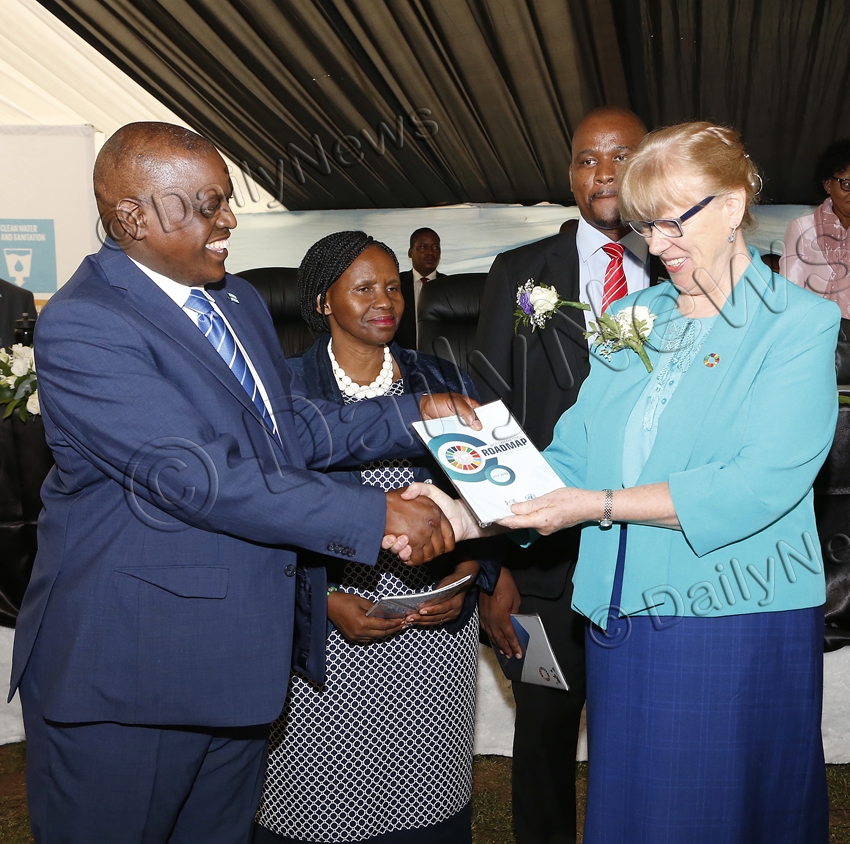
The Vice President, Mr Mokgweetsi Masisi who was officiating at the launch of Botswana SDGs roadmap on yesterday, said there was need for all stakeholders to work harder towards realising the ideals of the SDGs. He said achieving an inclusive society that provided dignified livelihoods for all would not come about without a shared adoption of collaborative platforms at both national and local levels.
Mr Masisi said the roadmap, a strategic document that provided for the implementation and monitoring of the SDGs within National Development Plan (NPD) 11 and beyond, affirmed the need for national ownership and coordination of the goals through mainstreaming them into all programmes for coherent implementation. He explained that the domestication and localisation of the goals were premised on six strategic areas, among those being; the need for national ownership, leadership and coordination as well as data monitoring, reporting and evaluation.
“It is critical therefore that all stakeholders play their part in the domestication, localisation and implementation exercise. In particular, I call upon government ministries and departments to be exemplary,” he said.
The Vice President indicated that the roadmap recognised the need for consultation through putting some emphasis on the need for sustained advocacy, sensitisation and awareness creation regarding the SDGs. This, he observed, would empower local communities and enhance their participation in the implementation process.
He noted that it was however gratifying that a comprehensive national SDG communication strategy was being finalised, noting further that it was without doubt that setting up an effective planning and coordinating structures was a pre-requisite for successful implementation of the SDGs.
“These platforms should ensure that strategic initiatives geared towards resource mobilisation, capacity building of stakeholders, monitoring and evaluation, as well as reporting among others, are undertaken,” he observed.
Vice President Masisi also highlighted the importance of the availability of timely and disaggregated data and monitoring and evaluation of performance against the set SDGs targets and indicators, saying it could not be over-emphasised.
Speaking at the same event, United Nations Resident Coordinator, Ms Jacinta Barrins explained that UN was committed to ensuring that Botswana attained the targets of the SDGs.
She said one of the steps that Botswana needed to do was to open up partnerships, saying UN would help Botswana to increase and strengthen more partnerships.
Further, she highlighted their commitment to assist through funding as funds were critical for the attainment of the goals.
Ms Barrins added that UN was also committed to helping in the areas of measuring progress towards the realisation of the goals and providing support for coordination of the implementation programmes and processes.
Secretary of Economic and Financial Policy at Ministry of Finance and Economic Development, Dr Taufila Nyamadzabo also emphasised the need for collaboration.
He said in order to realise the SDGs, it was crucial for all stakeholders to break their silos and start working with each other.
BOCONGO chairperson, Reverend Gabriel Tsuaneng concurred on the importance of collaboration. He thus called upon all stakeholders to work for SDGs attainment. Ends
Source : BOPA
Author : Keonee Kealeboga
Location : GABORONE
Event : launch
Date : 22 Feb 2018
Related News

21 Aug 2026

20 Aug 2026
Botswana Donates FMD Vaccines To Lesotho
20 Aug 2026