


Mabeo praises labour relations
11 Dec 2017
Botswana’s labour relations are built on democracy, freedom of association, the right to organise, social dialogue, collective bargaining and the protection of workers’ rights, says Minister of Employment, Labour Productivity and Skills Development.
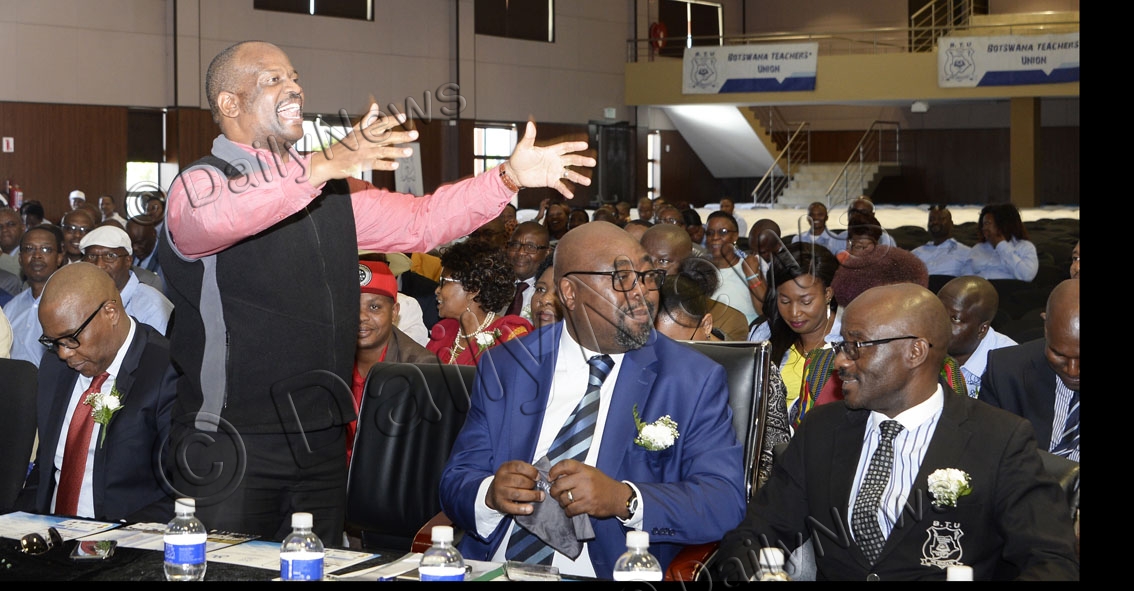
Speaking about the state of labour relations at Botswana Teachers’ Union (BTU) 80th anniversary celebrations on December 9, Mr Tshenolo Mabeo said such cornerstones were influenced by the country’s Constitution which guarantees the protection of fundamental rights and freedoms of an individual.
“Labour relations environment in Botswana is governed by the following pieces of legislation; Trade Unions and Employers’ Organisation Act (CAP. 48:01), Trade Disputes Act 2016, Employment Act (CAP. 47:01),Workers Compensation Act (CAP. 47:03), Factories Act (CAP. 44:01), Provisions of the Immigration Act 2010, Revised National Policy on Incomes, Employment, Prices and Profits of 2005,” he said.
Mr Mabeo said as a way of appreciating and acknowledging the dynamism of the labour environment, government was working with labour movements and the business community to review the Trade Unions and Employers’ Organisation Act and the Employment Act.
“For this purpose, so far views of labour and business have been solicited. The Factories Act (CAP. 44:01) and the Compensation Act are due for review and the processes to ensure that have been kick started,” continued Minister Mabeo.
He noted that in an effort to ensure that there was engagement of labour, government facilitated and maintained dialogue through the Labour Advisory Board, Minimum Wage Board and the Labour Sector Sub-High Level Consultative Council.
“It is through these structures that we keep each other informed on issues that need attention in the interest of the economy,” he added.
On trade unions operating in Botswana, Mr Mabeo said as of November 2017 their records showed that 61 registered trade unions (28 in the services sector, six in education, two in construction, three in retail, six in manufacturing, five in mining and 11 miscellaneous), two registered trade union federations and one employers’ organisation have registered as per the Trade Unions and Employers’ Organisation Act .
“There is however some notable challenges with regard to the operations of these registered trade unions being failure to furnish the registrar with annual returns in terms of sections 41 and 42 of the Trade Unions & Employers Organisations Act, and that the majority of them are inactive,” he said, further adding that as of November 30, 2017, 36 trade unions were not compliant with the stipulation, and that it meant that more than half were non-compliant.
On the number of disputes his ministry had observed between employers and employees, Mr Mabeo said in 2015, 3 368 cases were recorded, 6 634 in 2016 and 7 083 in 2017.
“This is an indication that dialogue structures in the workplaces are not yet as effective as they should be, noting the issues reported at our offices for mediation and arbitration. In an effort to prevent disputes in the workplace, my ministry will strengthen the inspection unit with the intention to ensure that potential disputes are detected early and resolved at the place of work,” he said.
Mr Mabeo further said labour practices required that workplaces be inspected to check compliance to labour laws, and to take necessary steps in cases of non-compliance.
He noted that as of November 2017, his ministry had conducted 1 253 inspections from which a compliance level of 86 per cent was observed.
“Common contraventions noted during inspections included failure to ensure workers, failure to observe hours of work as well as failure to keep employment records,” he said. ENDS
Source : BOPA
Author : Omphile Ntakhwana
Location : GABORONE
Event : Anniversary Celebrations
Date : 11 Dec 2017
Related News

21 Aug 2026

20 Aug 2026
Botswana Donates FMD Vaccines To Lesotho

20 Aug 2026