


Lesotho Botswana sign water transfer study
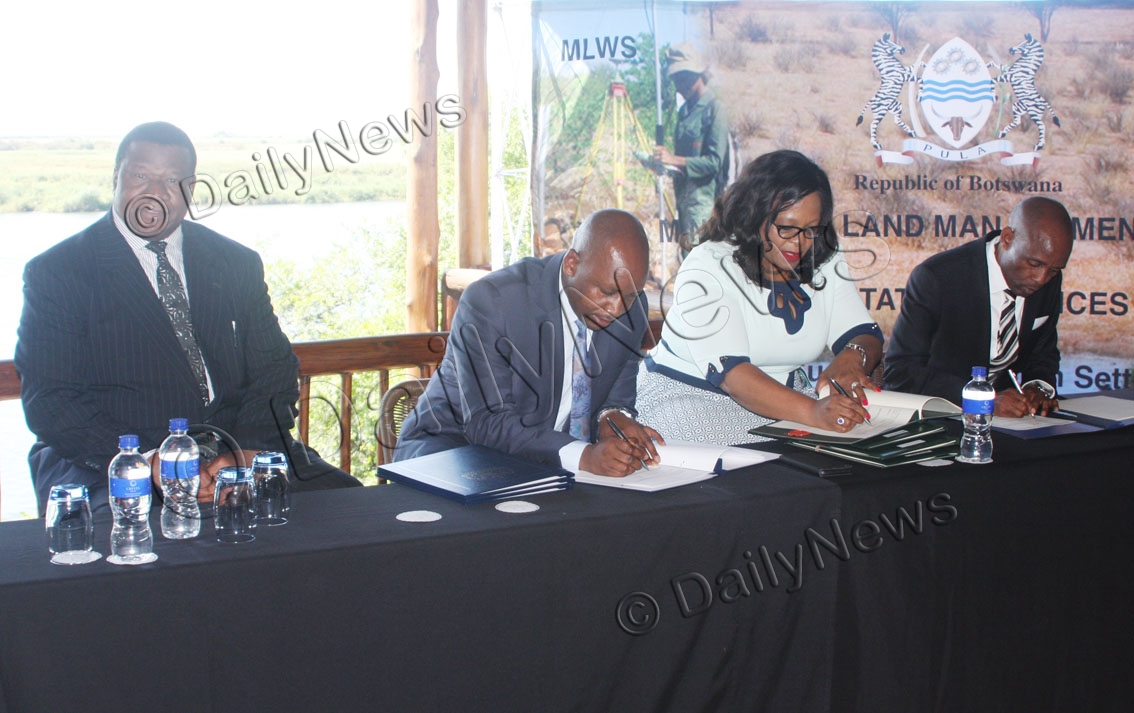
22 Nov 2017
Cooperation at local, regional and global levels is the only way to achieve a water secure future.
Minister of Land Management, Water and Sanitation Services, Mr Prince Maele said this during the 4th Ordinary meeting of the Orange-Senqu River Commission (ORASECOM) Forum of the Parties on November 17.
The meeting concluded with the signing of a memorandum of agreement for the Lesotho-Botswana water transfer project.
He explained that interdependence on this resource is growing every day and that building partnerships would therefore advance future people and institutions together.
Cooperation is about sharing the benefits of water and creating a platform where stakeholders come together to share a common vision and develop and agree on plans, he said.
Minister Maele highlighted that as the four ministers responsible for water in Botswana, Lesotho, Namibia and South Africa, people in these countries looked up to them to provide policy and political guidance on the ORASECOM programme of work and also give their commitment for the continued sustenance of the water basin.
The minister further asserted that this had been made possible by the existence of mutual cooperation amongst all riparian countries within the ORASECOM.
In addition, he mentioned that the main highlight of the meeting was the signing of a Memorandum of Agreement to facilitate feasibility studies on the Lesotho-Botswana Water Transfer Project, and review of progress on initiation of the feasibility studies, together with progress on mobilisation of funding for the studies.
Consequently, he posited that the leader of the Botswana delegation to ORASECOM and executive secretary of the water basin were directed to lead the initiative of mobilising the full financing of the feasibility studies from both local and international financing institutions as well as multilateral and bilateral financing agencies.
The project, he said, had raised hopes that it would address water challenges faced by Botswana.
Minister Maele highlighted that ministers of the basin in 2015 adapted the 10-year basin-wide integrated water resources management plan to guide management, development and conservation of water resources of the Orange Senqu Basin.
“Understanding the challenges and benefits of water cooperation can help build mutual respect, understanding and trust,” he explained.
For his part, Minister of Water in Lesotho, Mr Samonyane Ntsekele explained that Lesotho was blessed with water and that over 45 per cent of the total runoff of the Orange Senqu basin was contributed from his country.
This, he said, was due to the physiographic make up of alpine wetlands systems in the mountain ranges that regulate water in order to sustain the flows of the Senqu system.
“This therefore, means that particular effort must be made to conserve these resources to sustain water needs of the present and future generations in the basin,” he said.
In addition, Mr Ntsekele said that Lesotho pledged to host the Lesotho-Botswana Water Transfer Project Management Office.
Despite having water in relative abundance, he explained that Lesotho was one of the least developed in terms of water resources for the benefit of her citizens.
Minister of Water and Sanitation in South Africa, Ms Nomvula Mokonyane noted that their cooperation was driven by their common vision, which positioned water as a driver for industrialisation and regional economic integration in Southern Africa.
She maintained that it was their aim to ensure that people benefited from the four countries’ shared vision of water security.
“The work that we do as a collective on the Joint Study Management Committee on planning and implementation for the provision of water to Botswana from the Lesotho Highlands, while taking care of the needs of Lesotho and South Africa en-route, demonstrates our vision of benefitting our ordinary communities,” she maintained.
Minister of Agriculture, Water and Forestry in Namibia, Mr John Mutorwa maintained that his country was a signatory to the SADC Treaty and had ratified the SADC Revised Protocol on Shared Watercourses, and was also committed to the sustainable development, utilisation and judicious management of the water resources in the Orange-Senqu Basin. ENDS
Source : BOPA
Author : Puso Kedidimetse
Location : KASANE
Event : ORASECOM Meeting
Date : 22 Nov 2017
Related News

21 Aug 2026

20 Aug 2026
Botswana Donates FMD Vaccines To Lesotho

20 Aug 2026