


Govt suspends soil testing requirement
08 Nov 2017
Government has taken a deliberate decision to suspend soil testing requirements by farmers in order to benefit from fertilizer application under the Integrated Support Programme for Arable Agricultural Development (ISPAAD) for this coming cropping season due to a number of short comings.
Initially, government had said that the decision to conduct soil testing in order to benefit from fertilizer application under the ISPAADD for 2017/18 still stands.
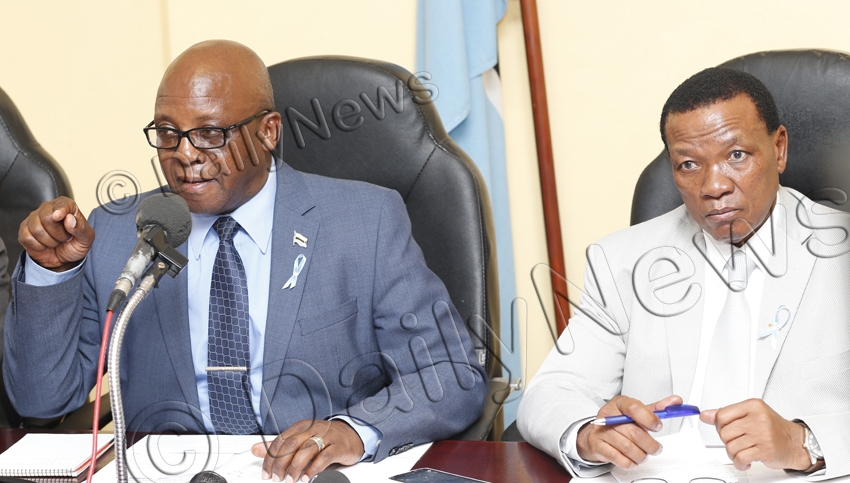
Addressing a press conference on November 7, the Minister of Agricultural Development and Food Security, Mr Patrick Ralotsia said one of the short comings is the lack of supply of fertilizers by suppliers.
ISPAAD is one of the main Agricultural Support Schemes introduced in 2008 to address challenges of poor technology adoption by farmer and low productivity of the arable sub-sector.
The primary objectives of the programme are to increase grain production, promote food security at household and national levels, commercialise agriculture through mechanisation, and facilitate access to farm inputs and credit, amongst other benefits.
However, Mr Ralotsia stressed the need for soil testing, adding that soil testing remained a requirement for every farmer because it gives the farmer the direction of what to plough in the soil.
He said every farmer has a responsibility to make sure that the soil was tested, adding, “This is not an option, but what must be done.”
Minister Ralotsia explained that the law would take its course for those who misuse government programmes such as ISPAAD.
He said he had instructed all stakeholders to put an eye into ISPAADD projects because evidence on the ground fully suggested that there were corruptive activities regarding the programme.
He lamented that some suppliers of fertilizers sell fertilizers to farms and later buy them at a cheaper price - something he termed ‘criminal’.
He said over P564 million was allocated to ISPAADD every financial year and some farmers take it for granted that ISPAADD is for free when there are expenses incurred on the side of the government.
“We cannot accept a situation where people put millions of Pula into fire,” he added.
On other issues, the minister said after realising that there was an acute shortage of cowpeas produced in the country, the government made a deliberate decision to incentivise local producers to enhance the production of cowpeas.
He explained that government directed Botswana Agricultural Marketing Board (BAMB) to buy cowpeas from farmers at P700 per 50 kilogramme bag instead of the market price, which was around P350 per 50 kilogramme.
He said the arrangement was that government, through his ministry, committed to pay BAMB the difference between the market price and the enhanced price.
Therefore, BAMB claimed the difference from the Strategic Grain Reserve, which had since been exhausted. Minister Ralotsia further explained that following the introduction of the cowpeas subsidy in 2012/13, the ministry witnessed a surge in the production of Tswana varieties.
“Statistics show that before the introduction of the subsidy, BAMB used to procure less than 1 000 metric tonnes as opposed to almost 10 000 metric tonnes currently,” he added.
He said due to the favourable conditions in the SADC region, during the current 2016/17 cropping season, there was a bumper harvest for cowpeas which had resulted in market prices falling below P200 per 50 kilogrammes.
Mr Ralotsia further stated that in earlier this month he presented a Cabinet memorandum recommending that government should reduce the enhanced price from P700/50 kilogramme effective from the 2017/18 cropping season and that BAMB sells at the same price with government paying the difference between the market price and the P450 and that government augments the subsidy to cater for the enhanced price.
He said Cabinet approved the same and issued a Presidential Directive, which directed his ministry to develop a statutory instrument to promote local produce by allowing traders and individuals to procure 100 per cent of the products from Botswana and import only after exhausting local produce, amongst others. ENDS
Source : BOPA
Author : Thamani Shabani
Location : GABORONE
Event : Press Conference
Date : 08 Nov 2017
Related News

21 Aug 2026
20 Aug 2026
Botswana Donates FMD Vaccines To Lesotho

20 Aug 2026