


Europe holds lessons on regional integration
12 Apr 2017
Although there are few universally applicable formulae guiding regional integration, the Southern African Development Community (SADC) region and the broader constellation of African Union (AU) states can still draw lessons from the experience of the European Union (EU).
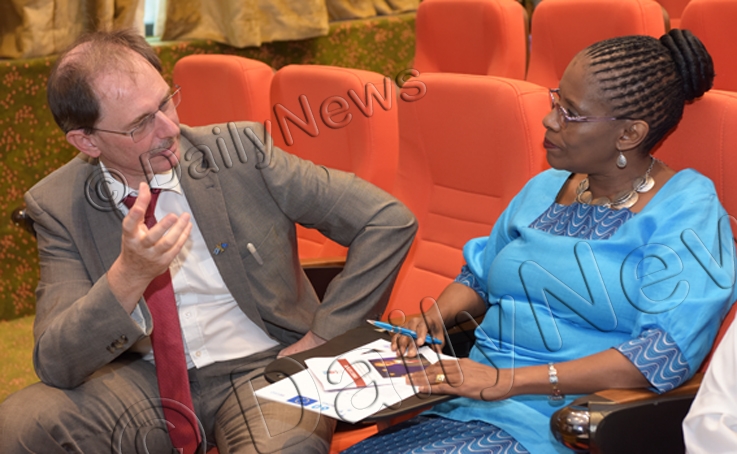
These sentiments were expressed by the EU head of delegation to Botswana and SADC, Ambassador Alexander Baum, when presenting a public lecture at the University of Botswana (UB) on April 11.
In his lecture, titled 'The EU in Times of Resurgent Nationalism-A Bridge over Troubled Waters,' Ambassador Baum said modes of integration could not be easily transplanted from one region to the other, but Africa could learn from the European experience.
“The EU was founded as a response to some of the most violent conflicts experienced by human society, World War I and II.
The philosophy was that European economies should grow together lessening the prospects of war. SADC and the AU can study the European model, which is not perfect but has been a successful project,” Ambassador Baum said.
He said that the founding members of the EU- France, Germany, Belgium, Netherlands and Luxermburg signed the Rome Treaty that established the precursor to the EU, the European Economic Commission (EEC) on March 25 1957.
The EU recently commemorated 60 years, having steadily developed from a customs union with six members to a political and economic union with 28 countries sharing free movement of people, goods, services and capital, as well as a monetary union.
Ambassador Baum added that the evolution of the EU has been gradual process with stringent guidelines followed by states that aspired to join the union.
“Until the 1980s, there was a feeling that European movement towards integration was moving at a slow pace until 1986 when there was the first major revision to the original treaty. During the enlargement process, states had to fulfill economic and political criteria in order to join,” Ambassador Baum said.
He added that the EU faced the challenge of the decision by the United Kingdom to withdraw, an ongoing process, as well as the rising tide of nationalism that is sweeping across the continent.
Dr Emmanuel Botlhale of the Department of Political and Administrative Studies said that nationalism was a double-edged sword that can both be positive and negative.
“Africa in the 1960s gained independence through the efforts of nationalists such as Mr Kwame Nkurumah, Dr Kenneth Kaunda and others. But in the modern era, the nationalism that we see in countries such as the United States, Britain and South Africa where there has been xenophobic attacks against fellow Africans is corrosive and can dent regional integration,” Dr Botlhale said.
The dean of the faculty of Social Sciences, Professor David Sebudubudu added that Africa can draw parallels from the EU experience, but also cautioned that democracy was under threat in parts of Europe. ENDS
Source : BOPA
Author : Pako Lebanna
Location : GABORONE
Event : Public Lecture
Date : 12 Apr 2017
Related News

21 Aug 2026