Molefhi unveils radio astronomy telescope
17 Aug 2016
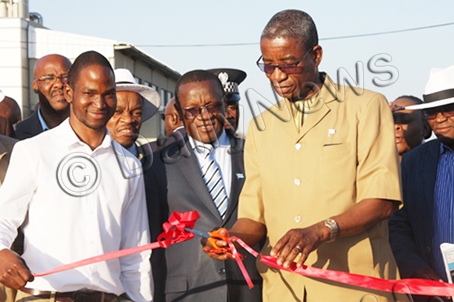
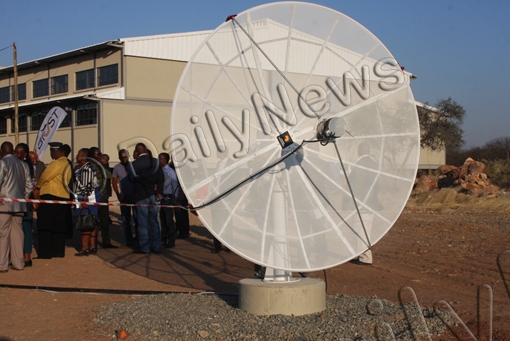
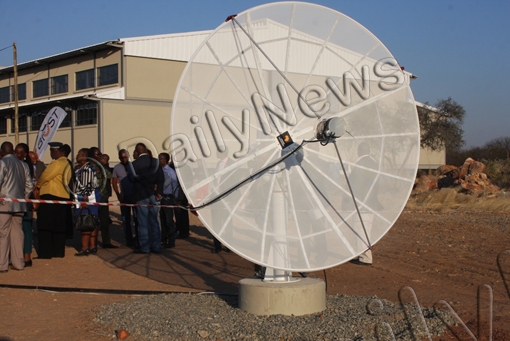
The Minister of Infrastructure, Science and Technology, Mr Nonofo Molefhi, on Tuesday (August 16) unveiled state of the art radio astronomy telescope hosted by the Botswana International University of Science and Technology (BIUST) in Palapye.
The university was nominated by the Ministry of Infrastructure, Science and Technology to host the Newton Fund Project on government behalf, mainly to build science and engineering capacity in radio astronomy in preparation for the Square Kilometre Array (SKA) project to be implemented in 2023.
The project would be hosted and managed by the department of physics and astronomy at BIUST.
The SKA is the radio telescopes secured and installed through the Newton Fund and the EUMETCast Receiving Station procured and installed through Monitoring for Environment in Africa (MESA) SADC.
BIUST vice chancellor, Prof. Otlogetswe Totolo, said during the unveiling ceremony that the project of this nature played a critical role in the journey to transform this country’s economy into knowledge based economy.
He said though BIUST hosts that equipment, it is available to all researchers in the country and internationally.
The SKA will be the world’s next generation radio astronomy telescope consisting of multi-radio telescopes, operating over a wide range of frequencies and its size will make it 50 times more sensitive and up to 10 000 faster in terms of survey speed than the best radio telescopes of today.
It is powerful enough to detect radio waves from objects that are millions or even billions of light years away from the earth.
The SKA is designed to address a wide range of questions in astrophysics, fundamental physics and cosmology.
In Botswana the SKA aims at building institutional capacity in universities, research institutions and government departments that promote the development of radio astronomy programmes and initiatives as well as develop a vibrant community of researchers and scientists to undertake radio astronomy studies across Africa.
Prof Totolo applauded those who participated in making the project possible, adding “Some of those who initially had sacrificed their time earlier in the years past working tirelessly for South Africa and partner countries including Botswana to win this Bid to host the biggest scientific endeavour the world has ever seen.”
He further said after long years of hard work by his colleagues, international collaborators and African governments, particularly South Africa, this country is witnessing the first tangible evidence of what is to come in 2025 when the first SKA dish from a total of 80 to be installed across the planes of this country.
In addition he said BIUST approved a strategic spanning 2016 t 2022 which is a road map that defines the seven key strategic areas including “Engagement for development” and “Research and Innovation Execellence.”
Radio astronomers will use the SKA to understand how stars and galaxies are formed, how they evolved over time, and to detect life elsewhere in the universe.
In addition the SKA will be used to obtain a better understanding of dark matter and dark energy. Many countries are working together to build the SKA, through the Newton Fund Project, each of the partner countries will be provided with two interferometers, a library, and a cluster of 10 powerful computers.
The unveiling was part of the activities that will be done during the Science, Technology and Innovation week in Palapye. ENDS
Source : BOPA
Author : Kgotsofalang Botsang
Location : PALAPYE
Event : Unveiling
Date : 17 Aug 2016
Related News