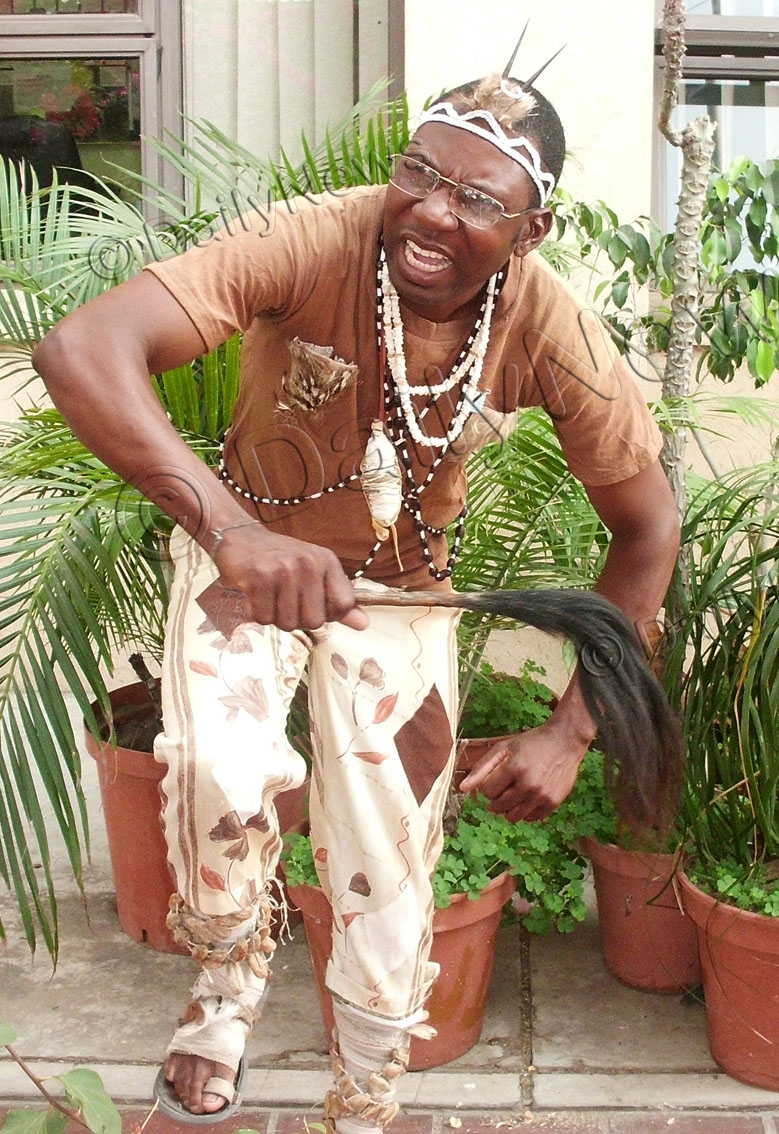
Monjwa survives by poetry
19 Nov 2015
Renowned South African poet and singer Mzwakhe Mbuli says in one of his songs: I am a stone. When a stone is thrown into a river, it creates waves.
Mbuli’s words are shared by one local poet, Odirilwe Monjwa, and they simply mean that even in tough situations, one has to be firm and be able to prevail against all odds.
According to Rita Francis Dove, an African-American author and poet, poetry is language at its most distilled and powerful, while for Monjwa, poetry is a way of reliving happiness and making one forget their sorrows.
The 32-year-old father of three, who hails from Legonono ward in Gumare, told BOPA in an interview that he is a seasoned Setswana, Sehambukushu and English poet who nurtured his talent from a very young age.
Monjwa says he used to imitate poetry giants like Mbuli while at primary school and in subsequent years as he progressed with education at Ngambao Junior Secondary School in Seronga.
While still at Ngambao CJSS, the poet says his Mathematics teacher, Thuso Shomana encouraged him to explore his linguistic talent; thus he started using literary and comedic references to enhance his dexterity, with his comic relief becoming a hit amongst the residents of Seronga.
To embolden his abilities, Monjwa entered his first ever poetry fair competition in 2002 at Maun Senior Secondary School and managed to scoop position three, which was commendable for a first timer.
After he finished his Form Three in 2003, unemployment confronted him, and, for some time he was idle until 2006 when he decided to do an auto mechanics course at Shakawe Brigade, which was to become a turning point in his life.
As Monjwa realised that the students at the brigade had yielded to drinking alcohol to pass time, he found it best to start-up and coach a drama and traditional club in the school. The idea was embraced by many and a lot of fellow students joined the club and their lives were transformed overnight.
Members used to meet after hours for rehearsals and training to advance their craft which would lead to the raising of awareness and funds towards orphans in the village. The mark they made was hailed as impressive by many and after finishing his studies at the brigade the following year, Monjwa moved on with his life.
From 2007 to 2008, Kgosi Kia Lempadi of Shakawe, encouraged him to apply for a job as a peer educator at a local private school called Botshelo Trust, and was successful in his undertaking.
“My experience at Botshelo Trust was rather slightly different but intriguing in the sense that it was actually my first time to train and teach underage children of 3-4 years.
I really learnt a lot as working with youngsters takes a lot of resilience and responsibility. They gave me a really rewarding task,” he said.
Monjwa says his main responsibilities at the school were to encourage, nurture, coach and mold the young minds into responsible citizens of tomorrow; as such, he empowered them with life skills. He also eased their mind with poetry, song and dance, he says, adding that the experience at Botshelo Trust was invigorating, to say the least.
“Throughout all this, I still had a hunger for poetry, and I was yearning to do it on a full-time basis,” he points out, adding that after his contract ended a year later, he joined a local ensemble called ‘Mashamba wa kare’.
The poet says he nurtured his craft by learning Sehambukushu, which the group normally used, and in exchange, he imparted the Setswana and Tsutsube skill to them and the result was life changing.
With his confidence growing, he went solo and in 2012 he registered his dexterous poetry trade at Ngwao Leshalaba Association where he started writing and reciting his own poems.
“I write poems and file them for future use. In years to come I want my legacy to prevail. What hones my writing skills is my love for the rich Setswana language. Other factors include social ills happening around us like suicide, murders, HIV and AIDS, as well as rape,” Monjwa says.
Some of his include: Lephata la ngwao, Botswana Pele, Suicide Murder and missing persons, which have been wildly acclaimed in kgotla meetings and gatherings like weddings. In Lephata la ngwao, he hails the Ministry of Youth, Sports and Culture (MYSC) for curbing the unemployment rate amongst the youth, unlike in the past when young people devoted their time to irrational behaviour.
Monjwa prides himself by entering the President’s Day Competitions in 2011 when he was still an amateur, adding that he went as far as the nationals in Gaborone although he did not win the ultimate first price. The young poet’s dream and aspiration are to be exemplary to the youth and he believes that his life-calling is to inspire, nurture talent and make a difference.
Monjwa also wants to use his earnings derived from poetry shows to start-up a well-established business, to help employ his fellow youth and continue to cultivate young talent in Ngamiland. However, he decries the lack of support for poets in Ngamiland as compared to the southern parts of the country.
He encourages people from looking down upon artists who earn a living by their talent, noting that they deserve as much respect and esteemed admiration like those in other careers.
The young poet encourages his peers to approach empowerment programmes like the Youth Development Fund (YDF) and the Department of Gender Affairs for funding so that they can stand on their own. Further, he urges well-established companies to invest in local talent, adding that his journey in poetry still continues. Ends
Source : BOPA
Author : Segolame Seidisa
Location : Gumare
Event : Interview
Date : 19 Nov 2015
Related News
06 Aug 2026
06 Aug 2026
Mayor implores creatives to be innovative
05 Aug 2026
Batho Ba Metsi honours Okavango Delta custodians
05 Aug 2026