Tale of Tjingirini festival
16 Sep 2015
The Ovambanderu originated from Namibia. They were cattle rearers and their staple food was Omaere (sour milk).
Upon arrival of the Germans in around 1867, they wanted to take land from them as it was fertile and good for agriculture. They also wanted to stop Kgosi Kahimemoa’s chieftaincy after the death of Edward Lambert who was of German origin.
Kahimemoa was a very powerful man, a fortune teller and the senior traditional diviner of the Ovambanderu. Oral tradition has it that the battle which was known as Otjunda had at least four Mbanderus killed on May 5 1896 and about 12 000 cattle killed and some taken away from them.
Kahimemoa was caught by the Germans at Omukurubaru after a long search together with his friend Harero who was of the Herero Clan and both were taken to Kambahaziza.
According to oral tradition, on their way the Kahimemoa saw a cow which he asked for permission from the Germans to milk because he craved for milk, he then milked the cow and threw the fresh milk into the air. Surprisingly it turned into sour milk.
The Germans were left astonished and wondering what kind of a man he was. Some even proposed that he be set free but others argued that if freed he would kill them.
To their amazement and shock he was shot 11 times but only died after the 12th bullet after he advised them jokingly. “When you want to kill a bull, shoot it on the forehead.’’
They were both killed on November 6 1896. After Kahimemoa’s death the Ovabanderu lived in fear which resulted in some of them mixing with the Baherero and some fleeing to Botswana in between 1896 and 1904.
Among the ones who fled to Botswana some of them died on the way because of old-age, famine and diseases. Those who made it settled in the then Okavimba in the North Western part of the country before they spread all over the country after the outbreak of sleeping sickness which killed a lot of people.
At around 1922 they arrived in the Boteti region under the leadership of Nicodimus Nguvauva. Frederick Maharero came to Nguvauva in 1931 teasing him that the Ovambanderu were all dead and the Baherero are ruling.
All this did not sit well with Nguvauva. Going back to Namibia, he found that his father’s people were mixed with the Baherero and had lost their identity and were using a red flag.
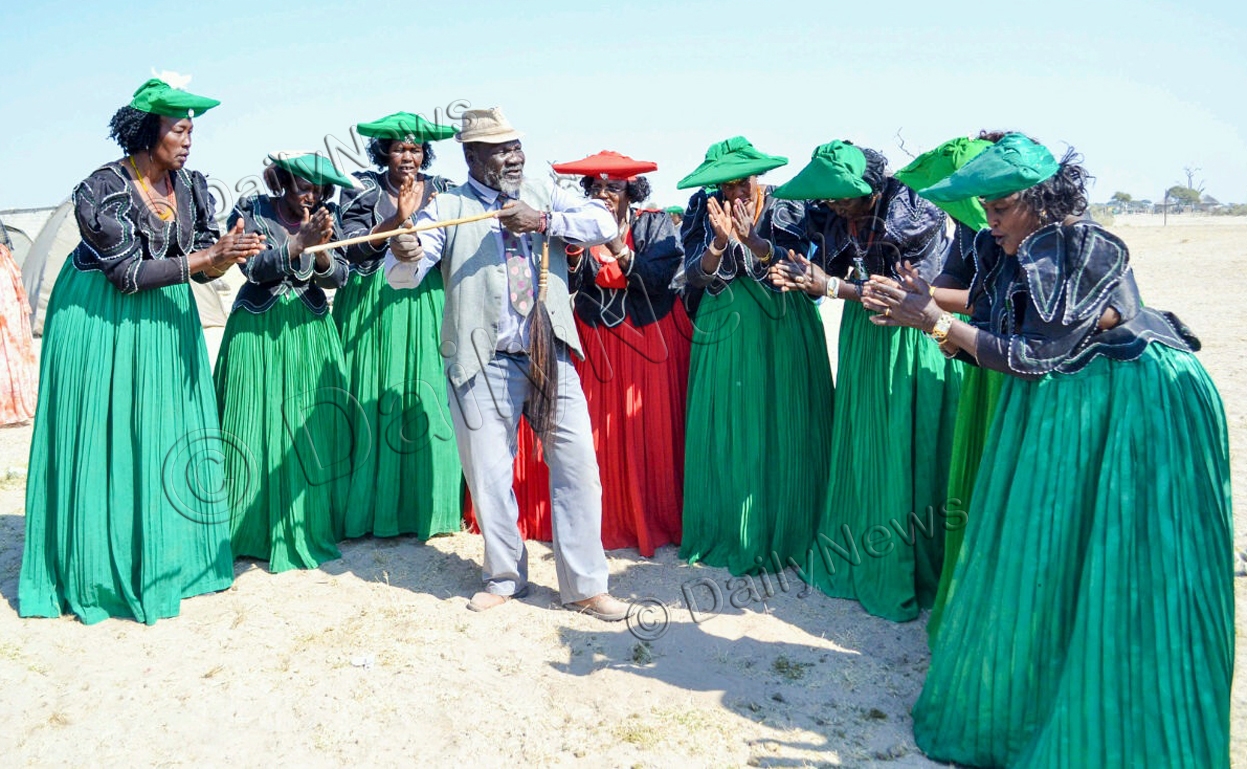
He then gave them the green flag (known as Tjingirini) which acted as a symbol to distinguish them from other ethnic groups, the Baherero in particular.
The flag was green which stands for growth, white for peace and black means ‘until death do us apart.’ It also had a black cow which means the royal cattle which are in the wilderness cannot be seen but only their tracks.
If one happens to see them, it is considered bad luck. The letters NKMNMP on the flag means; Nicodumus son of Kahimemoa son of Munjuku son of Nguvauuva Mukuru Puenaete(the last two words mean God is with us).
While in Namibia Nicodimus Kahimemoa Nguvauva was taken to the Holy Fire in Okuruuo which is a place where fire is made and rituals performed to introduce one to the ancestors.
He died in July 1945 and in 1947 his body was exhumed and re-buried in Namibia which is the reason why Tjingirini Cultural Festival is held in July.
It is a celebration and commemoration of the life of a peace loving person he was and for culture revival. In 1951 Munjuku Nguvauva II became chief in Sehithwa and in 1960 he went back to Namibia.
On October 10, 1960 he was appointed officially as the Ovambanderu chief. He died on 16 January 2008. Before passing on, Munjuku II had written a will that he wanted the now paramount chief to succeed him despite him having an elder brother.
There were factions in the Morafe as some wanted Keharanjo II while others wanted Munjuku III. This led to court cases and Munjuku III emerged victorious.
In the midst of all the fights for bogosi Keharankjo II committed suicide. The fights stopped in November 2014 and later that year Kilus Karaerua Munjuku Nguvauva III was coronated.
This year’s festival was held under the theme Cultural Promotion is Key to Sustainability. It started with a visit to the royal cemetery followed by a historic teaching and later in the day Muhiva dance and the choir performed.
The youth turned out in great numbers to learn their history and culture and to talk to their ancestors as well as partake in the drama and cultural dances. ENDS
Source : BOPA
Author : Tachila Kayawe
Location : TOROMOJA
Event : Interview
Date : 16 Sep 2015
Related News

06 Aug 2026

06 Aug 2026
Mayor implores creatives to be innovative
05 Aug 2026
Batho Ba Metsi honours Okavango Delta custodians

05 Aug 2026