Transformation celebrated
19 Feb 2015
“We, the people, declare today that the most evident of truths - that all of us are created equal- is the star that guides us still; just as it guided our forebearers through Seneca Falls, Selma and Stonewall.
Just as it guided all those men and women, sung and unsung, who left footprints along this great mall, to hear a preacher say that we cannot walk alone; to hear a King proclaim that our individual freedom is inextricably bound to the freedom of every soul on earth.”
These were the words that roared on the streets of Washington, D.C. echoed by Barrack Obama as he was inaugurated as the 44th President of the United States which took place on Tuesday, January 20, 2009.
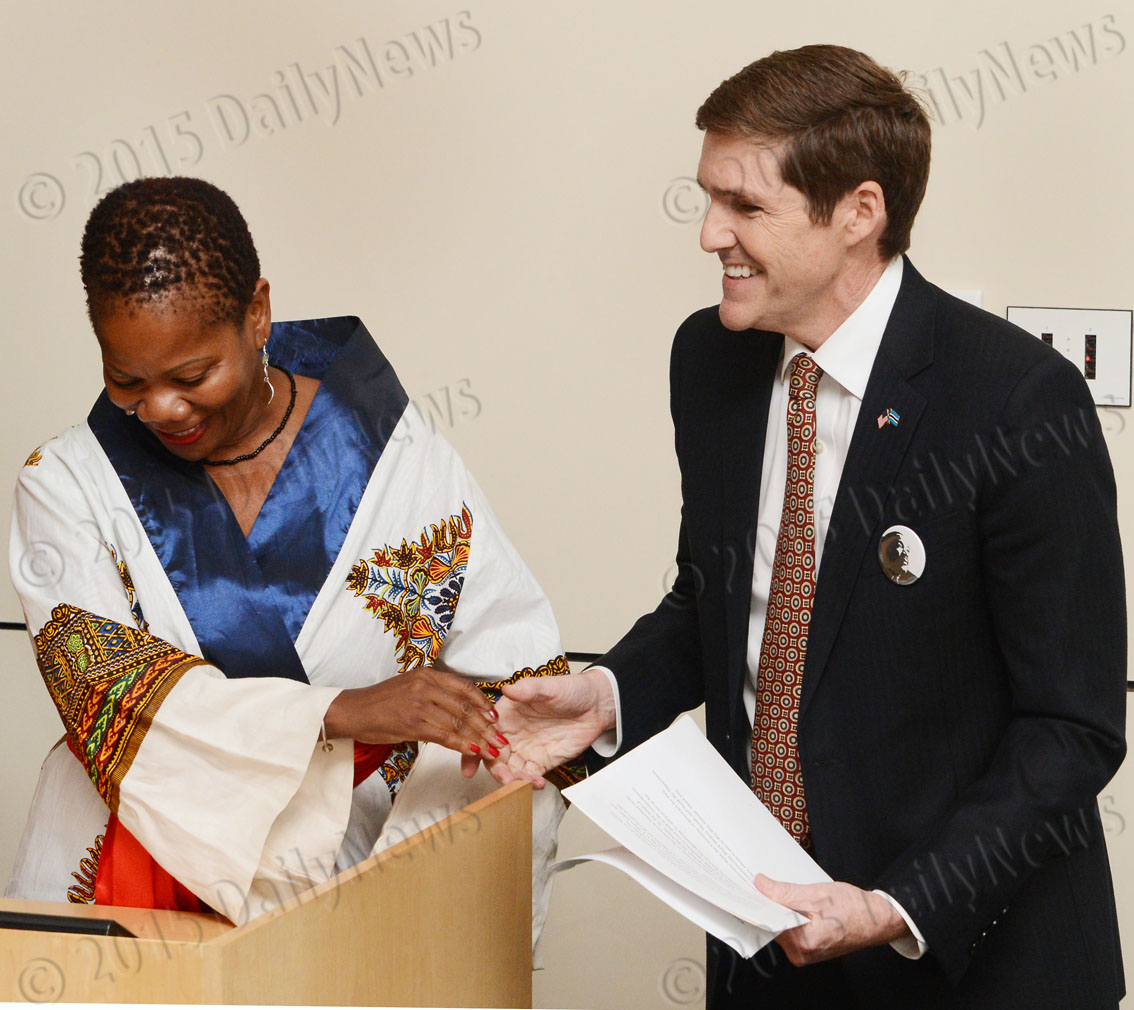
The 1st of February marks a series of events to celebrate the 11th Annual Black History Month hence the United States Embassy has partnered with the University of Botswana (UB) to celebrate the achievements and contributions of African Americans to the United States and the world.
This year’s theme, “A Century of Black Life, History, and Culture” highlights the essential role people of African descent in America have had in shaping world politics and social movements, as well as music, art, literature and sports.
Speaking at the Black History Month Festival, held at the University of Botswana, the United States Ambassador to Botswana, Mr Earl Miller said, “This year, we celebrate the transformation that has occurred since that first commemoration 100 years ago. The transformation of American society is the product of great effort and tremendous human spirit by people who knew their story matters.”
Ambassador Miller said, “In this film festival, and throughout this month, we celebrate African American leaders, whose names and contributions are now known throughout the world.
The film Boycott, he noted follows the life of Rosa Parks, who by refusing to sit at the back of a segregated bus in 1955, put into motion a series of events that sparked the civil rights movement in the United States and who alongside Dr Martin Luther King Jr. and others changed history.
The film festival also celebrates men and women whose names are not widely known, but whose stories are essential to the history of the country they helped to change, he said. In the movie, 12 Years a Slave Solomon Northup, a free African-American man, is kidnapped in Washington, D.C., in 1841 and sold into slavery, he said. “This story of cruelty and kindness, desperation and survival, reminds us the ugly truth of slavery and the triumph of human dignity.
During Black History Month, America takes time to think about our history and the progress we have made. But we must also acknowledge our unfinished work. Racial tensions and challenges in the U.S. linger today, and we must remain committed to advancing civil liberties for all citizens in the United States and worldwide,” said Ambassador Miller.
For his part, Dean of Humanities at UB, Mr Anderson Chebane mentioned that the films that are screened chronicles the achievements and struggles of Blacks from slavery, Civil Rights Movement to some of the events in the 21st Century.
He stated that the emergence of Mr Barrack Obama as the President of the United States of America was undoubtedly the results of the struggles and achievements of a long line of notable African Americans, past and present. Some of the struggles were indicated in the film of the evening and reflected by Barrack Obama in his Biography, he said.
“The Black History Month film festival has become an important annual feature in the academic and cultural calendar of the Department of English at UB because a substantial part of African Diaspora and World Literature course offerings relate to African Americans,” stated Mr Chebane. The film festival likewise would enable students in their courses to see literature in more practical rather than abstract terms, as it also includes a short documentary on Barrack Obama- His Story, Boycott and 12 Years a Slave, he said.
Further, in the film His Story, President Obama said, “With tremendous strength and abiding resolve, our ancestors, some of whom were brought to this land in chains, have woven their resilient dignity into the fabric of our nation and taught us that we are not trapped by the mistakes of history.”
He further said, “From slavery, to the civil rights movement, to the first black President of the United States, this history gives us hope for the future. At the heart of American ideals is the belief that regardless of your past or the circumstances of your birth, each person deserves the opportunity to achieve his or her potential.” ENDS
Source : BOPA
Author : Amolemo Nkwe
Location : Gaborone
Event : Commemoration
Date : 19 Feb 2015
Related News
06 Aug 2026
06 Aug 2026
Mayor implores creatives to be innovative
05 Aug 2026
Batho Ba Metsi honours Okavango Delta custodians
05 Aug 2026