


Artificial Insemination services benefit 591 farmers in Okavango
25 Feb 2026
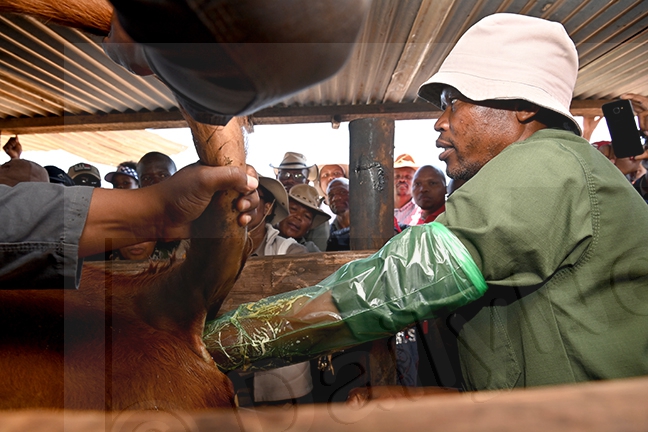
Since 2019 a total of 591 farmers in the Okavango District have benefited from government-provided artificial insemination services through the Nokaneng Artificial Insemination (AI) Camp.
This was said by Assistant Minister of Trade and Entrepreneurship, Mr Baratiwa Mathoothe, on behalf of acting Minister of Lands and Agriculture, in response a question in Parliament on Tuesday.
“I acknowledge that the vastness of the Okavango District, limits farmers’ access to artificial insemination services provided at the Nokaneng AI Camp. To address this, the ministry intends to use part of the Kgomokgwana Quarantine Camp to boost provision of AI services subject to availability of funds,” Mr Mathoothe said.
In the meantime, he said the ministry continued to maintain the Nokaneng AI camp, in spite of the intense wildlife damage, to ensure the continued implementation of the AI programme in the district.
“I absolutely foresee Okavango region contributing meaningfully towards the President Advocate Duma Boko vision of increasing the national cattle population to five million. I want to highlight some of the initiatives specifically targeting the Okavango region and aiming to support livestock livelihoods and its increasing agriculture contribution to the economy,” he added.
He indicated that the Okavango would to benefit from initiatives like A-Di-Tsale and on-farm artificial insemination (AI) programme which were aimed at boosting cattle production by enhancing reproduction, genetics and extension support for farmers.
“These programmes improve reproductive efficiency through targeted AI services, including AI and by fostering private sector involvement in on-farm services,” he said.
He further said the Okavango was the beneficiary of the Communities Living Amongst Wildlife Sustainably (CLAWS)-supported Herding 4 Health (H4H) project that aimed to promote sustainable livestock management, reduce human-wildlife conflict and improve rangeland health.
Through the programme, he said community livelihoods would be enhanced through better market access for beef and reduced livestock diseases, predation and improved rangelands. Also, he said the Green Climate Fund (GCF) supported a US$98 million project, co-financed by government with US$54 million (about P712m), with GCF grant at US$44m (about P580m).
“The programme aims to restore, manage and rehabilitate communal rangelands in Okavango (Ngamiland), Kgalagadi and Bobirwa regions,” he explained.
He indicated that the project which was launched in May 2025 by the President, was implemented by Conservation International, on behalf of the GCF, and the lands and agriculture ministry on behalf of government and complemented the CLAWS supported Herding for Health (H4H) programme.
He said the Botswana Meat Commission (BMC) had introduced the Direct Cattle Procurement Scheme to improve market access and stimulate production in the Okavango and North West regions.
Okavango West legislator, Mr Kenny Kapinga had asked the minister how many cattle farmers in Okavango had benefited from artificial insemination services provided by government and if he would acknowledge that the ministry had since 2019, not demonstrated any drive or intention to ensure that farmers in Okavango enjoyed the benefits of artificial insemination.
Mr Kapinga also asked if he expected any significant contribution by the Okavango region to the wish by the President to increase the cattle population to five million, in the absence of access to artificial insemination. BOPA
Source : BOPA
Author : BOPA
Location : Gaborone
Event : Parliament
Date : 25 Feb 2026
Related News

25 Aug 2026
Forensic audit generates 90 priority actions
25 Aug 2026