CITF key to industrialisation

14 Nov 2023
The world-class training programmes offered by Construction Industry Trust Fund (CITF) continue to add value to both skill acquisition and up-skilling in the era of digitisation and the fourth industrial revolution, thus ensuring preparedness on industrialised Botswana.
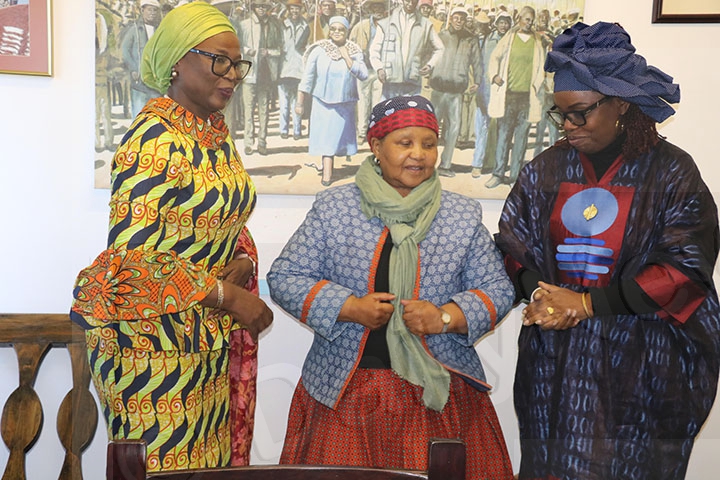
Giving a keynote address during the CITF open day, First Lady Ms Neo Masisi said the programmes were aligned with pillar two of the national Vision 2036 on human and social development.
Ms Masisi stated that CITF was crucial in equipping individuals with the skills and knowledge needed to thrive in today's rapidly changing world as it provided practical hands-on training that prepared individuals for a wide range of careers in the ever-changing labour market, including the in-demand skills.
She said one of the key strengths of CITF was its focus on developing and sharpening practical skills in order to produce highly competent individuals.
“CITF learning and training modules offer a unique learning experience that combines both theoretical knowledge with real world applications. This approach ensures the trainees are not only theoretically well-versed in their fields of study, but also possess the ability to adapt to new challenges in the production environment,” Ms Masisi said.
She said the technical and vocational education and training (TVET) offered at CITF catered to the needs of both students who preferred more hands-on approach to learning and those who wished to enter the workforce quickly, as well as secure jobs in the international market.
Ms Masisi called for an increase of female enrolment on TVET programmes, noting that females only constituted 13 per cent of the 700 trainees that completed the German Mechanical Engineering Industry Association (VDMA) Botswana customised programmes.
She said the small proportion of females' representation in this area compared to their male counterparts correlated with inequality of economic opportunities between men and women.
“It is an aspect of the feminisation of economic disadvantages and requires urgent change and urgent action,” she said.
As an advocate for gender equity and equality, Ms Masisi said she was hopeful that the number of females in TVET would increase as the drive to encourage young women and girls to enrol in these male-dominated fields continued.
She said the changes must begin in the foundations laid by basic education cycle, which would entail strengthening the learning profiles and multiple pathway system of learning.
“We ought to challenge the gender-typing of careers in order to realise the inclusive economic growth and development. It is important to acknowledge that beyond enhancing an individual's employability, TVET has the potential to promote entrepreneurship and self-employment,” she said.
Ms Masisi said TVET also drove innovation and industrialisation when supported by a well-funded ecosystem of research and development both within industrial sector and in tertiary education and training institutions.
In this regard, Ms Masisi highlighted the need for the private sector and development partners to invest in TVET in Botswana.
The collaborations, she said would result in highly competent trainees ready to be absorbed in the work place.
She said such collaboration would result in employment creation locally and hopefully enable the country to export excess skills.
“The collaborations will extend to infrastructure development, curriculum development and the provision of equipment and materials required for practical training, as demonstrated by VDMA and other CITF partners,” she said.
She therefore encouraged CITF to continue exploring new collaborations and partnerships with industry, both locally and internationally.ENDS
Source : BOPA
Author : Thato Mosinyi
Location : GABORONE
Event : CITF open day
Date : 14 Nov 2023
Related News

27 Jul 2026


27 Jul 2026
New P1.1m Child Helpline Call Centre opens
27 Jul 2026
Mohwasa commits to maintain public order

27 Jul 2026